Connector Miniaturization Challenges in Modern Electronics
Modern electronic systems are becoming smaller, lighter, and more integrated.
Devices that once had plenty of internal space now need to accommodate more functions within increasingly compact packages.
This trend has created strong demand for smaller and higher-density connectors.
However, making a connector smaller is not simply a matter of reducing the housing dimensions.
As connector size decreases, the available space for contacts, insulation, mechanical structures, sealing, and assembly also becomes smaller.
At the same time, electrical and mechanical requirements often remain the same—or become more demanding.
Connector miniaturization therefore requires a careful balance between:
Size + Electrical Performance + Mechanical Reliability + Manufacturability
For applications such as automotive electronics, industrial automation, medical equipment, consumer electronics, robotics, and compact control systems, successful miniaturization requires engineering optimization at every stage.

What Is Connector Miniaturization?
Connector miniaturization refers to reducing the physical size, pitch, height, or overall footprint of a connector while maintaining its required functional performance.
Miniaturization may involve:
- Smaller housing dimensions
- Reduced contact pitch
- Smaller terminals
- Lower connector height
- Higher contact density
- Reduced mounting footprint
The goal is usually to achieve:
More electrical functionality in less physical space.
However, reducing dimensions can create new engineering constraints.
Why Are Connectors Becoming Smaller?
Several market trends are driving connector miniaturization.
Smaller Electronic Devices
Electronic products increasingly require:
- Compact control units
- Smaller sensors
- Reduced PCB size
- Higher functional density
Connectors must fit within these increasingly constrained spaces.
Higher Functional Integration
A single electronic module may now integrate:
- Power
- Data
- Sensors
- Control signals
- Communication interfaces
This increases the number of electrical connections required within the same physical space.
Weight Reduction
In automotive and portable equipment, reducing component size can also contribute to overall weight reduction.
Smaller connectors can help optimize:
- Wiring space
- Module dimensions
- Packaging
- System weight
1.Contact Pitch Becomes More Challenging
One of the biggest challenges in connector miniaturization is reducing contact pitch.
As the distance between contacts decreases, engineers must maintain sufficient:
- Electrical isolation
- Mechanical strength
- Positioning accuracy
- Insulation performance
A smaller pitch leaves less room for dimensional variation.
This makes:
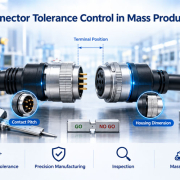
Terminal Position + Housing Accuracy + Manufacturing Tolerance
increasingly important.
2.Electrical Clearance Becomes More Limited
When contacts are positioned closer together, the available electrical spacing decreases.
Engineers need to evaluate:
- Clearance
- Creepage
- Insulation thickness
- Working voltage
- Pollution environment
For higher-voltage applications, simply reducing contact spacing may not be possible without changing the connector architecture.
This creates a fundamental design challenge:
How can the connector become smaller without compromising electrical safety?
3.Current Density Can Increase
Miniaturization can also increase current density.
If the same current must pass through a smaller terminal, the available conductive cross-section may decrease.
This can increase:
- Current density
- Joule heating
- Contact temperature
- Thermal stress
The design must therefore balance:
Contact Size + Material Conductivity + Contact Resistance + Current Rating
A smaller connector is not automatically suitable for the same current level as a larger connector.
4.Thermal Management Becomes More Difficult
Heat generated at a connector contact must be transferred away from the contact interface.
When connector dimensions decrease:
- Thermal paths may become smaller
- Contact spacing may decrease
- Heat concentration can increase
- Cooling space may be reduced
This can become particularly important in:
- High-current applications
- Compact automotive modules
- Industrial control systems
- Power electronics
Thermal design should therefore be considered alongside electrical design.
5.Contact Spring Design Becomes More Sensitive
Smaller terminals have less physical space for spring structures.
However, the contact still needs sufficient force to maintain reliable electrical connection.
The challenge becomes:
Small Contact + Controlled Spring Force + Long-Term Reliability
If spring force is too low:
- Contact resistance may increase
- Vibration resistance may decrease
- Intermittent connections may occur
If spring force is too high:
- Mating force increases
- Contact wear may accelerate
- Mating cycle life may decrease
Miniaturization therefore requires highly controlled contact geometry.
6.Mechanical Strength Can Be Reduced
Reducing terminal and housing dimensions can reduce structural strength.
Miniature connectors may be more sensitive to:
- Insertion force
- Extraction force
- Cable pulling
- Side loading
- Vibration
- Shock
The housing must therefore maintain sufficient:
- Retention strength
- Locking performance
- Terminal support
- Mechanical stability
Miniaturization should never compromise the mechanical integrity of the connector.
7.Manufacturing Tolerances Become More Critical
As components become smaller, the same absolute dimensional variation represents a larger percentage of the total geometry.
For example, a small terminal-position variation may have little effect in a large connector but become significant in a fine-pitch connector.
Critical areas include:
- Terminal pitch
- Terminal position
- Housing cavities
- Locking features
- Contact geometry
- Seal interfaces
This makes precision manufacturing and tolerance control increasingly important.
8.Assembly Becomes More Difficult
Smaller connector components can be more challenging to assemble.
Potential problems include:
- Terminal misalignment
- Incomplete terminal insertion
- Seal damage
- Housing deformation
- Locking errors
Manual assembly becomes more difficult as component size decreases.
For high-volume production, manufacturers may need:
- Precision assembly fixtures
- Automated insertion
- Vision inspection
- Automated electrical testing
9.Inspection Becomes More Challenging
Miniaturized features may be difficult to inspect using conventional measurement methods.
Traditional tools may not provide sufficient resolution or repeatability.
Manufacturers may therefore use:
- Optical inspection
- CCD systems
- Microscopic inspection
- Coordinate measurement
- Automated dimensional analysis
Inspection strategies must be designed around the actual critical features of the connector.
10.Miniaturization Can Affect Mating Reliability
Smaller connectors may have less mechanical tolerance for misalignment.
During mating, even a small angular or positional deviation can influence:
- Insertion force
- Terminal engagement
- Contact wipe
- Housing alignment
Good guiding features become increasingly important.
Common design solutions include:
- Polarization keys
- Guide posts
- Chamfered mating surfaces
- Self-alignment structures
These features help reduce the risk of incorrect or incomplete mating.
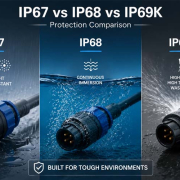
11.Sealing Becomes More Difficult
For miniature waterproof connectors, the available space for seals is limited.
Yet the connector may still need to achieve:
- IP67
- IP68
- Other application-specific sealing requirements
Engineers must optimize:
- Seal geometry
- Compression
- Housing interfaces
- Cable diameter
- Material selection
Reducing the connector size without compromising sealing performance can be challenging.
12.Miniaturization and Mating Cycles
A smaller connector does not necessarily have a shorter mating life, but reducing contact dimensions can make wear management more difficult.
Each mating cycle may affect:
- Contact plating
- Spring structure
- Contact surface
- Housing alignment
For applications requiring frequent connection and disconnection, engineers should validate:
- Insertion force
- Extraction force
- Contact resistance
- Wear
- Mating cycle performance
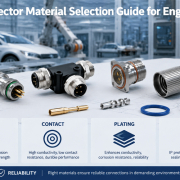
13.Material Selection Becomes More Important
Material selection can become more critical as connector dimensions decrease.
The housing material must provide appropriate:
- Mechanical strength
- Dimensional stability
- Temperature resistance
- Electrical insulation
Contact materials must provide:
- Conductivity
- Elasticity
- Fatigue resistance
- Corrosion resistance
For miniature connectors, small changes in material performance can have a noticeable impact on the overall system.
14.Miniaturization Requires Better Thermal and Electrical Simulation
For advanced connector designs, simulation can help evaluate potential problems before tooling.
Depending on the application, engineers may evaluate:
Electrical
- Current density
- Voltage distribution
- Contact resistance
Thermal
- Temperature rise
- Heat concentration
- Thermal paths
Mechanical
- Contact deformation
- Stress distribution
- Mating force
Simulation does not replace physical testing, but it can help identify design risks earlier.
Miniaturization Trade-Offs
Connector miniaturization is fundamentally an optimization problem.
| Design Goal | Potential Challenge |
|---|---|
| Smaller housing | Less internal space |
| Higher contact density | Reduced spacing |
| Higher current | Greater heat generation |
| Lower mating force | Potentially lower contact force |
| Smaller terminals | Reduced mechanical strength |
| Smaller seals | More difficult sealing |
| Tight tolerances | Higher manufacturing cost |
| More features | More complex assembly |
The objective is not simply:
Make It Smaller.
The objective is:
Make It Smaller Without Losing Performance.
Application Considerations
Different applications have different miniaturization priorities.
| Application | Key Miniaturization Challenge |
|---|---|
| Automotive Electronics | Space, vibration, temperature |
| Medical Equipment | Compactness, reliability, cleanliness |
| Industrial Automation | Density, mechanical durability |
| Robotics | Size, movement, mating cycles |
| Consumer Electronics | Space and high-density interconnection |
| Sensors | Compact size and environmental protection |
| Control Modules | Density, thermal management, assembly |
How to Approach Miniature Connector Design
A successful miniature connector development process should include:
Step 1: Define the Application
Identify:
- Voltage
- Current
- Signal type
- Temperature
- Vibration
- Mating cycles
- Environmental exposure
Step 2: Establish the Size Target
Define:
- Maximum housing dimensions
- Contact pitch
- Mounting footprint
- Connector height
Step 3: Design the Contact System
Optimize:
- Contact geometry
- Spring force
- Contact material
- Plating
- Current capacity
Step 4: Analyze Thermal and Electrical Performance
Evaluate:
- Contact resistance
- Temperature rise
- Current density
- Clearance
- Creepage
Step 5: Perform Tolerance Analysis
Review:
- Terminal position
- Housing dimensions
- Mating alignment
- Locking features
- Seal interfaces
Step 6: Validate Through Testing
Typical validation can include:
- Contact resistance
- Temperature rise
- Insertion/extraction force
- Mating cycles
- Vibration
- Thermal cycling
- Environmental testing
Common Connector Miniaturization Mistakes
| Mistake | Potential Result |
|---|---|
| Reducing size without thermal analysis | Excessive temperature rise |
| Reducing contact pitch excessively | Electrical clearance problems |
| Undersized terminal | Higher current density |
| Insufficient spring force | Unstable contact |
| Excessive spring force | High mating force |
| Ignoring tolerance stack-up | Mating problems |
| Weak housing structure | Mechanical failure |
| Poor seal design | Water or dust ingress |
| Insufficient inspection | Manufacturing variation |
How FPIC Supports Connector Miniaturization
FPIC supports customized connector development with engineering capabilities covering:
✔ Contact system design
✔ Housing design
✔ Terminal stamping
✔ Precision injection molding
✔ Tolerance control
✔ Electrical testing
✔ Mechanical reliability testing
✔ CCD/visual inspection
✔ Automated assembly and packaging
For demanding automotive applications, FPIC’s connector manufacturing capabilities are supported by IATF 16949 quality management requirements.
Connector production can also incorporate controlled cleanliness practices aligned with VDA 19.1 / ISO 16232 requirements where applicable.
The engineering objective is to optimize connector size without sacrificing:
- Electrical performance
- Mechanical reliability
- Manufacturing consistency
- Service life
Final Thoughts
Connector miniaturization is one of the most important trends in modern electronics.
But reducing connector dimensions creates a chain of engineering challenges.
Smaller connectors require careful control of:
Contact Density + Electrical Clearance + Thermal Performance + Spring Force + Mechanical Strength + Manufacturing Tolerance
The best miniature connector is not simply the smallest possible connector.
It is the smallest connector that can reliably meet its electrical, mechanical, environmental, manufacturing, and lifecycle requirements.
Successful miniaturization therefore requires a system-level approach:
Define → Design → Simulate → Manufacture → Test → Validate
When size reduction is combined with disciplined engineering and manufacturing control, miniature connectors can deliver high-density performance without compromising reliability.
FAQ
What is connector miniaturization?
Connector miniaturization is the process of reducing connector size, contact pitch, height, or mounting footprint while maintaining required electrical and mechanical performance.
What is the biggest challenge in miniature connector design?
There is no single challenge. Contact density, electrical clearance, thermal management, mechanical strength, manufacturing tolerance, and assembly precision often become more difficult simultaneously.
Does a smaller connector support less current?
Not necessarily, but reducing terminal size and conductive area can increase current density and heat generation. Current capability must be evaluated based on the complete contact design and application conditions.
Why are manufacturing tolerances important for miniature connectors?
As connector features become smaller, the same dimensional variation can have a greater functional impact, especially on terminal alignment, mating, and contact performance.
How can miniature connectors maintain reliability?
Reliable miniature connectors require optimized contact geometry, suitable materials and plating, controlled tolerances, appropriate thermal design, precise manufacturing, and application-specific validation.
Need a Compact Connector for a Space-Constrained Application?
FPIC supports custom connector development from contact design and tooling through precision manufacturing, testing, and mass production.
Whether you need compact signal connectors, circular connectors, automotive connectors, or customized high-density solutions, our engineering team can help balance size, performance, reliability, and manufacturability.
Contact FPIC to discuss your miniature connector requirements.
Resources
- IEC 60512 – Connectors for Electronic Equipment – Tests and Measurements
https://www.iec.ch/
International testing framework for electrical and mechanical performance of connectors. - USCAR Standards
https://www.uscar.org/
Automotive connector performance and validation resources. - IPC Standards
https://www.ipc.org/
Industry standards and technical resources for electronic interconnection and manufacturing. - IATF 16949
https://www.iatfglobaloversight.org/
Automotive quality management requirements for organizations in the automotive supply chain.