Connector Spring Force Design and Contact Reliability
Inside every reliable connector is a carefully engineered contact system.
While connector housings provide mechanical protection, the spring force generated by the contact structure determines whether electrical connections remain stable during operation.
The correct spring force helps maintain:
- Stable electrical contact
- Low contact resistance
- Resistance against vibration
- Long mating cycle life
However, designing connector spring force is a balance.
Too little force may cause intermittent connections, while excessive force can increase insertion force and accelerate contact wear.
For automotive electronics, industrial automation, robotics, energy storage systems, and other demanding applications, spring force design is a key factor in connector reliability.
A reliable connector does not simply make contact.
It maintains consistent contact pressure throughout its service life.
What Is Spring Force in Connector Contacts?
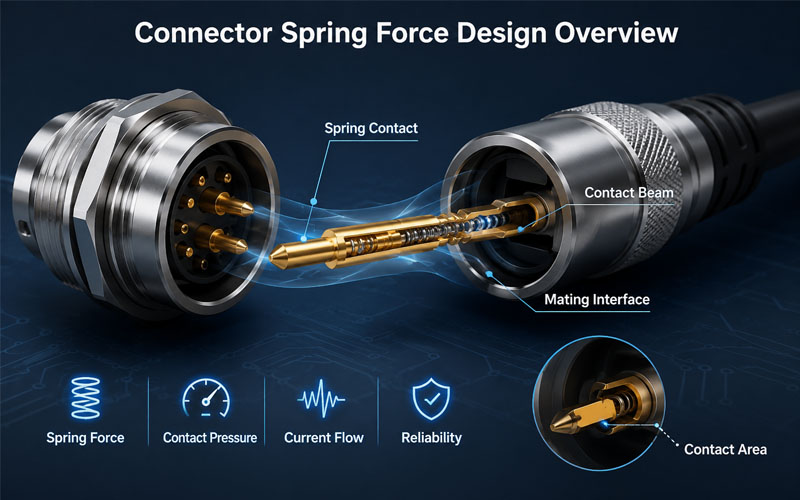
Spring force refers to the mechanical force generated by the elastic deformation of a connector contact element after mating.
When two contacts are connected:
1.The male and female contacts engage.
2.The contact element deforms elastically.
3.The spring force pushes the surfaces together.
4.Stable electrical contact is maintained.
This force creates the necessary contact pressure for reliable current transmission.
Common spring structures include:
- Cantilever beams
- Dual-beam contacts
- Leaf springs
- Cage-style contacts
- Elastic socket structures
Each design provides different performance characteristics.
Why Spring Force Matters in Connector Reliability
The contact interface is constantly exposed to mechanical and environmental stress.
A properly designed spring force helps maintain performance under:
- Vibration
- Shock
- Thermal expansion
- Repeated mating cycles
- Mechanical movement
Without sufficient spring force, connectors may experience:
- Increased contact resistance
- Signal interruption
- Electrical arcing
- Local heating
- Premature failure
1.Spring Force Maintains Stable Electrical Contact
Electrical current flows through the actual contact points between mating surfaces.
The spring force determines how tightly these surfaces remain connected.
Proper contact pressure helps:
✔ Increase effective contact area
✔ Reduce resistance variation
✔ Improve current stability
✔ Prevent micro-movement
Low Spring Force Problems
Insufficient spring force can cause:
Contact Interruption
Small movements caused by vibration may temporarily break the electrical connection.
Increased Resistance
Poor contact pressure creates unstable electrical pathways.
Fretting Corrosion
Micro-motion between metal surfaces may generate wear particles and oxidation.
Excessive Spring Force Problems
Too much force can create:
High Insertion Force
Users may experience difficulty during mating.
Faster Contact Wear
Higher mechanical stress accelerates surface damage.
Reduced Mating Life
Repeated cycles may permanently deform the contact structure.
2.Spring Force and Contact Resistance Relationship
Contact resistance is directly affected by contact pressure.
Higher contact pressure generally improves electrical performance by creating more stable metal-to-metal contact.
However, the relationship is not unlimited.
After reaching an optimal range, increasing force provides fewer benefits while increasing mechanical stress.
Connector engineers must optimize:
Contact Force + Material Elasticity + Surface Condition
to achieve long-term reliability.
3.Contact Spring Design Affects Connector Durability
Different contact structures generate spring force in different ways.
Cantilever Beam Contacts
A cantilever beam uses a flexible metal arm to create contact pressure.
Advantages:
✔ Simple structure
✔ Cost-effective manufacturing
✔ Good electrical performance
Common applications:
- PCB connectors
- Automotive connectors
- General electronic connectors
Dual Beam Contacts
Dual beam designs use two independent contact points.
Advantages:
✔ Improved redundancy
✔ Better vibration resistance
✔ More stable connection
If one contact point experiences contamination or wear, the second contact can help maintain electrical continuity.
Leaf Spring Contacts
Leaf spring structures provide controlled elastic force.
Advantages:
✔ Stable pressure distribution
✔ Good mechanical durability
✔ Suitable for high-cycle applications
4.Spring Force Helps Improve Vibration Resistance
Many connectors operate in environments with continuous vibration.
Examples:
- Vehicles
- Robots
- Industrial machinery
- Outdoor equipment
Vibration can cause:
- Contact separation
- Fretting wear
- Signal interruption
Proper spring force helps maintain contact pressure during mechanical movement.
This is especially important for:
- Automotive connectors
- Circular connectors
- Industrial Ethernet connectors
5.Spring Force Influences Mating Cycle Life
Every connector mating cycle creates mechanical stress.
During repeated mating:
- Contact surfaces slide
- Spring elements deform
- Plating layers experience wear
A well-designed spring system maintains:
✔ Stable force over time
✔ Controlled contact wear
✔ Reliable electrical performance
For connectors requiring thousands of mating cycles, spring force consistency is critical.
6.Material Selection Determines Spring Performance
Spring force depends heavily on contact material properties.
Important factors include:
- Elastic strength
- Fatigue resistance
- Conductivity
- Corrosion resistance
Common contact materials include:
Copper Alloys
Advantages:
✔ Good conductivity
✔ Balanced mechanical performance
Phosphor Bronze
Advantages:
✔ Excellent spring properties
✔ Good fatigue resistance
Commonly used for:
- High-cycle connectors
- Signal connectors
Beryllium Copper
Advantages:
✔ High elasticity
✔ Excellent mechanical durability
Used in applications requiring:
- High reliability
- Long service life
7.Spring Force Must Be Combined with Contact Plating
Spring force alone cannot guarantee reliability.
The contact surface also requires proper plating.
Gold Plating
Benefits:
✔ Low contact resistance
✔ Excellent corrosion resistance
✔ Long mating life
Suitable for:
- Signal connectors
- Precision applications
Tin Plating
Benefits:
✔ Cost-effective
✔ Suitable for many power applications
Suitable for:
- General electrical connectors
8.Testing Spring Force and Contact Reliability
Connector manufacturers validate spring performance through testing.
Common tests include:
Insertion and Extraction Force Testing
Measures:
- Required mating force
- User operation performance
- Mechanical consistency
Contact Resistance Testing
Evaluates:
- Electrical stability
- Contact performance
Mating Cycle Testing
Verifies:
- Contact durability
- Spring performance after repeated use
Vibration Testing
Evaluates:
- Contact stability under mechanical stress
9.Spring Force Design Requirements by Application
Different industries require different spring force characteristics.
| Application | Spring Force Requirements |
|---|---|
| Automotive Connector | Vibration resistance, stable contact pressure |
| Robotics Connector | High cycle durability, mechanical stability |
| Industrial Connector | Reliable performance in harsh environments |
| Energy Storage Connector | High current stability, thermal reliability |
| Medical Connector | Stable connection and low failure risk |
Common Spring Force Design Mistakes
| Design Issue | Potential Failure |
|---|---|
| Insufficient spring force | Intermittent connection |
| Excessive spring force | High insertion force |
| Poor material selection | Loss of elasticity |
| Uneven pressure distribution | Contact instability |
| Incorrect plating combination | Increased resistance |
How FPIC Optimizes Connector Contact Reliability
FPIC focuses on connector reliability through:
✔ Precision contact structure design
✔ Optimized spring force control
✔ Material and plating selection
✔ Contact resistance testing
✔ Mechanical reliability validation
Connector designs are evaluated to ensure:
- Stable electrical performance
- Reliable mating cycles
- Consistent production quality
Through engineering optimization and manufacturing control, FPIC supports customers with reliable connector solutions for industrial and automotive applications.
Final Thoughts
Spring force is one of the most important elements in connector contact reliability.
A successful connector design requires the right balance between:
- Contact pressure
- Electrical performance
- Mechanical durability
- User operation
Too little force creates unstable connections.
Too much force reduces usability and service life.
The best connector designs achieve controlled spring force that maintains reliable performance throughout thousands of operating cycles.
A connector is not reliable because the contacts touch.
It is reliable because the contacts remain stable.
FAQ
What is spring force in a connector?
Spring force is the mechanical force generated by the elastic deformation of connector contacts after mating.
Why is spring force important for connector reliability?
It maintains contact pressure, reduces resistance variation, and improves resistance to vibration and mechanical stress.
Can higher spring force improve connector performance?
Not always. Excessive force can increase wear and reduce mating cycle life.
How is connector spring force tested?
Manufacturers evaluate spring performance through insertion force, extraction force, contact resistance, mating cycle, and vibration tests.
What materials are commonly used for connector spring contacts?
Copper alloys, phosphor bronze, and beryllium copper are commonly used due to their electrical and elastic properties.
Need Reliable Connector Contact Design?
FPIC provides custom connector solutions with expertise in contact structure design, spring force optimization, material selection, and reliability testing.
From prototype development to mass production, FPIC helps OEM customers create connectors designed for long-term performance.
Contact FPIC today to discuss your connector project.
Resources
1.IEC 60512 – Connectors for Electronic Equipment – Tests and Measurements
https://www.iec.ch/
Connector testing methods covering mechanical and electrical performance evaluation.
2.EIA-364 Connector Test Standards
https://www.eia-global.org/
Industry standards for connector reliability and performance testing.
3.USCAR Connector Performance Standards
https://www.uscar.org/
Automotive connector performance requirements and validation guidelines.