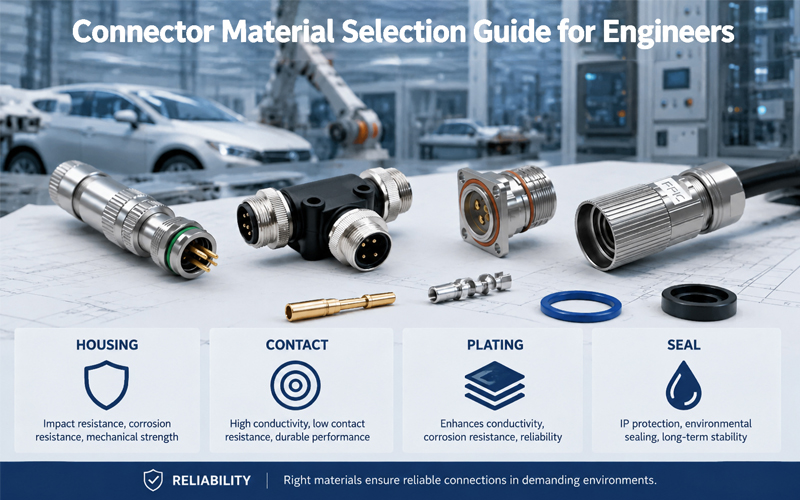
Connector Material Selection Guide for Engineers
A connector may look simple from the outside, but its reliability depends heavily on the materials used throughout the assembly.
A typical connector includes several material systems:
Housing + Contacts + Plating + Seals + Locks + Secondary Components
Each material has a different function.
The housing must provide insulation and mechanical protection. The contact system must maintain stable electrical performance. Plating must protect the contact interface from corrosion and wear. Seals must maintain environmental protection without compromising assembly performance.
Selecting materials based only on cost or a single specification can create reliability problems later in the product lifecycle.
For demanding applications such as automotive electronics, industrial automation, robotics, medical equipment, and energy systems, material selection should therefore be treated as a system-level engineering decision.
The objective is to balance:
Electrical Performance + Mechanical Strength + Thermal Stability + Environmental Resistance + Manufacturability + Cost
Why Connector Material Selection Matters
Connector materials directly influence how a connector performs throughout its service life.
Poor material selection can contribute to:
- Contact resistance increase
- Corrosion
- Terminal deformation
- Housing cracking
- Seal degradation
- Insulation failure
- Poor mating performance
- Reduced vibration resistance
- Premature connector failure
For example, a housing material may meet the required temperature rating but lack sufficient mechanical strength.
Likewise, a contact alloy may provide excellent conductivity but require a different plating system to achieve the required corrosion and wear resistance.
This is why engineers should evaluate the complete material combination, rather than selecting each material independently.
1.Connector Housing Material Selection
The connector housing provides:
- Electrical insulation
- Mechanical support
- Terminal positioning
- Mating alignment
- Environmental protection
- Structural protection
The housing material therefore needs to withstand the expected electrical, thermal, mechanical, and environmental conditions.
Common connector housing materials include:
- PA / Nylon
- PBT
- PPS
- LCP
- PEEK
- PC and other engineering polymers
The best material depends on the application rather than simply its nominal strength.
2.PA / Nylon
Polyamide materials are widely used in connector housings because they can provide a useful combination of:
- Mechanical strength
- Impact resistance
- Processability
- Cost efficiency
However, different grades can behave differently in terms of:
- Water absorption
- Dimensional stability
- Temperature resistance
- Chemical resistance
For applications involving humidity or significant temperature variation, engineers should evaluate the specific PA grade rather than treating all nylon materials as equivalent.
3.PBT
Polybutylene terephthalate, or PBT, is commonly used for electrical and automotive connector housings.
Potential advantages include:
- Good dimensional stability
- Electrical insulation
- Chemical resistance
- Suitable molding characteristics
- Good temperature performance for many applications
PBT can be attractive where dimensional precision and electrical insulation are important.
4.PPS for Higher-Temperature Applications
Polyphenylene sulfide (PPS) is an engineering polymer commonly considered for demanding thermal and chemical environments.
Potential characteristics include:
- High temperature resistance
- Low moisture absorption
- Good dimensional stability
- Chemical resistance
- Electrical insulation
PPS can be useful when the connector must maintain dimensional stability under elevated temperatures.
However, material selection should always consider the actual temperature profile, not simply the maximum advertised material temperature.
5.LCP for Fine-Pitch Connectors
Liquid crystal polymer (LCP) is often considered for compact and fine-pitch connector designs.
Its characteristics can support applications requiring:
- Thin-wall molding
- Dimensional precision
- Fine-pitch structures
- Good thermal performance
- Low moisture absorption
As connector dimensions decrease, housing dimensional stability becomes increasingly important.
A material suitable for a large connector may not necessarily be the best choice for a miniature high-density connector.
6.PEEK for Highly Demanding Applications
PEEK is a high-performance engineering polymer used in applications requiring demanding combinations of:
- Temperature resistance
- Chemical resistance
- Mechanical strength
- Dimensional stability
Its higher material cost means it is generally considered when standard engineering plastics cannot adequately meet the application requirements.
Material selection should therefore consider total system requirements, rather than simply selecting the highest-performance material available.
7.Flame Retardancy
For many electronic and industrial applications, connector housing materials may need to meet specific flammability requirements.
Engineers should consider:
- Applicable safety requirements
- Electrical application
- Equipment enclosure
- Operating voltage
- Installation environment
A flame-retardant grade can affect other material characteristics such as:
- Mechanical strength
- Flow behavior
- Moldability
- Cost
Therefore, flame retardancy should be evaluated together with the overall material specification.
8.Connector Contact Material Selection
The contact system is responsible for maintaining the electrical interface.
Common contact alloys include:
- Copper
- Brass
- Phosphor bronze
- Copper alloys
- Beryllium copper for specialized applications
The selected material affects:
- Electrical conductivity
- Spring properties
- Contact force
- Fatigue resistance
- Thermal behavior
- Corrosion resistance
- Manufacturability
A connector contact must provide both electrical performance and mechanical reliability.
9.Brass Contacts
Brass is widely used for connector terminals because it provides a practical balance of:
- Conductivity
- Strength
- Formability
- Cost
It can be suitable for many general-purpose connector applications.
However, for high-flex or high-contact-force applications, another copper alloy may provide more suitable mechanical properties.
10.Phosphor Bronze Contacts
Phosphor bronze can provide good spring characteristics and fatigue resistance.
It is often considered when the contact must maintain stable mechanical behavior during repeated mating or long-term operation.
Potential applications include:
- Signal connectors
- Control connectors
- Industrial equipment
- Repeated mating interfaces
The final choice depends on the required contact force, conductivity, mating cycles, and environmental conditions.
11.Beryllium Copper
Beryllium copper can provide excellent spring properties and good electrical conductivity.
It may be considered for applications requiring:
- High contact force
- Miniaturized contacts
- Repeated mating
- Strong elastic recovery
Because material cost and processing considerations can be higher, engineers should use it when its performance advantages justify the additional complexity.
12.Contact Plating Selection
Contact plating forms the actual surface interface between mating contacts.
Common plating materials include:
Tin
Tin is widely used for cost-sensitive applications and can provide practical performance for many power connections.
Gold
Gold plating provides excellent corrosion resistance and stable contact behavior.
It is particularly useful where:
- Low-level signals are involved
- Long-term contact stability is important
- Corrosive environments are present
- High mating-cycle performance is required
Silver
Silver has excellent electrical conductivity and can be considered for certain power and high-current applications.
However, its behavior under specific environmental conditions must be carefully evaluated.
13.Gold Plating Thickness Matters
Simply specifying “gold plated” is not enough.
Engineers should also consider:
- Gold thickness
- Plating area
- Underplating
- Contact force
- Mating cycles
- Operating environment
A thin decorative gold layer and an engineered contact plating system do not necessarily provide the same long-term performance.
For demanding applications, plating specifications should be clearly defined in the connector drawing or technical specification.
14.Underplating Matters Too
The plating system can include multiple layers.
For example:
Base Contact Alloy → Underplating → Gold Surface
The underplating can help provide:
- Corrosion protection
- Diffusion resistance
- Better plating stability
The complete plating structure should therefore be evaluated rather than looking only at the visible surface material.
15.Connector Seal Material Selection
Seals become critical when connectors must resist:
- Water
- Dust
- Oil
- Chemicals
- Temperature cycling
Common sealing materials include:
- Silicone rubber
- EPDM
- Fluoroelastomer materials
- Other application-specific elastomers
The correct seal depends heavily on the environment.
16.Silicone Seals
Silicone can provide good flexibility across a broad temperature range.
It is commonly considered where connectors must tolerate:
- Temperature variation
- Repeated assembly
- Flexible sealing interfaces
However, chemical compatibility must still be evaluated for the actual application.
17.EPDM Seals
EPDM can provide good resistance to:
- Water
- Weathering
- Ozone
- Certain environmental conditions
It may be suitable for outdoor or automotive environments depending on the specific fluid and temperature exposure.
18.Chemical Compatibility Is Critical
A connector material may perform well in a laboratory but degrade when exposed to the actual application environment.
Potential contaminants include:
- Automotive fluids
- Lubricants
- Cleaning agents
- Coolants
- Hydraulic fluids
- Industrial chemicals
Material compatibility should therefore be validated against the actual chemicals and concentrations expected during the connector’s service life.
19.Temperature Selection Should Consider the Complete System
Connector temperature performance is not determined by housing material alone.
The complete system includes:
Current → Contact Resistance → Heat Generation → Housing → Surrounding Environment
Higher current can increase temperature at the contact interface.
This means the connector must be evaluated under realistic electrical loading.
Engineers should consider:
- Ambient temperature
- Current load
- Number of loaded circuits
- Contact resistance
- Heat dissipation
- Housing material
- Installation conditions
20.Material Selection for High-Current Connectors
High-current connectors place greater demands on the contact system.
Important factors include:
- Contact resistance
- Conductivity
- Contact force
- Terminal cross-section
- Plating
- Temperature rise
- Thermal dissipation
Simply choosing a highly conductive alloy does not automatically create a reliable high-current connector.
The complete contact geometry and mechanical interface also matter.
21.Material Selection for Fine-Pitch Connectors
Miniaturized connectors create different material challenges.
As pitch decreases:
- Housing walls become thinner
- Terminal spacing decreases
- Dimensional tolerances become tighter
- Mating alignment becomes more sensitive
Materials with good dimensional stability and molding precision may therefore become increasingly important.
This is one reason material selection should be performed together with connector geometry and manufacturing process development.
22.Material Selection for Automotive Connectors
Automotive connectors may encounter:
- Temperature cycling
- Vibration
- Humidity
- Dust
- Oil
- Chemical exposure
- Long service life requirements
Material selection should therefore consider the complete automotive environment.
For automotive connector products, FPIC applies IATF 16949 quality management requirements and supports production processes designed for demanding automotive applications.
23.Material Selection for Industrial Connectors
Industrial connectors may be exposed to:
- Continuous vibration
- Machinery movement
- Oil
- Dust
- Chemicals
- Outdoor environments
Industrial connector material selection should consider not only IP protection but also mechanical durability and chemical compatibility.
For example, an industrial connector used near motors may require different mechanical characteristics from one installed inside a protected control cabinet.
24.Material Selection for Medical Connectors
Medical applications may place additional requirements on:
- Biocompatibility
- Cleaning resistance
- Chemical exposure
- Sterilization
- Reliability
- Traceability
The material selection process should therefore begin with the applicable medical device requirements and cleaning or sterilization process.
25.Manufacturing Must Be Considered
A material with excellent laboratory performance may still be difficult to manufacture.
Engineers should evaluate:
- Injection molding behavior
- Shrinkage
- Warpage
- Flow characteristics
- Terminal stamping
- Plating process
- Crimp compatibility
- Assembly tolerances
Material selection should support not only prototype performance but also stable mass production.
Connector Material Selection Matrix
| Component | Common Materials | Main Selection Factors |
|---|---|---|
| Housing | PA, PBT, PPS, LCP, PEEK | Temperature, insulation, strength, chemicals |
| Contact | Brass, phosphor bronze, copper alloys | Conductivity, spring force, fatigue |
| Plating | Tin, gold, silver | Corrosion, current, mating cycles |
| Seal | Silicone, EPDM, fluoroelastomer | Temperature, water, chemicals |
| Locking Parts | Engineering plastics / metals | Retention, vibration, durability |
| Shielding | Copper alloys / metal shells | EMC, grounding, mechanical strength |
Common Connector Material Selection Mistakes
| Mistake | Potential Consequence |
|---|---|
| Selecting housing only by temperature rating | Mechanical or dimensional problems |
| Treating all nylon grades as identical | Unexpected moisture or thermal behavior |
| Selecting contact material only by conductivity | Insufficient spring performance |
| Specifying gold plating without thickness | Unclear contact durability |
| Ignoring underplating | Corrosion or diffusion concerns |
| Selecting seals without chemical testing | Swelling or degradation |
| Ignoring current-related heat generation | Excessive temperature rise |
| Choosing materials without DFM review | Molding or assembly problems |
| Selecting the highest-performance material automatically | Unnecessary cost |
| Evaluating materials independently | System-level compatibility problems |
A Practical Connector Material Selection Workflow
Step 1: Define the Environment
Identify:
- Temperature
- Humidity
- Water
- Dust
- Chemicals
- Vibration
- UV exposure
Step 2: Define Electrical Requirements
Identify:
- Current
- Voltage
- Signal type
- Contact resistance
- Mating cycles
Step 3: Define Mechanical Requirements
Consider:
- Contact force
- Mating force
- Retention
- Shock
- Vibration
- Connector size
Step 4: Select Housing Material
Match:
Temperature + Insulation + Mechanical + Environmental Requirements
Step 5: Select Contact Alloy
Match:
Conductivity + Spring Properties + Fatigue + Formability
Step 6: Select Plating
Match:
Corrosion + Wear + Current + Signal + Mating Cycles
Step 7: Select Seal Material
Match:
Temperature + Fluids + Water + Chemical Exposure
Step 8: Validate the Complete Connector
Evaluate:
- Electrical performance
- Mechanical performance
- Temperature rise
- Environmental resistance
- Mating cycles
- Dimensional stability
- Production consistency
Material Selection Should Follow Application Requirements
A common mistake is starting with a preferred material and trying to make it fit the application.
A better approach is:
Application → Requirements → Material Properties → Component Design → Validation
For example, if a connector operates in a high-temperature environment, engineers should not simply select the highest-temperature housing material.
They should first ask:
- What is the actual temperature profile?
- How much current flows through the contacts?
- How long is the exposure?
- Is vibration present?
- Are chemicals present?
- How many mating cycles are required?
The answers determine the appropriate material combination.
Why Material Compatibility Matters
A connector is a multi-material system.
Consider:
Housing + Contact Alloy + Plating + Seal + Cable + Mating Connector
Changing one material can influence another.
For example:
- Housing shrinkage can affect terminal position.
- Contact force can affect plating wear.
- Seal hardness can affect mating force.
- Temperature can affect housing dimensions.
- Chemical exposure can affect both housing and seals.
This is why reliable connector development requires cross-functional material engineering.
How FPIC Supports Connector Material Selection
FPIC provides customized connector development and manufacturing solutions covering:
- Connector housing materials
- Contact materials
- Contact plating
- Sealing systems
- Terminal stamping
- Connector assembly
- Electrical testing
- Dimensional inspection
- Reliability validation
FPIC’s automotive connector products are manufactured under IATF 16949 quality management requirements.
For automotive connector production, FPIC also supports mass-production cleanliness requirements aligned with VDA 19.1 / ISO 16232 practices.
Material and component selection can be evaluated together with connector geometry, tooling, assembly, and testing requirements.
This system-level approach helps OEM customers develop connectors that balance performance, reliability, manufacturability, and cost.
Final Thoughts
Connector material selection is not simply a question of choosing the strongest plastic, most conductive metal, or thickest plating.
The correct material combination depends on the complete application.
Engineers should evaluate:
Housing + Contact + Plating + Seal + Environment + Electrical Load + Mechanical Requirements
The best connector material is the one that provides the required performance throughout the expected service life while remaining manufacturable and commercially practical.
A structured selection process can help reduce:
- Corrosion risk
- Thermal problems
- Mechanical failure
- Seal degradation
- Manufacturing variation
- Lifecycle cost
Ultimately, successful connector design begins with understanding the application and selecting materials that work together as a complete system.
FAQ
What is the most important factor in connector material selection?
There is no single factor. Temperature, current, environment, mechanical loading, mating cycles, dimensional requirements, and manufacturing conditions should all be considered together.
Which material is commonly used for connector housings?
PA and PBT are widely used for many connector applications, while PPS, LCP, PEEK, and other engineering polymers may be considered for more demanding thermal, dimensional, or chemical requirements.
What materials are commonly used for connector contacts?
Brass, phosphor bronze, and other copper alloys are commonly used. The selection depends on conductivity, spring properties, contact force, fatigue resistance, and application requirements.
Is gold plating always better than tin plating?
Not necessarily. Gold can provide excellent corrosion resistance and stable contact performance, but it can increase cost. Tin may be suitable for many power applications. The correct plating depends on current, signal type, environment, and mating requirements.
How should connector seal material be selected?
Seal material should be evaluated against the actual temperature range, water exposure, chemicals, oils, cleaning agents, and expected service life.
Does connector housing material affect electrical reliability?
Yes. Housing material affects insulation, terminal positioning, dimensional stability, heat resistance, and mechanical protection, all of which can influence connector reliability.
Why should material selection consider manufacturing?
A material may perform well technically but create molding, stamping, plating, assembly, or cost problems at production volume. DFM should therefore be included early in the material selection process.
Need Help Selecting Materials for Your Connector?
FPIC supports OEM and engineering teams with connector design and manufacturing from material selection and tooling through assembly, testing, and mass production.
Whether you need a compact fine-pitch connector, high-current connector, automotive connector, industrial connector, or customized interconnection solution, our engineering team can evaluate the complete material and application requirements.
Contact FPIC to discuss your connector development project.
Resources
- IEC
https://www.iec.ch/
International standards and technical resources covering electrical and electronic technologies. - SAE International
https://www.sae.org/
Automotive engineering standards and technical resources. - IPC
https://www.ipc.org/
Industry standards and resources for electronic interconnection and manufacturing. - IATF Global Oversight
https://www.iatfglobaloversight.org/
Resources related to IATF 16949 automotive quality management requirements.