CPA and TPA in Automotive Connectors: Why Secondary Locks Matter
Automotive connector must maintain stable electrical connections despite vibration, temperature changes, mechanical loading, and repeated service operations. A connector may initially pass an electrical continuity test but still develop intermittent faults if its terminals are not fully seated or its mating lock is not properly engaged.
This is why secondary locking features play an important role in automotive connector design.
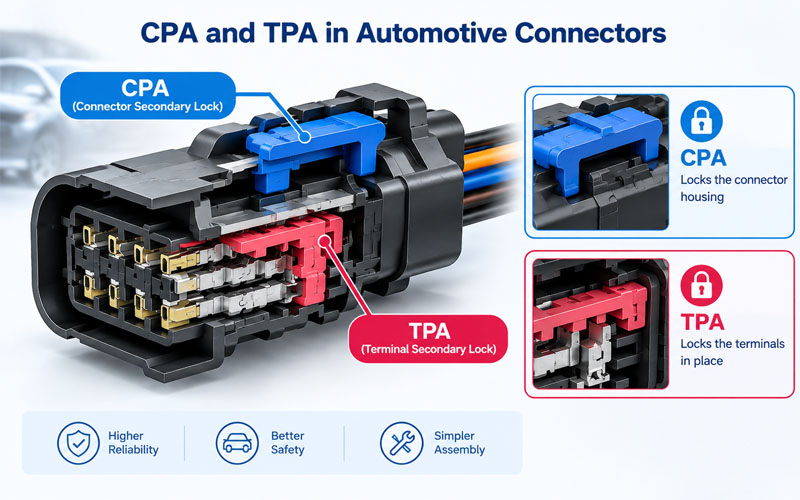
Two commonly used mechanisms are Connector Position Assurance (CPA) and Terminal Position Assurance (TPA). Although both improve connection security, they address different mechanical risks. CPA helps secure the mated connector interface, while TPA helps retain individual terminals inside the connector housing.
Understanding the distinction between these mechanisms helps engineers improve assembly quality, reduce terminal back-out, and design more reliable automotive electrical systems.
What Is CPA in an Automotive Connector?
CPA stands for Connector Position Assurance. It is a secondary locking feature designed to help prevent a mated connector pair from becoming unintentionally disconnected.
Most connector systems already include a primary latch. The CPA works with this mechanism by restricting unintended latch release or providing additional confirmation that the connector has reached its intended locked condition, depending on the design.
CPA is particularly useful in applications exposed to:
- Vehicle vibration and mechanical shock
- Harness movement and cable loading
- Repeated handling during assembly or maintenance
- Restricted installation spaces where visual inspection is difficult
- Long-term operation in demanding environments
For example, if a connector’s primary latch is accidentally pressed during installation or service, a properly designed and engaged CPA can reduce the likelihood of unintended disconnection.
However, CPA does not replace the primary latch. It is an additional retention feature, and its effectiveness depends on correct engagement and the specific connector architecture.
What Is TPA in an Automotive Connector?
TPA stands for Terminal Position Assurance. It is a secondary locking mechanism that helps ensure each terminal is fully inserted and retained within the connector housing.
During harness manufacturing, a crimped terminal is inserted into its designated cavity. The terminal’s primary retention lance or locking feature engages with the housing to hold it in position. The TPA then provides an additional level of retention or position verification.
Depending on the design, the TPA may be a separate insert, a sliding lock, or an integrated secondary locking structure.
A properly designed TPA helps address several common assembly risks:
- Incompletely inserted terminals
- Terminal back-out during connector mating
- Terminal movement under vibration
- Incorrect terminal positioning during assembly
- Intermittent electrical connections caused by poor terminal seating
In many designs, the TPA cannot reach its fully locked position if a terminal is incorrectly seated. This creates a useful assembly control, but it should not be treated as a substitute for electrical testing or process verification.
CPA vs. TPA: What Is the Difference?
The key difference is the location and function of each locking mechanism.
| Feature | CPA | TPA |
|---|---|---|
| Full name | Connector Position Assurance | Terminal Position Assurance |
| Main function | Helps secure the mated connector pair | Helps retain terminals inside the housing |
| Primary location | At or near the connector mating latch | Within or attached to the terminal housing |
| Main risk addressed | Accidental connector separation | Terminal back-out or incomplete seating |
| Assembly stage | After connector mating | After terminal insertion |
| Typical verification | Confirm the mating latch and CPA are engaged | Confirm terminals are seated and TPA is fully locked |
CPA and TPA are complementary rather than interchangeable. A connector can have a fully engaged CPA while still containing a poorly seated terminal. Likewise, all terminals may be correctly retained by the TPA, but the connector pair can still be vulnerable to accidental separation if its mating lock is not properly secured.
For demanding applications, both functions should be evaluated where required by the connector design and customer specification.
Why Secondary Locks Matter for Electrical Reliability
Secondary locks are mechanical features, but their performance can directly affect electrical reliability.
1.Preventing Terminal Back-Out
A terminal that is not fully inserted may be pushed backward when the connector halves are mated. This can reduce the effective engagement between the mating contacts or prevent the connection from being established correctly.
A properly engaged TPA helps retain the terminal in its intended position and reduces the risk of movement under mechanical loading.
2.Reducing Accidental Disconnection
Vehicle vibration, harness movement, and service handling can place stress on the connector latch. If the primary latch is unintentionally released, electrical continuity may be interrupted.
A CPA adds a secondary safeguard to the mating interface, helping the connector remain secured during operation.
3.Supporting Stable Contact Engagement
Electrical performance depends on the contact system, including terminal geometry, contact force, plating, and correct mating depth.
Secondary locks do not directly guarantee low contact resistance. Instead, they help maintain the mechanical positioning needed for the contact system to perform as designed.
4.Improving Assembly Consistency
Secondary locking features can provide a clear indication that an assembly step has been completed. In production, this can help operators identify incomplete terminal insertion or connector mating before the assembly proceeds to the next operation.
The benefit is greatest when the locking feature is combined with standardized work instructions, visual inspection, and appropriate process checks.
Common Failure Modes When CPA or TPA Is Not Properly Engaged
| Failure mode | Possible cause | Potential consequence | Recommended control |
|---|---|---|---|
| Terminal back-out | Incomplete terminal insertion or damaged retention lance | Intermittent contact or open circuit | Verify terminal seating and retention |
| TPA will not close | Terminal is not fully seated, a cavity is incorrect, or the lock is misaligned | Incomplete assembly or terminal retention risk | Stop and inspect; never force the lock |
| Connector separates unexpectedly | CPA or primary latch is not fully engaged | Loss of electrical connection | Verify mating and secondary-lock engagement |
| Intermittent electrical fault | Terminal movement, poor contact engagement, or vibration | Unstable signal or power delivery | Combine mechanical inspection with electrical testing |
| Broken secondary lock | Excessive insertion force, misalignment, or improper handling | Reduced retention capability | Review component condition and assembly method |
| Lock appears engaged but retention is inadequate | Damaged latch features or incorrect components | Potential field failure | Verify component compatibility and retention performance |
A critical troubleshooting principle is to distinguish between the symptom and its root cause. For example, an intermittent signal may be caused by terminal back-out, contact wear, poor crimping, or a damaged wire—not necessarily by the CPA itself.
Design Considerations for CPA and TPA
Secondary locks should be considered during connector development rather than added as an afterthought.
Lock Geometry and Engagement
The locking structure must provide adequate retention while remaining compatible with the primary latch or terminal retention system. Design reviews should examine engagement depth, tolerance stack-up, locking travel, and the risk of unintended release.
Material and Temperature Performance
Housing and lock materials must withstand the expected operating temperature range, mechanical loads, and environmental exposure. Material selection should account for dimensional stability, creep, fatigue, and the intended service life.
Assembly Force and Ergonomics
The required insertion or engagement force should support reliable assembly without damaging the housing or locking feature. Excessive force may indicate misalignment, an incompletely seated terminal, or a component mismatch.
Serviceability
Some connectors are designed for repeated servicing, while others prioritize secure retention in applications with limited maintenance. The release method should be clear and practical for trained technicians, and the design should minimize the risk of damaging reusable components during disassembly.
Packaging and Harness Routing
The location of a CPA or TPA can affect connector size, tool access, harness routing, and installation clearance. Engineers should assess the complete connector assembly in its actual installation environment.
CPA and TPA in Automotive Connector Manufacturing
Reliable locking features depend on more than component design. Manufacturing processes must ensure that terminals, housings, and secondary locks are assembled correctly and consistently.
A typical control process includes:
1.Terminal preparation: Verify terminal part number, crimp quality, and compatibility with the housing.
2.Terminal insertion: Insert each terminal into the correct cavity and confirm its seating condition.
3.TPA engagement: Move the secondary terminal lock to its specified final position without forcing it.
4.Connector mating: Engage the primary latch according to the assembly instructions.
5.CPA engagement: Confirm the connector position assurance feature is fully engaged, where applicable.
6.Visual and mechanical inspection: Check for damaged locks, incorrect positioning, or incomplete assembly.
7.Electrical verification: Perform continuity and other specified electrical tests.
8.Traceability and release: Record the required inspection and test results according to the control plan.
Depending on product design and production volume, additional controls may include presence detection, vision inspection, automated assembly checks, or terminal-retention testing.
Importantly, a continuity test alone cannot confirm that every secondary lock is correctly engaged or that sufficient mechanical retention will be maintained over the product’s service life.
How to Validate Secondary Lock Performance
Validation should reflect the connector’s intended application, customer requirements, and expected service environment.
Terminal Retention Testing
Evaluate whether terminals remain in their specified positions under the required mechanical loads. Test methods and acceptance criteria should follow the applicable product specification.
Connector Mating and Unmating Evaluation
Verify that the primary latch and CPA operate correctly, that the intended engagement sequence is followed, and that the release mechanism remains functional.
Vibration and Mechanical Shock
Where required, expose the assembled connector to application-relevant vibration and shock profiles. Inspect for latch damage, terminal movement, connector separation, and electrical interruptions.
Temperature and Environmental Testing
Evaluate the locking structure under the specified temperature range and environmental conditions. Depending on the application, this may include temperature cycling, humidity, fluid exposure, or other relevant tests.
Electrical Testing Before and After Exposure
Continuity and contact-resistance measurements can help identify electrical degradation associated with mechanical or environmental stress. Where appropriate, monitor for intermittent interruptions during dynamic testing.
Post-Test Inspection
After validation, inspect the primary latch, CPA, TPA, terminal retention features, and housing for cracks, deformation, wear, or displacement.
No single test proves overall connector reliability. The validation plan should combine the relevant mechanical, electrical, and environmental evaluations specified for the application.
Common Design and Assembly Mistakes to Avoid
Several preventable mistakes can undermine the effectiveness of secondary locks:
- Treating CPA and TPA as the same mechanism
- Assuming a closed TPA automatically proves every terminal is correctly seated
- Forcing a secondary lock when resistance is encountered
- Ignoring terminal-retention requirements during design verification
- Inspecting only the connector housing while overlooking individual terminal positions
- Using continuity testing as the only acceptance criterion
- Failing to verify lock engagement after connector mating
- Reusing damaged locking components without approval
- Overlooking serviceability and release-tool access during design
A robust process defines how each lock should be assembled, what a correctly engaged condition looks like, and how nonconforming assemblies are identified and handled.
How FPIC Supports Automotive Connector Reliability
Automotive connector reliability requires coordination between terminal design, housing geometry, locking mechanisms, manufacturing processes, and validation.
FPIC supports automotive connector projects through connector development, manufacturing quality control, electrical testing, and reliability validation. For customized applications, reviewing the terminal retention structure, connector mating mechanism, installation environment, and production assembly sequence early can help identify potential risks before mass production.
For automotive OEMs and Tier suppliers, the objective is not simply to add more locking features. It is to select and validate the right retention architecture for the application’s mechanical, electrical, environmental, and service requirements.
Final Thoughts
CPA and TPA address two different but closely related risks in automotive connector systems. CPA helps prevent unintended separation of mated connectors, while TPA helps ensure that terminals are properly seated and retained inside the housing.
When correctly designed, assembled, and validated, these secondary locking mechanisms support more consistent manufacturing and help reduce the risk of terminal back-out, accidental disconnection, and intermittent electrical faults.
The most effective approach combines sound connector design with controlled assembly, mechanical inspection, electrical verification, and application-specific reliability testing.
FAQ
What does CPA mean in an automotive connector?
CPA stands for Connector Position Assurance. It is a secondary locking feature that helps prevent a mated connector pair from becoming unintentionally disconnected.
What does TPA mean in an automotive connector?
TPA stands for Terminal Position Assurance. It helps confirm that terminals are correctly seated and provides additional retention within the connector housing.
Can a connector have both CPA and TPA?
Yes. A connector system may use both features because they address different risks: CPA secures the mating interface, while TPA addresses terminal positioning and retention. The exact configuration depends on the connector design.
Does TPA prevent all terminal back-out?
No. TPA can reduce the risk of terminal back-out when correctly designed and engaged, but performance also depends on the primary terminal retention feature, terminal compatibility, assembly quality, and mechanical loading.
Does CPA improve electrical contact resistance?
CPA does not directly control contact resistance. It helps maintain the mated condition, reducing the risk of unintended disconnection. Contact resistance also depends on contact geometry, force, plating, contamination, and terminal condition.
Why should a TPA never be forced into place?
Resistance may indicate an incompletely seated terminal, incorrect component, misalignment, or damage. Forcing the lock can damage the housing or locking mechanism and conceal an assembly problem.
What tests are important for CPA and TPA validation?
Depending on the application, relevant tests may include terminal retention, connector mating and unmating evaluation, vibration, mechanical shock, temperature cycling, electrical continuity, contact resistance, and post-test inspection. The final test plan should follow the applicable customer and product requirements.
Developing a customized automotive connector?
Discuss your connector design, terminal retention requirements, locking structure, and validation needs with FPIC. Early engineering review can help align connector reliability with application requirements and manufacturing capability.
Contact FPIC to discuss your automotive connector project.
Resources
- Amphenol RF – What Is Position Assurance?
Explains the functional differences between TPA and CPA and how they support terminal retention and connector mating security.
https://www.amphenolrf.com/en-us/resources/articles/what-is-position-assurance/ - TE Connectivity – AMPSEAL 16 Connector FAQs
Provides manufacturer explanations of CPA and TPA functions in sealed connector systems for demanding applications.
https://www.te.com/en/faqs/ampseal-16-connectors.html - Molex – Connector Contact Retention Guide
Discusses connector contact-retention principles and the difference between terminal retention and connector locking.
https://supplychain.molex.com/content/molex/molex-dot-com/language-masters/en/trends-insights/engineering-insights/connector-contact-retention.html - Automotive Connectors – Connector and Terminal Position Assurance
Provides an overview of secondary locks and position-assurance mechanisms in automotive connector assemblies.
https://www.automotive-connectors.com/en/wiki/