IP67 vs IP68 vs IP69K Connectors: What the Ratings Really Mean in Field Use
When selecting industrial connectors, one of the first specifications engineers notice is the IP rating. Products are commonly advertised as IP67, IP68, or IP69K, often implying that a higher number automatically means better protection.
However, this assumption is not always correct.
Each protection level is designed for different environmental conditions, and choosing the wrong rating can either reduce equipment reliability or unnecessarily increase product cost.
This article explains what IP67, IP68, and IP69K ratings actually mean, how they are tested, and how engineers should interpret these ratings in real-world applications.
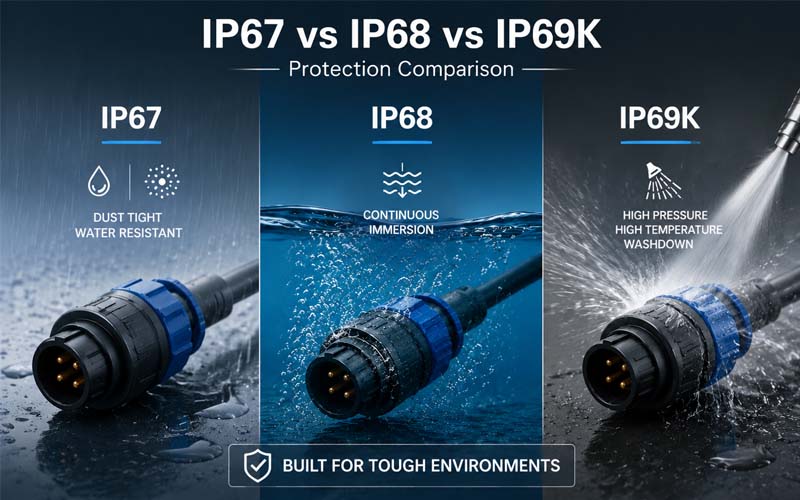
Understanding the IP Rating System
The Ingress Protection (IP) rating is defined by IEC 60529, an international standard used to classify the degree of protection provided by electrical enclosures against solid particles and liquids.
An IP rating consists of two digits.
- The first digit indicates protection against solid objects and dust.
- The second digit indicates protection against water.
For industrial connectors, the first digit is commonly 6, representing complete protection against dust ingress.
The primary difference between IP67, IP68, and IP69K lies in their resistance to water under different conditions.
What Does IP67 Mean?
IP67 is one of the most common protection ratings used in industrial automation.
A connector meeting IP67 requirements must:
- Be completely dust-tight (IP6X)
- Withstand temporary immersion in water up to 1 meter for 30 minutes
Typical Applications
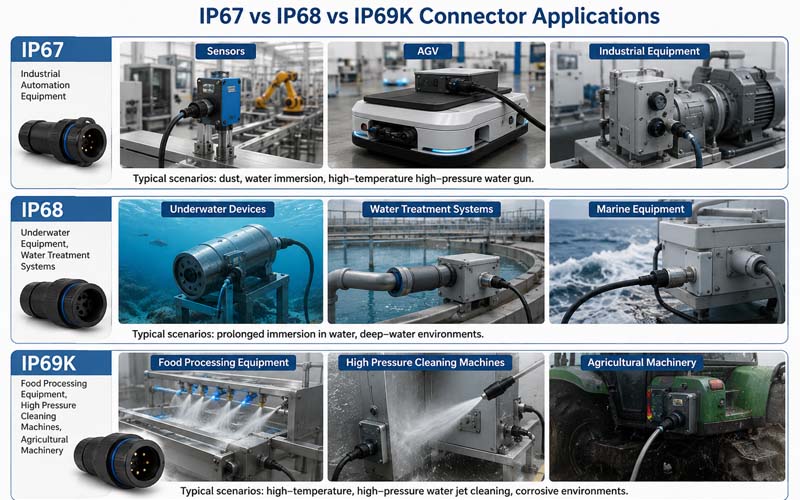
IP67 connectors are commonly used in:
- Industrial automation equipment
- Sensors
- Factory machinery
- AGVs
- Warehouse automation
- Outdoor lighting
What IP67 Does Not Mean
One common misconception is that IP67 connectors are suitable for continuous underwater operation.
In reality, IP67 is designed for temporary immersion only. Continuous submersion may eventually compromise the sealing system unless the connector is specifically designed for that environment.
What Does IP68 Mean?
IP68 provides protection against continuous immersion.
Unlike IP67, IEC 60529 does not specify a fixed immersion depth or duration.
Instead, the manufacturer defines the test conditions.
Typical examples include:
- 2 meters for 24 hours
- 5 meters for 48 hours
- Other application-specific requirements
Because of this flexibility, two IP68 connectors may have significantly different underwater performance.
Typical Applications
IP68 connectors are often selected for:
- Marine equipment
- Underground monitoring systems
- Water treatment facilities
- Outdoor telecommunications
- Renewable energy systems
When comparing IP68 products, engineers should always verify the manufacturer’s immersion specifications rather than relying solely on the IP rating.
What Does IP69K Mean?
IP69K addresses a completely different challenge.
Instead of prolonged immersion, IP69K evaluates resistance to high-pressure, high-temperature water jets.
During testing, connectors are exposed to:
- Water temperatures up to 80°C
- Pressures around 80–100 bar
- Spray angles of 0°, 30°, 60°, and 90°
- Rotating spray conditions
The objective is to verify sealing performance during aggressive cleaning processes.
Typical Applications
IP69K connectors are widely used in:
- Food processing equipment
- Beverage production
- Pharmaceutical manufacturing
- Agricultural machinery
- Construction equipment
- Commercial vehicles
Frequent washdown environments often require IP69K rather than IP68.
IP67 vs IP68 vs IP69K: A Practical Comparison
| Feature | IP67 | IP68 | IP69K |
|---|---|---|---|
| Dust Protection | Yes | Yes | Yes |
| Temporary Water Immersion | ✔ | ✔ | Not primary purpose |
| Continuous Submersion | Limited | ✔ | Not designed for this |
| High-Pressure Washdown | ✖ | Limited | ✔ |
| High-Temperature Cleaning | ✖ | ✖ | ✔ |
The table shows that none of these ratings is universally “better.” Each addresses a different environmental challenge.
Common Misconceptions About IP Ratings
Higher IP Ratings Are Not Always Better
Selecting IP69K for a machine that only requires occasional rain exposure may increase cost without providing additional practical benefits.
Conversely, using IP67 in a high-pressure washdown environment may result in premature seal failure.
IP68 Is Not a Universal Underwater Rating
Because manufacturers define immersion conditions, engineers should always request the specific IP68 test parameters.
Connector Design Matters
Even when connectors share the same IP rating, long-term field performance depends on factors such as:
- sealing materials
- connector locking mechanism
- cable gland quality
- installation practices
- maintenance procedures
Proper installation is just as important as connector selection.
Additional Factors Beyond the IP Rating
An IP rating only evaluates protection against dust and water.
Industrial connector selection should also consider:
- vibration resistance
- operating temperature
- UV resistance
- chemical compatibility
- mating cycle life
- corrosion resistance
- EMC shielding
In harsh environments, these characteristics often determine connector reliability more than the IP rating itself.
Validation in Real Applications
Field validation should include tests that reflect actual operating conditions.
Typical validation activities include:
- water immersion testing
- pressure wash testing
- thermal cycling
- vibration testing
- salt spray testing
- connector durability testing
- sealing inspection after repeated mating cycles
Laboratory certification alone does not guarantee long-term field reliability.
How FPIC Supports Sealed Connector Development
Selecting the correct protection level requires understanding the actual operating environment rather than simply choosing the highest IP rating.
FPIC develops custom connector and cable assembly solutions for industrial automation, robotics, energy storage, transportation, medical equipment, and harsh-environment applications. Our engineering team supports customers in selecting sealing structures, connector configurations, and validation methods that match real operating conditions while balancing performance, durability, and cost.
Final Thoughts
IP67, IP68, and IP69K are often misunderstood as progressive levels of waterproof performance.
In reality, each rating addresses different environmental conditions.
Understanding the testing methods behind these ratings allows engineers to make better connector selections, improve equipment reliability, and avoid unnecessary costs.
Rather than asking which rating is higher, the more important question is:
Which rating best matches the actual application?
FAQ
Is IP69K better than IP68?
Not necessarily. IP69K is designed for high-pressure, high-temperature washdown, while IP68 is intended for continuous water immersion.
Can an IP67 connector be used underwater?
Only for temporary immersion. Continuous underwater applications generally require a connector specifically qualified for IP68 conditions.
Does IP68 always mean the same immersion depth?
No. The immersion depth and duration are defined by the manufacturer and should always be verified.
Are IP69K connectors also dustproof?
Yes. Like IP67 and IP68, IP69K connectors provide complete protection against dust ingress.
What other factors should be considered besides IP ratings?
Engineers should also evaluate vibration resistance, temperature range, UV resistance, chemical compatibility, mating cycle life, and corrosion resistance.
Looking for Reliable Sealed Connector Solutions?
Choosing the right IP rating is only one part of connector selection. FPIC provides custom sealed connectors and cable assemblies engineered for demanding industrial environments, helping customers improve equipment reliability while avoiding unnecessary design costs.
Contact FPIC today to discuss your application requirements.
Resources
- IEC 60529 – Degrees of Protection Provided by Enclosures (IP Code): Defines the international IP rating system, including IP67 and IP68 test requirements.
- ISO 20653 – Road Vehicles – Degrees of Protection (IP Code): Specifies IP69K testing methods for high-pressure, high-temperature water jet protection used in automotive and industrial applications.
- Phoenix Contact – IP Protection Classes Explained: Explains how IP ratings apply to industrial connectors and highlights practical selection considerations.
- TE Connectivity – Sealed Connector Solutions: Discusses sealing technologies, environmental performance, and connector selection for harsh environments.
- UL Solutions – Environmental Testing Services: Provides an overview of environmental validation methods, including water ingress, thermal cycling, and durability testing.