Automotive Connector Miniaturization Trends for Modern Vehicles
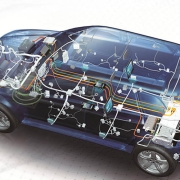
Modern vehicles integrate an increasing number of electronic functions, from cameras and radar sensors to infotainment systems, electronic control units (ECUs), and advanced driver assistance systems (ADAS). These technologies require more electrical connections and data links, while available installation space remains limited.
As a result, automotive connector miniaturization has become an important design strategy for vehicle manufacturers and automotive component suppliers.
Smaller connectors can help reduce packaging space, simplify module integration, and support higher connection density. However, reducing the connector footprint also places greater demands on terminal geometry, manufacturing precision, thermal performance, and mechanical reliability.
The engineering challenge is not simply to make a connector smaller. It is to achieve the required electrical, mechanical, and environmental performance within a more compact design.
This article examines the major trends in automotive connector miniaturization, the applications driving demand, and the design considerations engineers should evaluate before selecting or developing a compact connector system.
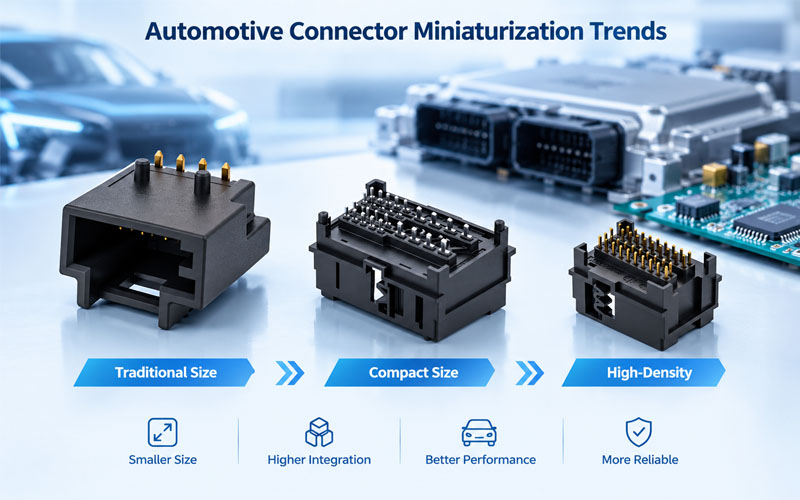
Why Automotive Connector Miniaturization Is Becoming More Important
Several changes in vehicle architecture are increasing demand for smaller, more efficient connector systems.
1.Increasing Electronic Content
Modern vehicles incorporate more sensors, control modules, displays, cameras, actuators, and communication interfaces than many earlier vehicle platforms.
Each additional electronic function creates connectivity requirements. If every function uses a separate connector with a large footprint, the cumulative packaging demand can become difficult to manage.
Miniaturized connectors help engineers accommodate more circuits within restricted spaces, particularly inside compact electronic modules.
2.Advanced Driver Assistance Systems
ADAS applications rely on interconnected cameras, radar sensors, control units, and other electronic components.
These devices are often installed in locations where available space is restricted, such as mirrors, lighting modules, bumpers, and compact sensor housings.
Smaller connectors can support more flexible packaging and routing. However, applications exposed to vibration, moisture, temperature changes, or electromagnetic interference still require suitable environmental protection and signal performance.
3.Zonal and Centralized Vehicle Architectures
Traditional vehicle electrical architectures often distribute connections across numerous individual control units.
Zonal architectures organize electronic functions around vehicle locations and connect them through more consolidated power and data networks. This can reduce some wiring complexity, but it may increase connection density around zone controllers and centralized computing modules.
Compact, high-density connectors can help manage these concentrated interfaces without consuming excessive PCB or enclosure space.
The overall benefits depend on the vehicle architecture, cable routing, and system-level design.
4.Weight and Packaging Optimization
Reducing connector size can contribute to lower component mass and more efficient use of available space.
Across a vehicle platform, savings from multiple components may support broader weight-reduction objectives. Smaller connectors can also improve integration in compact modules where connector dimensions influence housing size and mounting arrangements.
However, weight reduction should not come at the expense of required current capacity, mechanical strength, sealing performance, or serviceability.
Key Trends in Automotive Connector Miniaturization
1.Higher Terminal Density and Smaller Pitch
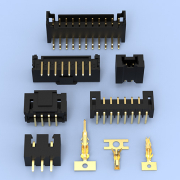
One of the most visible trends is the use of smaller terminal systems and tighter contact spacing.
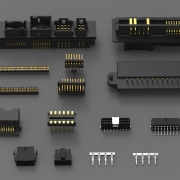
Higher terminal density allows more electrical circuits to fit within a given connector footprint. This is particularly useful for low-voltage signal connections inside electronic control modules, sensor systems, and vehicle body electronics.
Miniaturized connector families, including 0.50 mm terminal systems, demonstrate how reduced terminal dimensions can support compact packaging. Actual terminal pitch, wire-size range, current rating, and environmental performance vary by product family and configuration. TE Connectivity – Miniature Automotive Connector Systems
From an engineering perspective, smaller pitch introduces several challenges:
- Reduced space between adjacent conductive features
- Greater sensitivity to dimensional variation
- More demanding terminal insertion and retention requirements
- Increased importance of PCB layout and assembly accuracy
- Potentially more difficult inspection and rework
Designers must evaluate the complete interconnection system rather than focusing on terminal pitch alone.
2.Compact Terminals and Optimized Contact Geometry
Terminal miniaturization requires careful optimization of contact geometry, material properties, and retention features.
The terminal must maintain the required contact force and electrical performance while fitting into a smaller housing.
Reducing terminal dimensions can affect:
- Contact beam stiffness
- Mating and unmating forces
- Contact resistance stability
- Terminal retention strength
- Current-carrying capability
- Resistance to wear and deformation
For this reason, a smaller terminal should not automatically be assumed to provide the same electrical or mechanical performance as a larger design.
Material selection, plating, spring geometry, and the complete mating interface must be evaluated together.
3.Smaller Connectors for Compact Electronic Modules
Miniaturized connectors are increasingly relevant to applications where several electrical interfaces must fit within a limited enclosure.
Examples include:
- Camera and radar modules
- Lighting control electronics
- Steering wheel electronics
- Door and seat control modules
- Infotainment and display systems
- Compact body control units
- Sensor and actuator assemblies
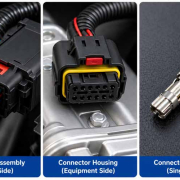
In these applications, connector height, width, mating direction, PCB footprint, and cable exit orientation can all influence the overall module design.
Low-profile and right-angle configurations may improve packaging flexibility, while board-to-wire and wire-to-wire designs address different integration requirements.
The best configuration depends on available space, assembly direction, maintenance access, and electrical requirements.
4.High-Density Connections for ADAS and Data Communication
Modern vehicle electronics require more than compact power and signal connections. Cameras, sensors, and computing modules also need reliable data transmission.
As data rates increase, connector miniaturization must be coordinated with signal-integrity requirements.
Important considerations include:
- Impedance control
- Insertion loss and return loss
- Crosstalk between adjacent circuits
- Shielding and grounding
- Differential-pair routing
- Connector and cable transitions
Reducing the physical size of a connector can change the electrical geometry of its contacts and surrounding structures. High-speed designs therefore require appropriate simulation, measurement, and validation rather than relying on mechanical fit alone.
A connector suitable for low-speed control signals may not be suitable for a high-speed camera or data interface simply because the physical dimensions are compatible.
5.Compact Mixed-Function Connectivity
Some vehicle applications benefit from integrating multiple connection functions into a more compact interface.
Depending on the product architecture, a connector system may support different combinations of power, low-speed signals, and data connections.
Potential benefits include reduced connector count, simplified packaging, and more efficient module integration.
However, integration introduces additional design questions:
- Are current and temperature requirements compatible?
- Can power circuits interfere with sensitive signals?
- Is the required shielding and grounding architecture maintained?
- Can each circuit be tested and serviced appropriately?
- Does the integrated connector meet the relevant customer specifications?
Combining functions is not always the best option. Separate connector systems may be preferable when circuits have substantially different voltage levels, environmental requirements, or service needs.
6.Compact Connectors With Automotive-Grade Robustness
A smaller connector must still withstand its intended automotive environment.
Depending on the installation location, this may include vibration, mechanical shock, temperature cycling, moisture, contamination, and repeated mating.
Miniaturization can make some design features more sensitive to manufacturing variation or mechanical loading. Small retention features, for example, require careful geometry and process control to ensure consistent engagement.
Engineers should therefore evaluate:
- Terminal retention and back-out resistance
- Connector latch strength
- Contact-force stability
- Housing deformation
- Thermal performance
- Environmental sealing, where required
- Resistance to vibration and mechanical shock
Automotive connector qualification should follow the applicable customer requirements and product specifications. Relevant references may include USCAR-2, LV214, and other OEM-specific requirements, depending on the connector type and application.
7.Precision Manufacturing and Inspection
As connector dimensions decrease, manufacturing consistency becomes increasingly important.
Small variations in terminal geometry, plating, crimp dimensions, housing cavities, or contact alignment can have a greater effect on assembly and performance.
Manufacturing controls may include:
- Precision terminal stamping
- Controlled plating thickness and surface quality
- Crimp-height and crimp-force monitoring
- Terminal insertion and retention checks
- Dimensional inspection
- Automated vision inspection
- Electrical continuity and resistance testing
- Process traceability
The specific controls should be determined by the product’s critical characteristics and risk assessment.
For miniature terminals, crimp quality deserves particular attention. A smaller terminal does not eliminate the need for a mechanically secure, electrically stable wire termination. Crimp tooling, wire compatibility, conductor compression, and inspection criteria must all be appropriate for the selected terminal system.
The Engineering Challenges of Smaller Automotive Connectors
Miniaturization offers packaging advantages, but several performance trade-offs must be managed.
Current Capacity and Temperature Rise
Smaller terminal dimensions can limit the available conductive cross-section and heat-dissipation capability.
The relationship between current, resistance, and heat generation is commonly expressed as:
P = I²R
As current increases, resistive heating increases with the square of current for a given resistance.
Consequently, designers should not select a miniature connector based on its physical fit alone. The terminal system must meet the required current under the actual operating conditions, including ambient temperature, circuit loading, contact resistance, and thermal interaction with adjacent circuits.
Relevant design checks include:
- Maximum continuous current
- Peak current and duty cycle
- Temperature-rise limits
- Number of simultaneously loaded circuits
- Wire size and termination compatibility
- Ambient and local operating temperatures
The final current rating must come from the validated connector specification and applicable derating requirements, not from terminal size alone.
Mechanical Strength and Terminal Retention
Smaller terminal systems often use more compact retention features. These features must remain effective during assembly, connector mating, vibration, and service operations.
Insufficient retention can lead to terminal back-out, reduced contact engagement, or intermittent electrical faults.
Design verification should consider terminal insertion force, retention force, latch engagement, tolerance stack-up, and the effects of repeated mating where applicable.
Secondary locking mechanisms such as TPA and CPA may be used depending on the connector architecture. TPA helps secure terminal positioning, while CPA helps prevent unintended separation of mated connectors. Neither should be treated as a substitute for the primary retention system or required validation.
Sealing and Environmental Protection
Miniaturized connectors may have limited space for sealing features, especially when individual wire seals, peripheral seals, or cavity plugs are required.
Designers must maintain the required sealing performance without creating excessive assembly force or compromising terminal retention.
Important considerations include seal compression, housing tolerances, wire insulation diameter, seal installation, and access for inspection.
Where ingress protection is required, the assembled connector should be tested against the applicable specification. A compact connector should not be assumed to meet IP67 or IP68 requirements unless its specific configuration has been appropriately validated.
Signal Integrity and Electromagnetic Compatibility
Higher connection density can increase the importance of controlling electrical coupling between adjacent circuits.
For high-speed or noise-sensitive applications, engineers should assess impedance, crosstalk, shielding, grounding, and the transitions between the PCB, connector, and cable.
The connector should be validated as part of the complete transmission path. A mechanically compact design does not guarantee acceptable high-frequency performance.
Assembly, Repair, and Serviceability
Very small terminals and locking features can make manual assembly, inspection, and repair more difficult.
Manufacturers should evaluate whether operators can correctly identify terminal orientation, achieve full insertion, engage secondary locks, and inspect the finished assembly.
Depending on production volume and product complexity, suitable controls may include dedicated insertion tools, vision inspection, automated presence detection, and electrical testing.
Serviceability should also be considered early. If a connector is difficult to release or a terminal is difficult to replace, maintenance time and the risk of component damage may increase.
How to Select a Miniaturized Automotive Connector
A structured selection process helps engineers avoid choosing a connector based only on size or pin count.
Step 1: Define the Electrical Requirements
Identify the required number of circuits, voltage, continuous and peak current, signal type, and data rate.
Separate power, low-speed signals, and high-speed data requirements where necessary.
Step 2: Establish Packaging Constraints
Define the maximum available connector dimensions, PCB footprint, mating direction, cable exit direction, and installation clearance.
Check whether the connector can be assembled and serviced within the actual module or vehicle location.
Step 3: Evaluate the Operating Environment
Identify the expected temperature range, vibration, mechanical shock, moisture, dust, chemical exposure, and mating-cycle requirements.
Select environmental protection and mechanical features based on the application rather than assuming that all miniature connectors have the same robustness.
Step 4: Review Terminal and Wire Compatibility
Confirm that the terminal system supports the specified wire size, insulation diameter, crimp process, current requirements, and retention performance.
The wire and terminal combination should be validated as an assembly.
Step 5: Verify Signal and Thermal Performance
For power circuits, evaluate current capacity and temperature rise. For high-speed circuits, evaluate signal integrity and electromagnetic compatibility.
Mixed-function systems may require both types of analysis.
Step 6: Confirm Qualification and Manufacturing Capability
Review the relevant customer specifications, qualification status, manufacturing process, inspection plan, and test requirements.
Where the design is customized, confirm that prototype verification and production validation can demonstrate consistent performance.
Miniaturization Is a System-Level Design Decision
A connector’s physical dimensions affect more than the connector itself. They influence the PCB layout, housing size, cable routing, assembly process, inspection access, and overall electronic architecture.
For example, reducing the connector footprint may allow a smaller control module. However, if the selected connector requires difficult cable routing, specialized assembly tools, or additional thermal management, the system-level benefits may be reduced.
Engineers should compare the complete design rather than evaluating only connector dimensions.
A useful review should consider:
| Design area | Key question |
|---|---|
| Packaging | Does the connector fit the available space and mating clearance? |
| Electrical performance | Can it meet current, voltage, and signal requirements? |
| Thermal design | Is temperature rise acceptable under the specified loading? |
| Mechanical reliability | Are terminal retention and connector locking adequate? |
| Environmental protection | Does the assembled design meet the required ingress and durability criteria? |
| Manufacturing | Can the connector be assembled and inspected consistently? |
| Serviceability | Can it be installed, disconnected, or repaired as required? |
| Qualification | Can performance be demonstrated against customer specifications? |
This system-level approach helps prevent a compact connector from creating new risks elsewhere in the design.
How FPIC Supports Automotive Connector Development
Automotive connector miniaturization requires coordination between connector geometry, terminal design, material selection, manufacturing processes, and application requirements.
FPIC supports automotive connector projects through connector development, manufacturing quality control, electrical testing, and reliability validation.
For customized applications, early engineering review can help align connector dimensions, terminal configuration, wire compatibility, locking features, and environmental requirements with the intended vehicle system.
The goal is not simply to reduce connector size. It is to develop a practical interconnection solution that meets packaging constraints while maintaining the required electrical, mechanical, and environmental performance throughout its intended service life.
Final Thoughts
Automotive connector miniaturization is being driven by increasing electronic content, tighter packaging constraints, higher connection density, and evolving vehicle architectures.
Key trends include smaller terminal systems, compact electronic-module interfaces, higher-density data connections, integrated connectivity, and more precise manufacturing processes.
However, miniaturization also creates trade-offs involving current capacity, heat generation, mechanical retention, signal integrity, sealing, and serviceability.
The most effective design strategy balances size reduction with application-specific performance requirements. By evaluating the complete connector system and validating its electrical, mechanical, environmental, and manufacturing characteristics, engineers can achieve compact designs without compromising automotive-grade reliability.
FAQ
What is automotive connector miniaturization?
Automotive connector miniaturization is the process of reducing connector dimensions, terminal size, or overall packaging footprint while maintaining the required electrical, mechanical, and environmental performance.
Why are smaller connectors needed in modern vehicles?
Modern vehicles integrate more sensors, cameras, ECUs, displays, and communication systems. Smaller connectors help accommodate more electrical interfaces within limited space and can support weight and packaging optimization.
Do smaller automotive connectors always have higher terminal density?
Not necessarily. Miniaturization can reduce the overall footprint, increase circuit density, or lower connector height. The actual result depends on terminal pitch, housing geometry, circuit count, and the connector architecture.
Can miniaturized connectors handle high current?
Some compact connector systems are designed for power applications, but current capacity depends on terminal geometry, conductive material, contact resistance, wire size, ambient temperature, and thermal conditions. Always use the validated product rating and applicable derating requirements.
What are the main challenges of automotive connector miniaturization?
Key challenges include terminal retention, crimp quality, temperature rise, dimensional tolerances, signal integrity, sealing performance, vibration resistance, and assembly consistency.
How does miniaturization affect high-speed automotive data connections?
Smaller connectors must still maintain the required impedance, insertion loss, return loss, crosstalk, shielding, and grounding performance. High-speed applications require appropriate electrical design and validation of the complete connector-and-cable path.
Which standards should be considered for miniaturized automotive connectors?
The applicable standards depend on the connector type, application, and customer requirements. LV214, USCAR-2, and relevant OEM-specific specifications may be applicable to automotive connector qualification. Engineers should confirm the required versions and test conditions for each project.
Looking for a compact connector solution for an automotive application?
Discuss your packaging constraints, circuit requirements, terminal configuration, and reliability targets with FPIC. Early engineering review can help identify the right balance between connector size, electrical performance, manufacturing feasibility, and long-term reliability.
Contact FPIC to discuss your customized automotive connector project.
Resources
- TE Connectivity – Trends in Miniaturization of Automotive Connectors
Explains the industry drivers behind smaller automotive connectors and the need to balance space savings with automotive-grade robustness.
https://www.te.com/en/industries/automotive/applications/trends-in-miniaturization.html - TE Connectivity – Miniature Automotive Connector Systems
Provides technical information on compact terminal systems, pitch, wire-size compatibility, and automotive applications.
https://www.te.com/en/products/connectors/automotive-connectors/intersection/miniaturized-terminal-and-connector-systems.html - Aptiv – What Connector Miniaturization Means for Automotive
Discusses increasing electronic content, packaging constraints, and the impact of zonal architecture on automotive connectivity.
https://www.aptiv.com/en/insights/article/what-connector-miniaturization-means-for-automotive - Molex – Automotive Miniaturization Solutions
Covers compact connector solutions and their role in modern automotive electronics, packaging, and reliability.
https://www.molex.com/en-us/industries-applications/automotive-connectivity/automotive-miniaturization/auto-miniaturization-solutions - DigiKey – Vehicle Electronics Depend on Ever-Smaller Connectors
Explores why increasing electronic functionality and limited vehicle space are driving demand for smaller connector systems.
https://www.digikey.com/en/articles/vehicle-electronics-depend-on-ever-smaller-connectors