Circular Connector Shield Termination: Common Mistakes That Hurt EMC Performance
As industrial automation systems continue to adopt high-speed communication protocols such as Industrial Ethernet, EtherCAT, PROFINET, and CAN Bus, electromagnetic compatibility (EMC) has become an essential part of circular connector design.
While engineers often focus on cable shielding, one critical detail is frequently overlooked—the shield termination inside the connector.
A high-quality shielded cable can still perform poorly if the shield is improperly terminated. In many EMC failures, the connector itself is not the problem; rather, it is the way the shield is connected.
This article explains the most common shield termination mistakes found in circular connectors and provides practical recommendations for improving EMC performance.
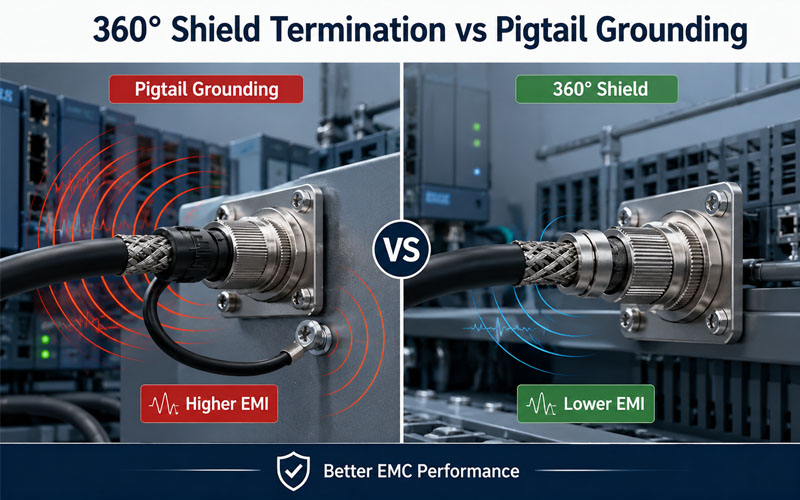
What Is Shield Termination?
Shield termination refers to the method used to electrically connect the cable shield to the connector housing or grounding system.
Its purpose is to:
- Maintain shield continuity
- Minimize electromagnetic emissions
- Improve immunity against external interference
- Provide a low-impedance path for high-frequency noise
A properly terminated shield allows electromagnetic energy to flow safely to ground instead of coupling into nearby signal conductors.
Why Shield Termination Matters
Modern industrial equipment contains numerous EMI sources, including:
- Servo drives
- Frequency inverters
- Switching power supplies
- Industrial Ethernet
- High-speed digital communication
- High-current power cables
Without effective shield termination, these noise sources may result in:
- Communication failures
- Packet loss
- Encoder errors
- Sensor instability
- Unexpected equipment shutdown
Proper shield termination is often the difference between passing and failing EMC testing.
Common Mistake #1: Pigtail Grounding
One of the most common installation mistakes is connecting the shield through a long drain wire or “pigtail.”
Although convenient, this creates additional inductance that significantly reduces shielding effectiveness at high frequencies.
Recommended practice:
- Avoid long pigtails.
- Use direct 360° shield termination whenever possible.
Common Mistake #2: Incomplete 360° Shield Contact
Some connectors only contact a small portion of the cable braid.
This creates gaps in the shielding path and allows electromagnetic energy to leak.
Good shield termination should provide:
- Full circumferential contact
- Uniform pressure
- Continuous metal-to-metal connection
Complete 360° termination offers substantially better EMC performance.
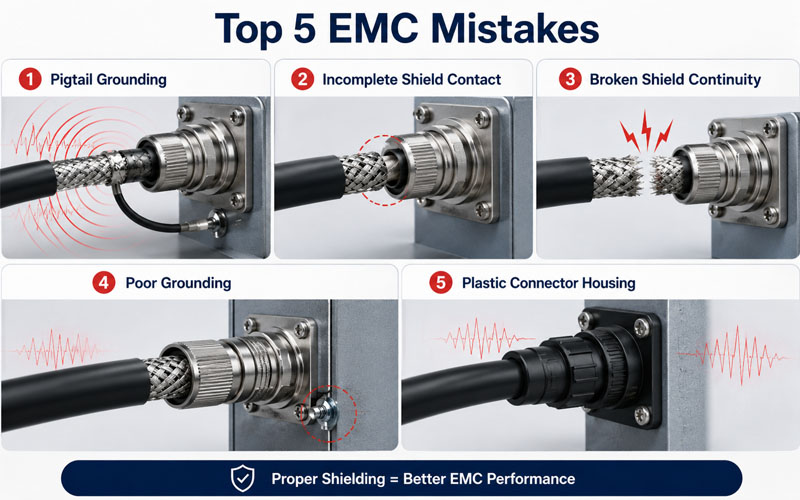
Common Mistake #3: Poor Shield Continuity
The shield should remain electrically continuous from one connector to the other.
Common problems include:
- Broken braid
- Damaged foil
- Poor crimping
- Loose shield clamps
- Oxidized metal surfaces
Even small discontinuities may reduce shielding effectiveness.
Common Mistake #4: Incorrect Grounding Strategy
Shield grounding depends on system architecture.
Single-end grounding may reduce low-frequency ground loops.
Dual-end grounding generally provides better high-frequency EMC performance.
The appropriate strategy should be selected according to:
- Operating frequency
- Equipment layout
- Grounding system
- EMC requirements
There is no universal solution for every application.
Common Mistake #5: Ignoring Connector Housing Material
Plastic connector shells provide little shielding capability.
For demanding industrial environments, engineers often prefer:
- Metal circular connectors
- Conductive connector shells
- Nickel-plated housings
- Aluminum alloy housings
Metal housings improve overall shielding continuity and EMC performance.
Selecting Connectors for High EMC Applications
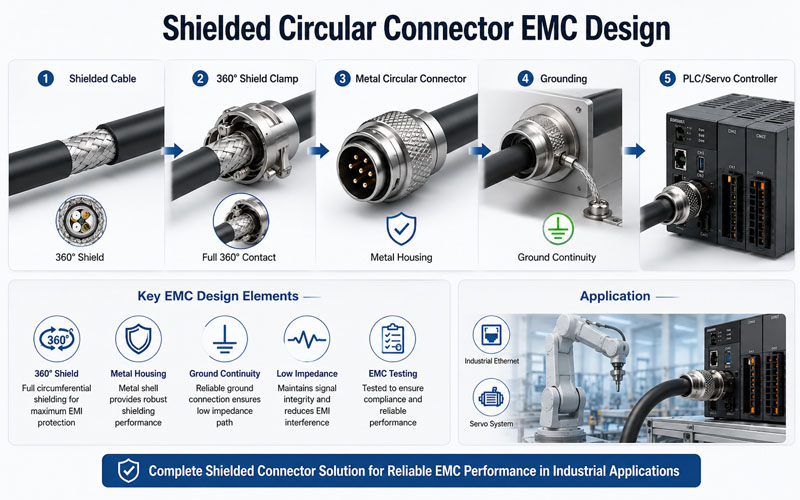
When selecting circular connectors for robotics, industrial automation, or energy storage systems, engineers should evaluate:
- 360° shield termination
- Metal housing
- Shield continuity
- Contact resistance
- IP protection level
- Vibration resistance
- Mating cycle durability
Connector performance should be evaluated as part of the complete cable assembly rather than as an individual component.
Verifying Shield Performance
Proper shield termination should be validated through testing.
Typical evaluations include:
- Shield continuity measurement
- Contact resistance testing
- Radiated emission testing
- Conducted emission testing
- EMC immunity testing
- High-frequency impedance measurement
- Cable flex testing
Laboratory verification ensures consistent EMC performance before production.
Industry Standards
Shielded circular connectors commonly reference:
- IEC 61000 Series — Electromagnetic Compatibility (EMC)
- IEC 61076 Series — Connectors for Electronic Equipment
- CISPR 11 — Industrial Equipment Emissions
- CISPR 32 — Multimedia Equipment EMC Requirements
- IEC 60512 — Connector Mechanical and Electrical Tests
Compliance with these standards helps ensure reliable operation in industrial environments.
How FPIC Supports EMC Connector Solutions
FPIC develops circular connectors, push-pull self-locking connectors, and customized connector assemblies for industrial automation, robotics, medical devices, and energy storage applications.
Our engineering team focuses on optimized shield termination, reliable connector grounding, and robust mechanical design to help customers achieve stable signal transmission and improved EMC performance in demanding environments.
Final Thoughts
Shield termination is one of the most important—but often overlooked—factors affecting connector EMC performance.
Even the highest-quality shielded cable cannot compensate for poor connector termination.
By using proper 360° shield termination, maintaining continuous shielding, selecting appropriate connector materials, and validating EMC performance, engineers can significantly improve communication reliability and reduce electromagnetic interference.
As industrial communication speeds continue to increase, connector shield termination will play an even greater role in system performance.
FAQ
What is shield termination in a circular connector?
Shield termination is the electrical connection between the cable shield and the connector housing or grounding system, providing a controlled path for electromagnetic noise.
Why is a 360° shield termination better than a pigtail?
A 360° termination minimizes high-frequency impedance and provides continuous shielding around the cable, while pigtails introduce inductance that reduces EMC performance.
Do metal connector housings improve EMC?
Yes. Metal housings help maintain shield continuity and provide better electromagnetic shielding than plastic housings.
Should cable shields be grounded at one end or both ends?
The best grounding method depends on operating frequency, grounding architecture, and EMC requirements. High-frequency applications often benefit from dual-end grounding.
How is shield termination verified?
Common tests include shield continuity, contact resistance, EMC emissions, immunity testing, and high-frequency performance evaluation.
Looking for High-Performance Shielded Circular Connectors?
Reliable EMC performance begins with proper connector design. FPIC provides shielded circular connectors, push-pull self-locking connectors, and custom connector solutions engineered for industrial automation, robotics, medical equipment, and energy storage systems. Our engineering team supports customers with optimized shielding, connector integration, and reliable manufacturing for demanding applications.
Contact FPIC today to discuss your EMC connector requirements.
Resources
- IEC 61000 Series – Electromagnetic Compatibility (EMC)
https://webstore.iec.ch/
International EMC standards covering electromagnetic emissions, immunity, and grounding practices. - IEC 61076 Series – Connectors for Electrical and Electronic Equipment
https://webstore.iec.ch/
Provides international standards for the design, testing, and performance of circular and industrial connectors. - IEC 60512 – Connectors for Electronic Equipment – Tests and Measurements
https://webstore.iec.ch/
Specifies mechanical, electrical, and environmental test methods for connector assemblies. - Phoenix Contact – EMC Connection Technology
https://www.phoenixcontact.com/
Explains shield termination, grounding concepts, and EMC best practices for industrial connectors. - TE Connectivity – EMC Shielding Solutions for Industrial Connectivity
https://www.te.com/
Provides technical guidance on connector shielding, 360° shield termination, and high-speed industrial communication.