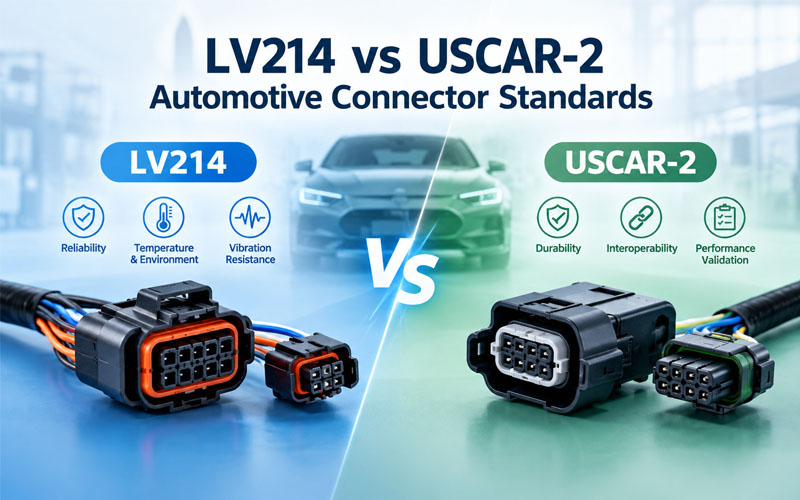
LV214 vs USCAR-2: Automotive Connector Testing Standards Explained
Automotive connector operate under a combination of electrical, mechanical, thermal, vibration, moisture, corrosion, and assembly stresses. A connector that performs well in a laboratory at room temperature may still experience contact degradation, terminal movement, sealing problems, or intermittent electrical failures during vehicle operation.
This is why automotive connector qualification relies on structured testing standards and customer-specific requirements.
Two frequently encountered references are LV214 and SAE/USCAR-2.
Although both are used to evaluate automotive connector reliability, they are not identical standards and should not be treated as one-for-one alternatives.
LV214 is associated with the German automotive industry and the AK testing framework for automotive connectors. USCAR-2 is maintained within the USCAR/SAE ecosystem and defines performance testing for automotive electrical connector systems.
The right validation approach depends on the customer, vehicle program, connector architecture, electrical requirements, installation environment, and applicable specification.
1.What Is LV214?
LV214 is an automotive connector test specification developed within the German automotive industry.
It is commonly referenced in European automotive connector programs and is closely associated with German OEM requirements. Testing laboratories list LV214 alongside customer-specific specifications such as VW 75174 and other German automotive requirements.
The purpose of LV214 is to evaluate the performance and reliability of automotive connectors and terminals under defined mechanical, electrical, climatic, and application-related stresses.
Depending on the applicable revision and customer requirements, the validation framework can address areas such as:
- Dimensional conformity
- Visual inspection
- Terminal characteristics
- Contact resistance
- Mating and unmating behavior
- Terminal retention
- Vibration
- Temperature exposure
- Temperature cycling
- Humidity
- Corrosion
- Mechanical durability
- Connector locking
- Crimp-related characteristics
LV214 is therefore more than a simple environmental test. It is part of a broader connector qualification approach.
2.What Is USCAR-2?
USCAR-2 is the Performance Specification for Automotive Electrical Connector Systems developed within the USCAR/SAE framework.
The current published revision is USCAR2-9, revised December 6, 2024. It covers performance testing of electrical terminals, connectors, and related components used in road-vehicle electrical connection systems. The current scope includes low-voltage systems from 0 to 60 VDC as well as coaxial applications, with specific exclusions defined by the specification.
USCAR-2 covers testing across different stages of the product lifecycle, including:
- Development
- Production
- Field analysis
It also places responsibility on the supplier for verifying and documenting applicable test results and acceptance criteria.
This makes USCAR-2 particularly important when developing connector systems for automotive programs that specify the USCAR validation framework.
3.LV214 vs USCAR-2: The Basic Difference
The easiest way to understand the relationship is to look at their origins and intended engineering ecosystems.
| Item | LV214 | USCAR-2 |
|---|---|---|
| Industry background | German / European automotive | North American automotive |
| Organization / framework | AK automotive connector testing framework | USCAR / SAE |
| Main purpose | Automotive connector and terminal qualification | Automotive electrical connector system performance |
| Typical program context | European / German OEM programs | North American OEM programs |
| Test philosophy | Structured connector qualification and reliability testing | Performance testing across development, production and field analysis |
| Customer-specific requirements | Often important | Often important |
| Interchangeable? | No | No |
The key point is that LV214 and USCAR-2 overlap in many technical objectives, but their requirements, test methods, severity levels, sample plans, and acceptance criteria can differ.
A connector passing one standard should not automatically be described as compliant with the other.
4.Why Do Both Standards Exist?
Automotive connector reliability is influenced by vehicle architecture, regional engineering practices, OEM requirements, and historical validation methods.
Different automotive markets developed their own qualification frameworks.
As a result, connector manufacturers supplying global automotive customers may encounter several validation systems within the same product portfolio.
For example, a supplier may need to support:
- LV214
- USCAR-2
- ISO 16750
- Customer-specific OEM specifications
- Terminal and crimp specifications
- Internal engineering validation requirements
The important engineering task is therefore not to ask:
Which standard is better?
A more useful question is:
Which validation requirements apply to this specific connector, vehicle program, and installation environment?
5.How LV214 and USCAR-2 Overlap
Despite their differences, both standards address the fundamental reliability challenges of automotive connectors.
These include:
Electrical reliability
Both validation approaches consider electrical performance such as contact behavior and electrical continuity.
The objective is to ensure that the connection remains electrically stable under the specified conditions.
Mechanical reliability
Automotive connectors must withstand:
- Vibration
- Mechanical loads
- Mating cycles
- Terminal movement
- Connector retention forces
Mechanical degradation can eventually become an electrical failure.
Environmental reliability
Automotive connectors may experience:
- High temperature
- Low temperature
- Thermal cycling
- Humidity
- Water exposure
- Corrosive environments
- Automotive fluids
Both validation frameworks therefore require consideration of environmental stress.
Terminal performance
The terminal is one of the most critical elements in the connector system.
Poor terminal geometry, inadequate contact force, improper retention, or unstable crimping can produce failures even when the connector housing itself is mechanically intact.
6.LV214 vs USCAR-2: Test Philosophy
One of the most important differences is not simply which tests exist, but how the overall qualification process is structured.
LV214
LV214 is commonly used as part of European automotive connector qualification, with strong attention to connector and terminal characteristics under defined test groups and automotive environmental conditions.
Testing laboratories identify LV214 as an automotive connector test specification and list it alongside German OEM-related connector specifications.
USCAR-2
USCAR-2 takes a broader performance-specification approach covering testing through development, production, and field analysis.
The current USCAR2-9 also emphasizes documented verification of applicable requirements and acceptance criteria by the supplier.
Therefore, the validation strategy should consider not only the test list but also:
- Sample configuration
- Test sequence
- Test severity
- Acceptance criteria
- Measurement method
- Documentation
- Customer requirements
7.Electrical Testing: Contact Resistance Matters
Contact resistance is one of the most important parameters in automotive connector validation.
A connector with excessive or unstable contact resistance can generate localized heating and electrical performance problems.
The basic relationship is:
P = I²R
where:
- P = power dissipated as heat
- I = current
- R = resistance
For this reason, contact resistance should not be considered only as an initial value.
A robust validation strategy should examine whether contact resistance remains stable after exposure to:
- Vibration
- Thermal cycling
- Humidity
- Corrosion
- Mating cycles
- Mechanical stress
The important engineering question is not simply:
Is the initial resistance low?
It is:
Does the contact system maintain stable electrical performance after the expected service stresses?
8.Mechanical Validation: Vibration and Terminal Retention
Automotive connectors can experience continuous mechanical excitation throughout vehicle operation.
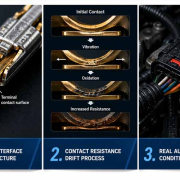
Vibration can produce microscopic relative movement between mating contacts, potentially contributing to fretting and contact degradation.
Terminal retention is another important area.
A terminal that moves backward inside the housing can result in:
- Incomplete mating
- Reduced contact engagement
- Increased electrical resistance
- Intermittent signal
- Loss of circuit continuity
Therefore, connector validation should evaluate both the electrical interface and the mechanical retention system.
The exact vibration profile and mechanical requirements should always be taken from the applicable standard revision and customer specification rather than assumed from a generic test matrix.
9.Environmental Validation: Temperature and Humidity
Automotive connectors can operate across large temperature ranges.
Thermal stress affects:
- Housing materials
- Terminal materials
- Contact force
- Plating
- Seals
- Dimensional stability
Temperature cycling can be especially important because repeated expansion and contraction may gradually change the mechanical relationship between different materials.
Humidity and water exposure introduce another set of risks.
Moisture can contribute to:
- Corrosion
- Leakage current
- Insulation degradation
- Contact resistance increase
For sealed automotive connectors, environmental validation should therefore consider both the initial sealing capability and the ability of the sealing system to maintain performance after mechanical and thermal stresses.
10.Corrosion and Surface Protection
Terminal plating is an important part of automotive connector reliability.
A connector’s electrical performance depends on the condition of its contact interface.
Potential problems include:
- Oxidation
- Corrosion
- Plating wear
- Surface contamination
- Fretting-related surface damage
The plating system must therefore be selected according to:
- Base material
- Contact force
- Mating cycles
- Current level
- Environmental exposure
- Temperature
- Required service life
Validation should confirm that the contact interface remains within the required performance limits after applicable environmental and mechanical stresses.
11.LV214 and USCAR-2 Are Not Interchangeable
This is one of the most important points for automotive connector manufacturers.
A connector tested according to LV214 should not automatically be described as USCAR-2 compliant.
Likewise, passing USCAR-2 does not automatically establish LV214 compliance.
Why?
Because standards can differ in:
- Test methods
- Test sequences
- Severity levels
- Sample quantities
- Acceptance criteria
- Measurement methods
- Environmental conditions
- Mechanical loads
- Customer-specific interpretations
A real connector project may require testing against one standard, the other, or a combination of applicable standards.
A manufacturer should therefore create a requirements-to-test matrix before validation begins.
12.Customer Requirements Always Come First
Industry standards provide a technical framework, but automotive programs frequently include additional customer requirements.
For example, an OEM may specify:
- Specific vibration severity
- Specific temperature range
- Specific mating-cycle requirements
- Additional water-ingress testing
- Special chemical exposure
- Additional terminal tests
- Special crimp requirements
- Additional electrical monitoring
- Customer-specific acceptance criteria
This means that a connector cannot be validated correctly simply by saying:
“We tested it according to LV214.”
or:
“We tested it according to USCAR-2.”
The engineering team needs to identify the exact revision, applicable clauses, customer deviations, additional requirements, and connector configuration.
13.How to Choose Between LV214 and USCAR-2
The decision should start with the customer and vehicle program.
Choose LV214 when:
- The customer specification requires LV214.
- The program is based on a European or German automotive qualification framework.
- The OEM drawing or validation plan references LV214.
- The connector is being developed for a program that specifically requires LV214 testing.
Choose USCAR-2 when:
- The customer specification requires USCAR-2.
- The program follows the USCAR/SAE validation framework.
- The OEM or Tier-1 customer references USCAR-2.
- The connector is intended for an application requiring USCAR-2 performance validation.
Use both when required
Global automotive programs may require evidence against multiple standards.
In that situation, the best approach is not simply to duplicate the entire test program without analysis.
Instead, engineers should create a gap analysis:
LV214 Requirements
↓
USCAR-2 Requirements
↓
Common Tests
↓
Different Tests
↓
Different Severity / Acceptance Criteria
↓
Customer-Specific Requirements
↓
Final Validation Matrix
This can reduce unnecessary duplication while ensuring that no required test is overlooked.
14.Building a Connector Validation Matrix
A validation matrix helps engineers convert standards into an executable test plan.
A simplified structure could look like this:
| Validation Area | LV214 | USCAR-2 | Project Requirement |
|---|---|---|---|
| Visual / dimensional inspection | Applicable | Applicable | Confirm drawing |
| Contact resistance | Applicable | Applicable | Define limits |
| Insulation performance | Applicable as specified | Applicable as specified | Customer requirement |
| Mating / mechanical behavior | Applicable | Applicable | Define cycles/force |
| Terminal retention | Applicable | Applicable | Confirm terminal system |
| Vibration | Applicable | Applicable | Define severity |
| Temperature exposure | Applicable | Applicable | Define profile |
| Thermal cycling | Applicable | Applicable | Define profile |
| Humidity / water | Application-dependent | Application-dependent | Define environment |
| Corrosion | Application-dependent | Application-dependent | Define exposure |
| Additional OEM tests | Possible | Possible | Customer-specific |
This table is only a planning framework.
The actual test conditions, sample quantities, acceptance criteria, and sequences must be taken from the applicable standard revision and customer documentation.
15.Why Test Sequence Matters
Testing individual characteristics separately does not always reproduce the actual degradation mechanism.
For example:
Thermal Cycling → Vibration → Electrical Measurement
can reveal a different result from testing the same parameters independently.
A connector may initially have:
- Low contact resistance
- Strong terminal retention
- Good sealing
But after repeated environmental and mechanical stress, the interface may experience:
- Contact movement
- Seal compression changes
- Material expansion mismatch
- Surface wear
- Corrosion
Therefore, validation planning should consider test sequence and accumulated exposure, not only individual test items.
16.Validation Should Connect With DFMEA
A good connector validation program should be connected to Design FMEA.
For example:
| Failure Mode | Potential Cause | Validation Focus |
|---|---|---|
| High contact resistance | Contact wear | Electrical measurement + durability |
| Intermittent signal | Vibration / fretting | Vibration + dynamic monitoring |
| Terminal back-out | Weak retention | Retention testing |
| Water ingress | Seal compression loss | Environmental / sealing testing |
| Housing crack | Thermal or mechanical stress | Temperature + mechanical validation |
| Corrosion | Moisture / contamination | Environmental exposure |
| Lock failure | Insufficient locking strength | Mechanical validation |
This approach ensures that testing is driven by actual engineering risk rather than simply by a checklist.
17.LV214 vs USCAR-2 for Global Automotive Connector Suppliers
For suppliers serving international automotive customers, maintaining capability for multiple validation frameworks can be valuable.
A global connector development process may need to accommodate:
- European OEM requirements
- North American OEM requirements
- Customer-specific specifications
- Regional environmental conditions
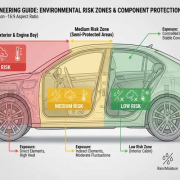
- Different vehicle installation positions
- Different terminal and connector architectures
The engineering challenge is therefore not simply laboratory capability.
It is the ability to translate customer requirements into:
Design Requirements → DFMEA → Test Matrix → Sample Preparation → Validation → Failure Analysis → Corrective Action → Documentation
This creates a repeatable development process across different automotive programs.
18.What Automotive Connector Manufacturers Should Verify Before Testing
Before starting formal validation, engineers should confirm:
1.Standard revision
Do not rely on an old copy or outdated test matrix.
2.Product configuration
Confirm:
- Housing
- Terminal
- Seal
- CPA/TPA
- Plating
- Wire size
- Mating connector
- Mounting configuration
3.Application environment
Identify:
- Vehicle location
- Temperature
- Vibration
- Moisture
- Chemical exposure
- Cable movement
- Current load
4.Customer requirements
Check all OEM and Tier-1 requirements in addition to the base standard.
5.Acceptance criteria
Define exactly what constitutes a pass or failure.
6.Documentation
Plan the required test report, sample identification, measurement data, photographs, failure analysis, and DVP&R documentation before testing starts.
USCAR2-9 specifically requires applicable verification and documentation of results and acceptance criteria by the supplier.
How FPIC Approaches Automotive Connector Validation
Automotive connector validation should be connected to the complete product development process rather than treated as an isolated laboratory activity.
FPIC supports automotive connector projects with engineering development, prototyping, automated production, electrical testing, dimensional inspection, and mass-production quality control.
For customer-specific automotive programs, the validation strategy can be structured around the applicable requirements, including LV214, USCAR-2, customer specifications, and project-specific environmental conditions.
FPIC’s automotive connector manufacturing experience also includes production quality requirements associated with automotive applications, helping connect:
Connector Design → Prototype Verification → Reliability Validation → Process Control → Mass Production
This integrated approach can help identify potential failure risks earlier and improve consistency when a validated connector moves into production.
Final Thoughts
LV214 and USCAR-2 both play important roles in automotive connector validation, but they serve different automotive engineering ecosystems and should not be treated as interchangeable standards.
LV214 is widely associated with European and German automotive connector qualification, while USCAR-2 is an SAE/USCAR performance specification used extensively in North American automotive programs. The current USCAR2-9 revision was published in December 2024 and defines its own scope, testing requirements, verification responsibilities, and documentation expectations.
For connector manufacturers, the best approach is to start with the customer and vehicle application, identify the exact applicable standard revision, map common and unique requirements, and then build a project-specific validation matrix.
The goal is not simply to pass a standard.
The goal is to demonstrate that the connector can maintain electrical, mechanical, environmental, and manufacturing reliability throughout its intended service life.
FAQ
Is LV214 the same as USCAR-2?
No. LV214 and USCAR-2 have overlapping automotive connector reliability objectives, but they originate from different automotive qualification frameworks and can differ in test methods, severity, sample requirements, and acceptance criteria.
Which is stricter, LV214 or USCAR-2?
There is no universally correct answer. The severity depends on the specific test, revision, connector configuration, application, and customer requirement. A better approach is to compare the actual project requirements rather than labeling one standard as universally stricter.
Is LV214 mainly used for European automotive programs?
LV214 is strongly associated with German and European automotive connector qualification and is commonly encountered in European OEM programs. However, the applicable requirement must always be confirmed from the specific customer documentation.
Is USCAR-2 only for American car manufacturers?
Not necessarily. USCAR-2 is part of the SAE/USCAR ecosystem and is widely used in North American automotive programs, but suppliers in other regions may also encounter it when serving customers or programs that specify USCAR requirements.
Can a connector tested to LV214 also pass USCAR-2?
It may perform well against both, but LV214 testing alone does not automatically establish USCAR-2 compliance. The actual requirements must be compared and any additional or different tests completed.
What is the current USCAR-2 revision?
The current SAE specification is USCAR2-9, revised December 6, 2024. It covers road-vehicle electrical connection systems within its defined scope, including 0–60 VDC low-voltage applications and coaxial applications.
Should automotive connector suppliers test to both standards?
Only when required by the customer, vehicle program, or project validation plan. When both are required, a requirements gap analysis can identify common tests and additional requirements before the final validation matrix is established.
Need an automotive connector validated to LV214, USCAR-2, or customer-specific requirements?
FPIC supports automotive connector development from engineering design and prototype verification to reliability testing, production validation, and mass production. Contact our engineering team to discuss your connector configuration and validation requirements.
Resources
- SAE International – USCAR2-9: Performance Specification for Automotive Electrical Connector Systems
Official SAE information for the current USCAR2-9 revision, including scope and verification requirements.
SAE USCAR2-9 Official Specification - USCAR – USCAR-2 Connector Testing
Official USCAR resource for automotive connector testing information and related documentation.
USCAR-2 Connector Testing - IMA Dresden – LV214 Automotive Connector Testing
Testing reference describing LV214 as an automotive connector test specification and its relationship with other European automotive requirements.
IMA Dresden LV214 Testing Reference - Molex – Product Specification Referencing LV214 and USCAR2
Example of an automotive connector product specification referencing both LV-214 and USCAR2 as applicable standards.
Molex Automotive Connector Specification