How Connector Plating Affects Performance and Lifetime
Connector contacts may look like simple metal components, but their surface finish plays a critical role in long-term electrical and mechanical performance.
A connector can have the correct housing design, terminal geometry and contact force, yet still experience reliability problems if the plating system is not appropriate for its application.
Connector plating influences:
- Contact resistance
- Corrosion resistance
- Wear resistance
- Mating performance
- Electrical stability
- Environmental durability
- Contact lifetime
For automotive electronics, industrial automation, robotics, energy storage and other demanding applications, plating should therefore be treated as part of the overall connector reliability strategy.
1.Why Connector Plating Matters
The base metal of a contact provides the mechanical and electrical foundation, but its exposed surface interacts directly with the surrounding environment.
During service, a connector may encounter:
- Humidity
- Oxygen
- Salt contamination
- Dust
- Chemicals
- Temperature cycling
- Mechanical vibration
- Repeated mating and unmating
- Electrical current
Without an appropriate surface finish, the contact interface can gradually deteriorate.
Typical consequences include:
Surface oxidation → higher contact resistance → localized heating → unstable electrical performance
In signal applications, surface deterioration can also contribute to intermittent electrical behavior.
This is why connector plating is not simply a cosmetic treatment. It is an engineered interface between the terminal and its operating environment.
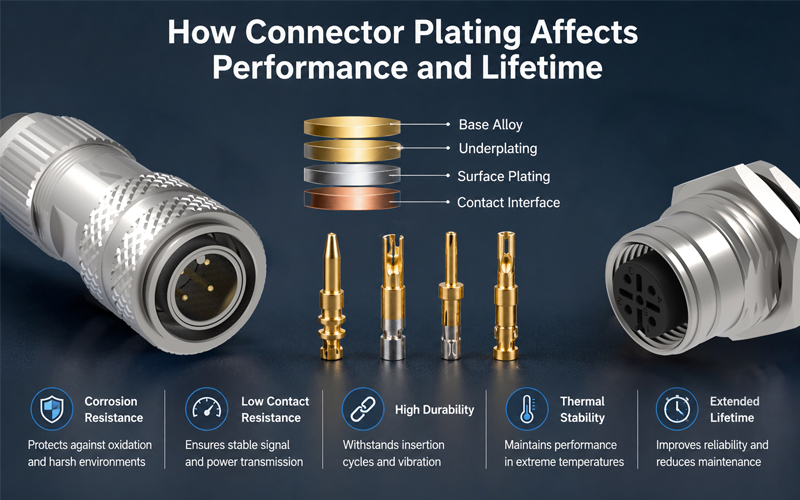
2.What Is Connector Contact Plating?
Connector contact plating is a metallic coating applied to the surface of a conductive contact.
A typical contact system may contain several layers:
Base Contact Alloy
↓
Underplating
↓
Surface Plating
The base alloy provides the structural and electrical properties of the terminal.
The underplating can provide a barrier between the base material and surface plating while supporting adhesion and durability.
The surface plating is the layer that directly interacts with the mating interface and environment.
The performance of the complete system depends on how these layers work together.
3.Common Connector Plating Materials
Three commonly used plating materials are:
| Plating | Typical Characteristics | Common Considerations |
|---|---|---|
| Tin | Cost-effective, good conductivity, widely used | Oxidation and wear must be considered |
| Gold | Excellent corrosion resistance and stable contact interface | Higher material cost |
| Silver | High electrical conductivity | Environmental and application conditions must be evaluated |
The correct choice depends on the electrical, mechanical and environmental requirements rather than simply choosing the highest-value material.
4.Tin Plating
Tin is widely used for connector terminals because it provides a practical balance between performance and cost.
It is commonly considered for applications where:
- Cost efficiency is important
- Current levels are moderate to high
- The connector operates in controlled environments
- Mating frequency is limited or appropriately managed
Tin-plated contacts are often used in automotive and industrial electrical systems.
However, engineers should consider surface condition, contact force, oxidation behavior and mechanical wear.
For applications involving frequent mating or demanding environmental exposure, the complete plating design should be evaluated rather than looking only at the presence of tin plating.
5.Gold Plating
Gold is widely recognized for its excellent resistance to corrosion and stable surface characteristics.
It is particularly valuable where reliable low-level electrical contact is important.
Typical applications may include:
- Signal connectors
- Control electronics
- Communication equipment
- Industrial sensors
- Medical electronics
- High-reliability electronic systems
Gold plating can help maintain a stable contact interface under challenging environmental conditions.
However, gold plating is not automatically the best choice for every connector.
Engineers should also consider:
- Plating thickness
- Underplating
- Contact force
- Mating cycles
- Base material
- Operating environment
- Cost target
A thin gold layer and a properly engineered gold-plating system are not necessarily equivalent.
6.Silver Plating
Silver has very high electrical conductivity and can be considered for applications where electrical performance and current handling are important.
However, silver surfaces can be affected by environmental exposure and surface contamination.
Therefore, silver plating should be evaluated according to:
- Operating temperature
- Current level
- Environmental conditions
- Contact geometry
- Exposure to contaminants
- Required service life
The key engineering principle is the same:
Select the plating system according to the actual operating environment.
7.How Plating Affects Contact Resistance
Contact resistance is one of the most important electrical characteristics of a connector.
Even when the bulk resistance of the terminal is low, the actual mating interface can introduce additional resistance.
A reliable plating system helps maintain a stable contact interface.
If the surface deteriorates through oxidation, corrosion or wear, contact resistance can increase.
Higher contact resistance can contribute to:
Electrical loss → Heat generation → Further degradation
This becomes especially important in higher-current applications.
For this reason, engineers should evaluate plating together with:
- Contact force
- Contact geometry
- Current level
- Terminal material
- Surface condition
- Temperature
Plating cannot compensate for an incorrectly designed contact system.
8.Why Plating Thickness Matters
One of the most common mistakes is evaluating plating only by material type.
For example:
Gold plated
does not fully describe the performance of a gold-plated contact.
Engineers should also consider the plating thickness and overall plating structure.
Plating thickness can influence:
- Corrosion protection
- Wear resistance
- Surface durability
- Mating lifetime
- Barrier performance
- Long-term contact stability
However, thicker plating is not automatically better.
Increasing plating thickness may increase cost without providing meaningful additional performance for a specific application.
The correct approach is to establish the required performance first and then define an appropriate plating system.
9.Gold Plating Thickness and Mating Cycles
For connectors with frequent mating and unmating, mechanical wear becomes a major consideration.
Every mating cycle can generate mechanical interaction between the contact surfaces.
Over time, repeated movement can gradually wear the plating.
Therefore, engineers should evaluate:
Plating Thickness + Contact Geometry + Contact Force + Mating Cycles
rather than considering plating thickness independently.
For example, a connector designed for frequent maintenance may require a different surface treatment strategy from a connector that is assembled once and expected to remain connected throughout its service life.
10.The Role of Underplating
Underplating is often overlooked because it is not visible from the finished connector surface.
However, it can play an important role in the plating system.
A properly selected underlayer can help:
- Improve the barrier between base metal and surface plating
- Support plating adhesion
- Reduce migration between material layers
- Improve long-term plating stability
The exact layer structure depends on the contact material, plating technology and application requirements.
Therefore, plating should be evaluated as a layered system, not as a single metallic coating.
11.Connector Plating and Corrosion Resistance
Corrosion is one of the major causes of connector degradation.
Environmental factors can include:
- Moisture
- Salt
- Humidity
- Industrial chemicals
- Pollutants
- Condensation
Corrosion at the contact interface can change the surface condition and increase electrical resistance.
For connectors used in harsh environments, engineers should consider the combined effect of:
Plating + Sealing + Housing + Environmental Protection
This is particularly important for automotive and industrial connectors installed outside protected electronic enclosures.
12.Connector Plating and Wear
Corrosion is not the only threat to plating.
Mechanical wear can also remove or damage the surface layer.
Common sources include:
- Repeated mating
- Vibration
- Sliding contact movement
- Cable movement
- Terminal deformation
- Assembly processes
A connector designed for high mating-cycle performance needs a plating system that can withstand the expected mechanical interaction.
This means plating selection should be connected to the connector’s mechanical design.
13.Connector Plating for High-Current Applications
High-current connectors introduce additional considerations.
As current increases, even a small increase in contact resistance can become more significant because electrical power dissipation at the contact interface increases with resistance.
Therefore, high-current connector design should consider:
- Contact material
- Contact cross-section
- Contact force
- Contact area
- Plating
- Thermal management
- Terminal connection quality
For energy storage, power distribution and industrial equipment, plating should be evaluated together with the complete current-carrying system.
Plating alone does not determine current capacity.
14.Connector Plating for Signal Applications
Signal connectors have a different set of priorities.
Very low-level electrical signals can be sensitive to surface contamination and contact instability.
For these applications, engineers may prioritize:
- Stable contact resistance
- Corrosion resistance
- Surface cleanliness
- Low-level signal reliability
- Mating-cycle performance
Gold plating is often considered in applications where maintaining a stable contact interface is particularly important.
However, the final selection still depends on connector design and operating conditions.
15.Automotive Connector Plating
Automotive connectors can experience challenging conditions, including:
- Vibration
- Temperature cycling
- Humidity
- Contamination
- Repeated electrical loading
- Long service periods
Therefore, plating selection must be integrated into the overall connector design.
Engineers should evaluate:
- Terminal Material
- Plating System
- Contact Force
- Sealing
- Mechanical Retention
- Environmental Requirements
For automotive connector production, consistent plating quality is also important because variations in surface condition can affect electrical and mechanical performance.
16.Industrial Connector Plating
Industrial connectors may be exposed to:
- Dust
- Oil
- Chemicals
- Humidity
- Vibration
- Frequent maintenance
Applications such as automation equipment, robotics, sensors and control cabinets may also require repeated connector service.
Therefore, plating selection should consider both environmental resistance and mechanical wear.
A connector that performs well in a clean indoor environment may require a different plating strategy when used in a factory environment with vibration, contamination or frequent maintenance.
17.Connector Plating Selection Matrix
| Application Requirement | Key Plating Consideration |
|---|---|
| Low-cost electrical connection | Cost-effective plating system |
| High corrosion resistance | Stable corrosion-resistant surface |
| Frequent mating | Wear resistance + plating thickness |
| Low-level signals | Stable contact interface |
| High current | Contact resistance + thermal performance |
| High humidity | Corrosion resistance + sealing |
| Industrial environment | Chemical and contamination resistance |
| Automotive application | Environmental + mechanical durability |
| Long service life | Complete plating system validation |
The table should be used as an engineering starting point rather than a universal material-selection rule.
18.Common Connector Plating Selection Mistakes
Mistake 1: Choosing plating only by material
Selecting “gold” or “tin” without considering thickness, base material and application requirements can lead to an incomplete specification.
Mistake 2: Assuming thicker is always better
More plating may increase cost without providing proportional performance benefits.
Mistake 3: Ignoring mating cycles
A plating system suitable for one-time assembly may not be suitable for repeated maintenance.
Mistake 4: Ignoring the environment
Humidity, salt, chemicals and contamination can significantly influence surface durability.
Mistake 5: Evaluating plating separately from contact design
Contact force, geometry and plating work together to determine interface performance.
Mistake 6: Focusing only on initial electrical performance
A connector may pass initial electrical testing but still experience degradation during long-term environmental or mechanical exposure.
19.How to Define a Connector Plating Specification
A practical engineering specification should include more than the plating material.
Consider defining:
1.Base Contact Material
Examples include brass, phosphor bronze and other copper alloys.
2.Underplating
Define the required layer structure according to the manufacturing process and application.
3.Surface Plating
Specify tin, gold, silver or another suitable finish.
4.Plating Thickness
Define the required thickness according to performance requirements.
5.Mating Requirements
Specify expected mating and unmating cycles.
6.Environmental Requirements
Consider temperature, humidity, corrosion, chemicals and contamination.
7.Electrical Requirements
Evaluate current, voltage, contact resistance and signal characteristics.
8.Validation Requirements
Define the appropriate electrical, mechanical and environmental tests.
This creates a much stronger specification than simply stating:
“Gold plated connector.”
20.Connector Plating Quality Control
For mass production, plating quality needs to be controlled consistently.
Depending on the product and specification, manufacturers may monitor:
- Plating thickness
- Surface appearance
- Adhesion
- Contact resistance
- Corrosion performance
- Mechanical wear
- Terminal dimensions
- Base material consistency
Process control is particularly important because plating variation can affect the finished contact interface.
A robust quality system should connect:
Incoming Material → Stamping → Plating → Terminal Processing → Assembly → Electrical Testing → Final Inspection
This helps identify potential variation before products reach the customer.
21.How FPIC Supports Connector Plating and Reliability
For custom connector projects, plating should be considered during the engineering and DFM stages rather than added as a final specification.
FPIC can support connector development by evaluating the relationship between:
- Contact material
- Plating system
- Terminal geometry
- Contact force
- Connector structure
- Application environment
- Manufacturing requirements
- Electrical performance
For automotive connector applications, FPIC operates an IATF 16949 quality management system and applies controlled manufacturing and inspection processes to support consistent connector production.
The objective is not simply to provide a specific plating material, but to develop a plating and contact system that matches the customer’s actual operating requirements.
22.A Practical Connector Plating Selection Workflow
A useful engineering workflow is:
Step 1 — Define the Application
Automotive, industrial, robotics, energy storage, medical or electronics.
↓
Step 2 — Define the Environment
Temperature, humidity, corrosion, chemicals and contamination.
↓
Step 3 — Define Electrical Requirements
Current, voltage, contact resistance and signal requirements.
↓
Step 4 — Define Mechanical Requirements
Mating cycles, vibration, insertion force and contact movement.
↓
Step 5 — Select the Contact Material
Choose an appropriate conductive alloy based on mechanical and electrical requirements.
↓
Step 6 — Select the Plating System
Evaluate surface plating, underplating and thickness.
↓
Step 7 — Validate
Conduct appropriate electrical, mechanical and environmental testing.
This approach reduces the risk of selecting plating based solely on material name or initial cost.
23.Final Thoughts
Connector plating is a small physical layer with a major impact on long-term connector performance.
The right plating system can help maintain:
- Stable contact resistance
- Corrosion resistance
- Mechanical durability
- Mating performance
- Electrical reliability
- Long service life
But plating should never be evaluated independently.
The final performance depends on the complete system:
Contact Material + Plating + Thickness + Contact Force + Geometry + Sealing + Environment
For engineers designing reliable connectors, the key question is not:
“Which plating is best?”
It is:
“Which plating system provides the required performance for this application throughout the expected service life?”
FAQ
What is connector plating?
Connector plating is a metallic surface coating applied to electrical contacts to improve properties such as corrosion resistance, contact stability and wear performance.
Is gold plating better than tin plating?
Not necessarily. Gold can provide excellent corrosion resistance and stable contact characteristics, while tin can offer a practical balance between performance and cost. The correct choice depends on the application.
Why does connector plating thickness matter?
Plating thickness can affect corrosion protection, wear resistance and service life. However, thicker plating is not automatically better because cost and application requirements must also be considered.
Does plating affect connector contact resistance?
Yes. Surface condition and plating can influence the stability of the contact interface and therefore affect contact resistance over the connector’s service life.
What plating is suitable for high-current connectors?
There is no single plating material that is universally best for high-current connectors. Engineers should evaluate plating together with contact material, geometry, contact force, resistance and thermal requirements.
How does plating affect mating cycles?
Repeated mating creates mechanical wear at the contact interface. The plating material, thickness, contact geometry and force all influence how well the surface withstands repeated cycles.
Should connector plating be specified during DFM?
Yes. Plating should be considered during connector design and DFM because it affects material selection, manufacturing processes, cost and long-term reliability.
Need Help Selecting the Right Connector Plating?
Choosing the right plating system requires more than selecting gold, tin or silver.
FPIC can help evaluate contact material, plating, terminal design, environmental requirements and manufacturing considerations for custom connector applications.
Talk to our engineering team about your connector requirements.
Resources
- IPC/WHMA-A-620 — Requirements and Acceptance for Cable and Wire Harness Assemblies
- SAE — Automotive engineering standards and specifications
- IEC — International electrotechnical standards
- IATF 16949 — Automotive quality management system requirements