M12 X-Coded vs D-Coded vs A-Coded Connectors: Which One Fits Industrial Ethernet
M12 Connectors have become one of the most widely used connectivity solutions in industrial automation.
You’ll find them in:
- PLC systems
- Industrial Ethernet networks
- Sensors and actuators
- Machine vision equipment
- Robotics
- Servo drives
- IIoT devices
However, one common misconception is that all M12 connectors are interchangeable.
In reality, X-coded, D-coded, and A-coded M12 connectors are designed for different purposes, and selecting the wrong type can lead to communication limitations, compatibility issues, or unnecessary costs.
This article explains the key differences and helps industrial buyers choose the right M12 connector for their application.
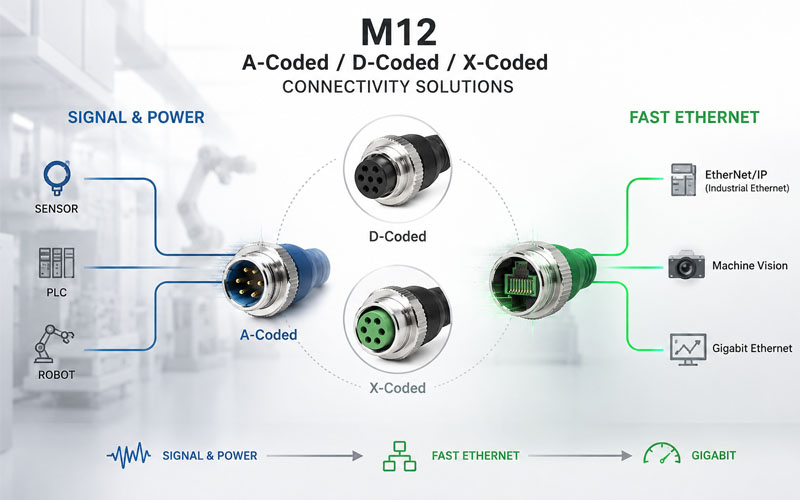
Understanding M12 Connector Coding
The coding of an M12 connector determines:
- pin arrangement
- electrical isolation
- supported protocols
- data transmission capability
- application suitability
The coding prevents incompatible connectors from being accidentally mated.
Among the various M12 coding types, A-coded, D-coded, and X-coded are the most commonly encountered in industrial automation.
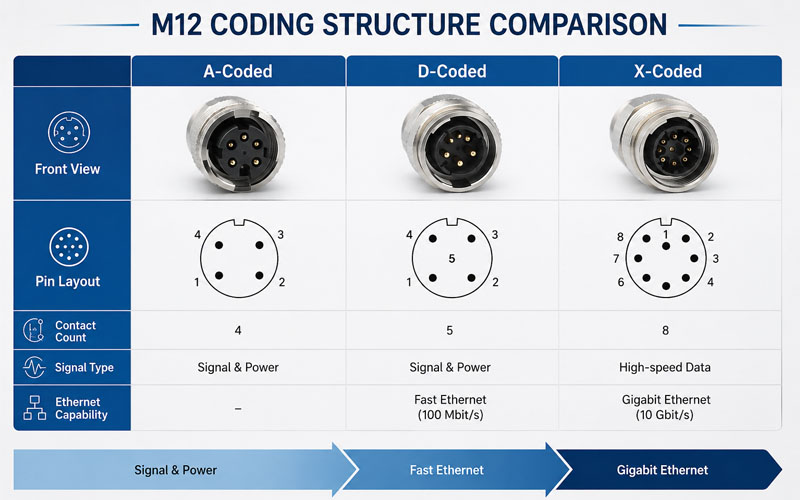
What Is an A-Coded M12 Connector?
A-coded connectors were originally developed for industrial sensors and actuators.
They are the most widely used M12 connector type.
Typical Applications
- Proximity sensors
- Photoelectric sensors
- Solenoid valves
- I/O modules
- Power distribution
- Basic field devices
Common Pin Counts
- 3-pin
- 4-pin
- 5-pin
- 8-pin
- 12-pin
Main Function
A-coded connectors primarily carry:
- power signals
- discrete I/O signals
- analog signals
They are generally not intended for high-speed Ethernet communication.
What Is a D-Coded M12 Connector?
D-coded connectors were developed specifically for Industrial Ethernet applications.
Typical Applications
- PROFINET
- EtherNet/IP
- Industrial switches
- PLC communication
- Machine networking
Ethernet Capability
D-coded connectors typically support:
- Fast Ethernet
- 100 Mbps communication
Pin Configuration
D-coded connectors use:
- 4 contacts
- 2 twisted pairs
This configuration is optimized for industrial network communication.
What Is an X-Coded M12 Connector?
X-coded connectors were introduced to support higher Ethernet bandwidth requirements.
As Industry 4.0 and machine vision applications expanded, Fast Ethernet became insufficient for many systems.
Typical Applications
- Gigabit Ethernet
- Machine vision
- Industrial cameras
- High-speed data acquisition
- Smart manufacturing equipment
Ethernet Capability
X-coded connectors support:
- 1 Gbps Ethernet
- 10 Gbps Ethernet (depending on system design)
Pin Configuration
X-coded connectors use:
- 8 contacts
- 4 twisted pairs
Internal shielding separates the pairs to improve EMC performance and reduce crosstalk.
Quick Comparison
| Feature | A-Coded | D-Coded | X-Coded |
|---|---|---|---|
| Primary Use | Sensors & Power | Industrial Ethernet | High-Speed Ethernet |
| Typical Speed | Signal/Power | 100 Mbps | 1 Gbps+ |
| Contact Count | 3–12 Pins | 4 Pins | 8 Pins |
| Ethernet Support | Limited | Yes | Yes |
| Shielding Requirement | Low–Medium | High | Very High |
| Common Applications | Sensors, I/O | PLC Networks | Vision & Data Systems |
Why X-Coded Is Becoming More Popular
Several trends are driving adoption of X-coded connectors:
Machine Vision Systems
Industrial cameras generate large amounts of data.
Gigabit Ethernet is often required.
Industry 4.0
Modern smart factories rely on:
- real-time monitoring
- edge computing
- high-speed communication
Future-Proofing
Many OEMs choose X-coded solutions today to avoid future bandwidth limitations.
Why D-Coded Remains Relevant
Although X-coded connectors offer higher speeds, D-coded connectors remain widely used.
Reasons include:
- lower cost
- established PROFINET infrastructure
- sufficient bandwidth for many automation systems
- simpler network architectures
Many PLC and I/O networks do not require Gigabit Ethernet.
Why A-Coded Connectors Are Often Misunderstood
A common mistake is assuming that all M12 connectors can be used for Ethernet.
Many A-coded connectors physically resemble D-coded or X-coded versions.
However:
- contact layouts differ
- shielding requirements differ
- communication capability differs
An A-coded connector should generally be viewed as a sensor, actuator, or power connector rather than an Ethernet connector.
Shielding Considerations
As data rates increase, EMC performance becomes more critical.
A-Coded
Typically used for power and signals.
Shielding requirements vary by application.
D-Coded
Requires shielded twisted pairs and proper grounding.
X-Coded
Requires:
- advanced shielding
- pair separation
- 360° shield termination
- controlled impedance design
High-speed Ethernet performance depends heavily on shielding quality.
IP Ratings and Environmental Protection
All three connector types can be supplied with:
- IP67 protection
- IP68 protection
- IP69K protection
The coding itself does not determine environmental sealing.
Protection level depends on connector design and assembly quality.
Connector Selection by Application
Choose A-Coded When:
✓ Connecting sensors
✓ Connecting actuators
✓ Transmitting power
✓ Handling standard I/O signals
Choose D-Coded When:
✓ Deploying PROFINET
✓ Using Fast Ethernet networks
✓ Connecting PLCs and switches
✓ Bandwidth requirements remain below Gigabit levels
Choose X-Coded When:
✓ Using Gigabit Ethernet
✓ Supporting machine vision systems
✓ Future-proofing network infrastructure
✓ Managing high-data applications
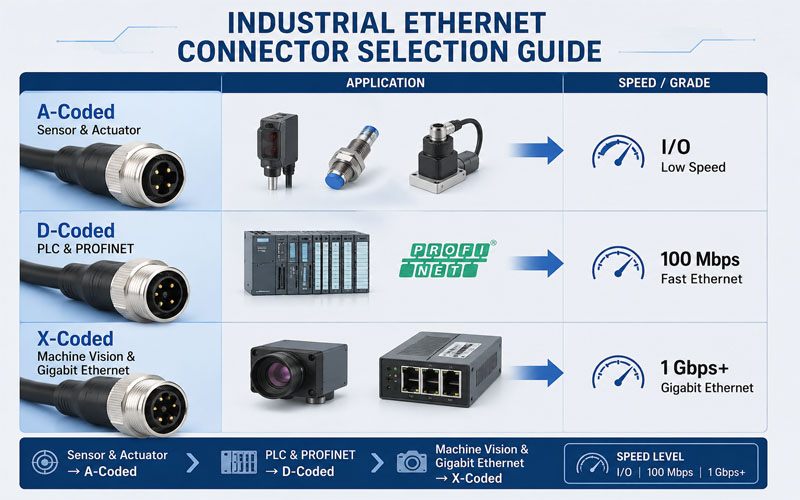
Common Buyer Mistakes
Selecting Based Only on Connector Appearance
M12 coding determines functionality.
Appearance alone can be misleading.
Overlooking Bandwidth Requirements
Future communication needs should be considered.
Ignoring Shielding Quality
High-speed communication requires robust EMC design.
Using A-Coded Connectors for Ethernet Applications
This can create communication failures and compatibility issues.
Focusing Only on IP Rating
Electrical performance is just as important as environmental protection.
Questions Buyers Should Ask Suppliers
Before selecting an M12 connector solution, ask:
- What coding is used?
- What Ethernet speed is supported?
- Is the connector shielded?
- Is 360° shield termination available?
- What IP rating is achieved?
- Is the assembly suitable for drag-chain applications?
- Has EMC validation been completed?
Typical Applications
A-Coded
- Sensors
- Actuators
- Field I/O
D-Coded
- PROFINET
- EtherNet/IP
- Industrial networking
X-Coded
- Machine vision
- Industrial cameras
- Gigabit Ethernet
- Smart manufacturing
How FPIC Supports M12 Connectivity Solutions
FPIC provides custom industrial connectivity solutions including:
- M12 A-coded cable assemblies
- M12 D-coded Ethernet harnesses
- M12 X-coded Gigabit Ethernet assemblies
- Industrial Ethernet cable solutions
- Drag-chain communication cables
- Custom overmolded cable assemblies
Our engineering team helps customers select the most suitable connector architecture based on network performance, EMC requirements, and environmental conditions.
Final Thoughts
Choosing between A-coded, D-coded, and X-coded M12 connectors depends on the application.
While A-coded connectors remain ideal for sensors and power distribution, D-coded and X-coded connectors are purpose-built for Industrial Ethernet.
For modern automation systems, selecting the correct coding ensures:
- network reliability
- EMC performance
- future scalability
- long-term system compatibility
Understanding these differences helps buyers avoid costly design mistakes and improve industrial network performance.
FAQ
Can A-coded M12 connectors be used for Ethernet?
Generally no. A-coded connectors are primarily designed for sensors, actuators, and power transmission.
What is the difference between D-coded and X-coded M12 connectors?
D-coded connectors typically support Fast Ethernet (100 Mbps), while X-coded connectors support Gigabit Ethernet and higher-speed communication.
Which M12 connector is used for PROFINET?
D-coded connectors are commonly used for PROFINET networks, although X-coded versions are increasingly adopted for higher bandwidth applications.
Is X-coded better than D-coded?
Not necessarily. X-coded offers higher bandwidth, but D-coded may be more cost-effective for applications that only require 100 Mbps communication.
Do all M12 connector types support IP67?
Yes. A-coded, D-coded, and X-coded connectors can all be designed to meet IP67 or higher protection ratings.
Looking for Custom M12 Cable Assemblies?
FPIC provides M12 A-coded, D-coded, and X-coded cable assemblies for sensors, Industrial Ethernet, machine vision, robotics, and smart factory applications.
Contact us to discuss your M12 connectivity requirements.
Resources
IEC 61076-2-101 – M12 Connector Standards
IEC 61076-2-109 – M12 X-Coded Connector Standards
PROFINET Installation Guidelines
ODVA EtherNet/IP Infrastructure Guidance
Phoenix Contact Industrial Ethernet Connectivity Documentation
Source References: IEC 61076 Series, PROFIBUS & PROFINET International (PI), ODVA, Phoenix Contact Industrial Connectivity Resources.