Automotive Connector Supplier Selection Checklist for OEM Projects
Choosing an automotive connector supplier involves much more than comparing quotations, product specifications, or delivery lead times. A connector may be a relatively small component, but its performance can directly affect electrical continuity, vehicle safety, system reliability, and manufacturing efficiency.
For OEMs and Tier 1 suppliers, selecting the right manufacturing partner requires a structured evaluation of technical competence, quality management, engineering support, production capability, and long-term supply chain stability.
A supplier that can provide samples quickly may not necessarily be ready for mass production. Similarly, a competitive quotation does not guarantee consistent product quality or effective engineering support throughout the project lifecycle.
This guide provides a practical automotive connector supplier selection checklist for OEM projects, covering the key factors to evaluate before approving a supplier.
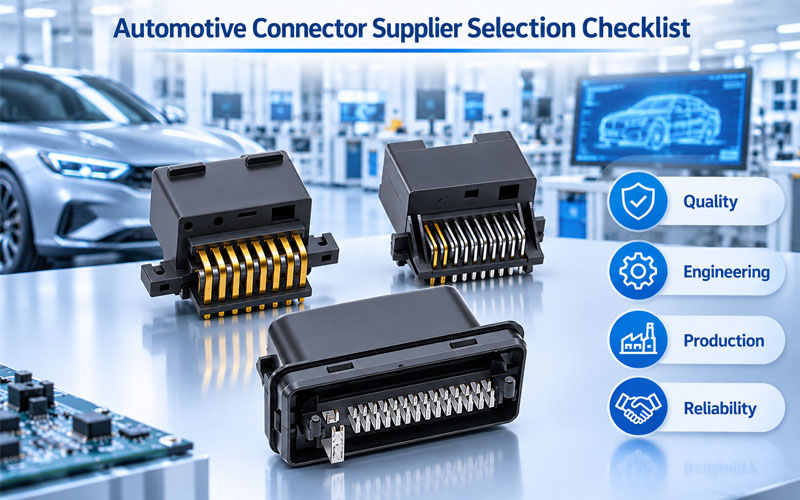
1.Confirm Automotive Quality Management System Requirements
A supplier’s quality management system is one of the first areas to review.
Automotive projects typically require more structured quality controls than general industrial applications. OEMs should confirm whether a potential supplier has an established quality management system and whether its certification status meets the specific project requirements.
What to check
- Does the manufacturing site hold a valid IATF 16949 certification, where required?
- Is the certificate issued by an accredited certification body?
- Does the certification scope cover the relevant manufacturing activities?
- Is the actual production site the same site identified in the certificate?
- Are internal audits and management reviews conducted regularly?
- Are nonconformities managed through documented corrective-action procedures?
- Can the supplier demonstrate continuous improvement in manufacturing quality?
IATF 16949 is an automotive-specific quality management system standard that works alongside ISO 9001 and addresses requirements for automotive production and service parts. However, certification alone should not be treated as proof that a supplier meets every OEM requirement. <Cite refs={[“turn257028search6″,”turn257028search9”]}/>
OEMs should also review applicable customer-specific requirements. These may define additional expectations for supplier approval, process audits, documentation, and product validation. The IATF publishes customer-specific requirement documents for participating automotive manufacturers. <Cite refs={[“turn257028search1”]}/>
Practical recommendation: Request the current certificate, verify its validity and scope, and confirm the quality requirements applicable to the specific project and customer.
2.Evaluate Engineering and Customization Capabilities
Automotive connector projects often involve application-specific requirements rather than standard catalog products.
Connector dimensions, terminal geometry, contact materials, plating, locking structures, sealing performance, and electrical characteristics may all need to be adjusted to match the vehicle’s electrical architecture.
A capable supplier should be able to participate in engineering discussions before the design is finalized.
What to check
- Can the supplier support customized connector development?
- Does it have experience with terminal and housing design?
- Can engineers review drawings and technical specifications?
- Can the supplier evaluate material and plating options?
- Does it understand contact force, terminal retention, and mating interface requirements?
- Can it assess sealing structures and environmental protection requirements?
- Can it identify potential manufacturing or assembly risks during design review?
- Is engineering support available throughout prototype and production stages?
Important engineering capabilities
| Evaluation area | What OEMs should verify |
|---|---|
| Connector housing | Material selection, dimensional accuracy, structural design |
| Terminal system | Contact geometry, retention, mating performance |
| Contact plating | Material suitability, thickness control, corrosion considerations |
| Sealing design | Seal structure, water and dust protection |
| Electrical performance | Current rating, voltage rating, contact resistance |
| Mechanical performance | Mating cycles, insertion force, vibration resistance |
A supplier should not simply confirm that a design is manufacturable. It should also help identify potential risks associated with the intended operating environment.
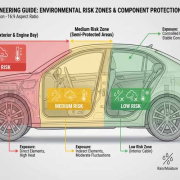
For example, a connector used near an engine compartment may require different temperature and vibration considerations from one installed inside a protected electronic control unit.
3.Review Prototype Development and Validation Capabilities
Prototype development is an important stage for identifying design and manufacturing issues before mass production.
OEMs should evaluate whether a supplier can support both sample manufacturing and the engineering verification activities required by the project.
What to check
- Can the supplier produce prototypes according to the latest approved drawings?
- Are prototype materials and manufacturing processes representative of the intended production design?
- Can dimensional inspection reports be provided?
- Are electrical tests available?
- Can mechanical performance be evaluated?
- Can environmental validation be arranged?
- Does the supplier maintain sample revision and change records?
- Can engineering issues be documented and resolved systematically?
Depending on the connector application, validation may include:
- Contact resistance testing
- Insulation resistance testing
- Dielectric withstand testing
- Temperature rise testing
- Terminal retention testing
- Insertion and withdrawal force testing
- Vibration and mechanical shock testing
- Thermal cycling
- Salt spray or corrosion testing
- Water and dust ingress testing
Not every connector requires every test. The validation plan should be based on the product specification, installation environment, applicable standards, and OEM requirements.
Practical recommendation: Ask for a sample development plan that identifies the prototype schedule, inspection requirements, validation methods, responsible personnel, and issue-resolution process.
4.Assess Manufacturing Process Control and Production Equipment
A supplier may produce acceptable prototypes but encounter quality variation when production volumes increase.
For OEM projects, manufacturing capability must be evaluated at the process level—not just by looking at the finished connector.
Relevant manufacturing processes may include:
- Precision metal stamping
- Terminal forming
- Injection molding
- Contact plating
- Terminal assembly
- Connector housing assembly
- Crimping and cable integration, where applicable
- Electrical and dimensional inspection
What to check
- Are critical manufacturing processes documented?
- Does the supplier use defined process parameters?
- Are production machines maintained and calibrated?
- Are critical dimensions monitored during production?
- Are automated inspection systems used where appropriate?
- Are operators trained for their assigned processes?
- Are process changes reviewed and approved?
- Are production defects recorded and analyzed?
Look beyond equipment quantity
The presence of automated machines does not automatically guarantee manufacturing consistency.
OEMs should understand how equipment is controlled, how inspection data is used, and how abnormal conditions are handled.
For example, terminal assembly may require monitoring of insertion position, terminal deformation, locking engagement, and other critical characteristics. A mature production process should define how these characteristics are checked and what happens when results fall outside approved limits.
5.Verify Quality Inspection and Testing Systems
A reliable automotive connector supplier should have an inspection system that covers incoming materials, in-process production, and finished products.
Quality should be built into the manufacturing process rather than depending only on final inspection.
What to check
| Quality control stage | Key evaluation points |
|---|---|
| Incoming inspection | Raw material, terminal material, plating and component verification |
| In-process inspection | Critical dimensions, assembly position, process parameters |
| Final inspection | Appearance, dimensions, assembly completeness |
| Electrical testing | Continuity, resistance, insulation or dielectric tests as specified |
| Functional inspection | Locking, mating, retention and other product-specific checks |
| Nonconformance control | Defect identification, segregation, investigation and corrective action |
OEMs should also ask how inspection equipment is calibrated and how measurement results are recorded.
For critical characteristics, the supplier should be able to explain the inspection method, acceptance criteria, sampling frequency, and reaction plan.
A documented control plan is particularly important because it connects product and process risks with actual manufacturing controls. AIAG’s Control Plan 1st Edition provides guidance on control plan development and includes the concept of Safe Launch controls for early production stages. <Cite refs={[“turn257028search8″,”turn257028search7”]}/>
6.Check Traceability and Documentation Management
Traceability becomes especially important when a quality issue occurs after products have been delivered to an OEM or Tier 1 customer.
Without sufficient production records, it may be difficult to identify affected batches, determine the root cause, or establish the scope of containment.
What to check
- Can finished products be traced to production batches?
- Are raw materials and key components recorded?
- Are production dates, machine information, and inspection results retained?
- Are product revisions and engineering changes documented?
- Can the supplier identify affected shipments during a quality investigation?
- Are quality records stored and retrieved systematically?
- Does the supplier have a defined document-control process?
For customized connectors, revision management is particularly important.
A change in terminal geometry, plating specification, housing material, or sealing structure may affect product performance. OEMs should confirm that obsolete drawings and specifications cannot be used accidentally in production.
7.Evaluate Mass Production Capacity and Delivery Reliability
A supplier’s ability to manufacture samples does not necessarily demonstrate its ability to support long-term OEM demand.
Before supplier approval, OEMs should evaluate production capacity against forecast volumes, ramp-up requirements, and possible demand fluctuations.
What to check
- What is the supplier’s current production capacity?
- Is there sufficient capacity for the forecast project volume?
- Can capacity be increased during a production ramp-up?
- Are critical machines or processes potential bottlenecks?
- Are backup machines or alternative production arrangements available?
- How are production schedules managed?
- What is the supplier’s historical on-time delivery performance?
- How are urgent orders and demand changes handled?
Evaluate production readiness
A useful supplier review should include a capacity discussion covering:
- Forecast demand and expected annual volume.
- Available production capacity.
- Equipment utilization and bottleneck processes.
- Labor and shift arrangements.
- Material availability and replenishment lead times.
- Ramp-up planning and contingency capacity.
OEMs should also understand whether the supplier depends heavily on a single production line, machine, or external processing partner.
Capacity commitments should be supported by realistic production data rather than general assurances.
8.Review Supply Chain Stability and Material Management
Automotive connector production depends on consistent access to raw materials and specialized components.
Copper alloys, engineering plastics, plating materials, seals, and other purchased components can affect both product performance and delivery continuity.
What to check
- Are key raw material suppliers qualified?
- Are alternative sources available for critical materials?
- Does the supplier monitor material quality and consistency?
- Are incoming materials traceable?
- How are long-lead-time components managed?
- Are inventory levels aligned with project demand?
- Does the supplier have a business continuity plan?
- Are sub-tier suppliers monitored and evaluated?
Sub-tier supplier management deserves particular attention when critical processes such as plating or specialized material production are outsourced.
OEMs should understand which processes are performed internally and which depend on external suppliers. They should also review how outsourced processes are qualified, monitored, and controlled.
9.Assess Engineering Communication and Project Management
Even technically capable suppliers can create project delays if communication is slow or responsibilities are unclear.
OEM projects often involve multiple departments, including purchasing, engineering, quality, manufacturing, and logistics. A supplier should be able to coordinate with these teams throughout the development process.
What to check
- Is there a designated project contact?
- Can the supplier provide engineering support during design review?
- Are technical questions answered within agreed timeframes?
- Are project milestones clearly defined?
- Are development risks communicated early?
- Are sample changes and drawing revisions documented?
- Are quality issues escalated through a defined process?
- Can the supplier support customer audits and technical meetings?
A good supplier should communicate potential problems before they affect the project schedule.
For example, if a terminal design requires a tooling adjustment or a specified material has a long procurement lead time, the supplier should raise the issue early and provide a realistic recovery plan.
10.Compare Total Cost, Not Just Unit Price
Price is an important part of supplier selection, but the lowest quotation does not always represent the lowest overall project cost.
OEMs should consider the total cost of ownership, including development, tooling, testing, quality management, logistics, and potential production risks.
Cost factors to review
| Cost category | Questions to ask |
|---|---|
| Unit price | Is the quotation based on the correct specification and volume? |
| Tooling | Are tooling costs, ownership, maintenance, and modification fees clear? |
| Development | Are prototype and engineering costs included? |
| Validation | Which tests are included, and which require additional charges? |
| Logistics | What are the packaging, freight, and delivery costs? |
| Quality | How are sorting, rework, replacement, and warranty costs handled? |
| Engineering changes | How are design and process changes quoted? |
A transparent quotation should clearly define the scope of supply, assumptions, exclusions, and commercial conditions.
OEMs should compare suppliers using the same technical requirements and commercial assumptions to avoid misleading price comparisons.
11.Evaluate Long-Term Partnership and Continuous Improvement
Automotive projects often continue for several years, and supplier performance must remain consistent throughout the product lifecycle.
The selection process should therefore consider not only initial project readiness but also the supplier’s ability to support ongoing production.
What to check
- Does the supplier monitor customer complaints and quality trends?
- Are corrective actions verified for effectiveness?
- Can it support engineering changes during production?
- Does it review process performance regularly?
- Are lessons learned incorporated into new projects?
- Can it support spare parts or service requirements where applicable?
- Does it have a structured approach to continuous improvement?
OEMs should also clarify responsibilities for engineering changes, product discontinuation, tooling maintenance, and end-of-life support before finalizing the supplier agreement.
12.Automotive Connector Supplier Selection Checklist
The following checklist can be used during supplier prequalification, technical evaluation, or on-site audits.
| No. | Evaluation category | Key questions | Priority |
|---|---|---|---|
| 1 | Quality certification | Does the supplier meet the required automotive QMS requirements? | High |
| 2 | Engineering capability | Can it support custom connector design and engineering review? | High |
| 3 | Prototype development | Can it provide controlled samples and validation support? | High |
| 4 | Manufacturing capability | Are critical production processes stable and documented? | High |
| 5 | Quality inspection | Are incoming, in-process, and final inspections established? | High |
| 6 | Traceability | Can products and production records be traced by batch or lot? | High |
| 7 | Production capacity | Can the supplier meet forecast demand and ramp-up requirements? | High |
| 8 | Supply chain | Are critical materials and outsourced processes controlled? | High |
| 9 | Project management | Are communication, milestones, and escalation procedures clear? | Medium |
| 10 | Commercial terms | Are pricing, tooling, logistics, and change costs transparent? | Medium |
| 11 | Risk management | Are business continuity and contingency plans available? | High |
| 12 | Continuous improvement | Does the supplier monitor performance and implement corrective actions? | Medium |
Suggested Supplier Evaluation Scoring
OEMs can use a weighted scoring model to compare shortlisted suppliers objectively.
| Evaluation category | Suggested weight |
|---|---|
| Quality management | 20% |
| Engineering and customization | 20% |
| Manufacturing and process control | 15% |
| Testing and validation | 15% |
| Production capacity and delivery | 10% |
| Supply chain and risk management | 10% |
| Commercial competitiveness | 5% |
| Communication and project support | 5% |
| Total | 100% |
Score each category from 1 to 5:
- 1 – Unsatisfactory: Major capability gaps or insufficient evidence.
- 2 – Weak: Some capabilities exist, but significant improvements are required.
- 3 – Acceptable: Meets the basic project requirements.
- 4 – Strong: Demonstrates reliable processes and supporting evidence.
- 5 – Excellent: Demonstrates mature capabilities and proven project performance.
The weighted score can help prioritize suppliers, but it should not replace mandatory approval requirements. A supplier that fails a critical safety, quality, compliance, or technical requirement should not be approved simply because its overall score is high.
13.Common Red Flags When Selecting an Automotive Connector Supplier
During supplier evaluation, OEMs should pay attention to warning signs that may indicate future project risks.
1.Certification without clear manufacturing scope
A supplier presents a certificate but cannot demonstrate that the actual production site and relevant processes are covered.
2.Limited engineering involvement
The supplier only accepts drawings and quotations but cannot provide meaningful technical feedback or identify manufacturing risks.
3.Unclear prototype-to-production transition
Samples are available, but there is no documented plan for tooling, process validation, production approval, or capacity verification.
4.Weak traceability
The supplier cannot identify production batches, material sources, or inspection records when asked.
5.Overpromised delivery capacity
The supplier commits to high volumes without providing capacity data, production planning, or material availability evidence.
6.Uncontrolled outsourced processes
Critical processes are outsourced, but supplier qualification, process monitoring, and change control are unclear.
7.Incomplete commercial quotations
Tooling ownership, validation costs, material specifications, and engineering change fees are not clearly defined.
These issues do not automatically disqualify a supplier, but they should trigger further investigation before a sourcing decision is made.
14.Final Thoughts: Choose a Supplier That Can Support the Entire Project Lifecycle
Selecting an automotive connector supplier is not simply a purchasing decision. It is a technical and operational decision that can influence product reliability, launch timing, manufacturing efficiency, and long-term supply continuity.
A suitable supplier should demonstrate more than competitive pricing or sample availability. It should have the engineering capability to support customization, the quality system to control production, the manufacturing capacity to meet demand, and the communication skills to work effectively with OEM project teams.
By applying a structured supplier selection checklist, OEMs can identify potential risks earlier, compare suppliers more objectively, and build a more reliable automotive supply chain.
For customized automotive connector projects, early communication between OEM engineering teams and connector manufacturers can also help identify design, material, and manufacturing considerations before they become costly production issues.
FAQ
What should OEMs look for when selecting an automotive connector supplier?
OEMs should evaluate quality management systems, engineering capabilities, prototype development, manufacturing process control, testing capabilities, traceability, production capacity, supply chain stability, and project support.
Is IATF 16949 certification mandatory for every automotive connector supplier?
Not necessarily. Requirements depend on the OEM, customer-specific requirements, product category, and supplier role in the supply chain. OEMs should confirm the applicable requirements and verify whether the supplier’s certification scope covers the relevant manufacturing site and activities.
Why is engineering capability important when choosing a connector manufacturer?
Automotive connector projects may require customized terminal geometry, contact materials, plating, housing structures, and sealing designs. Engineering support helps identify technical and manufacturing risks before tooling investment and mass production.
How can OEMs evaluate an automotive connector manufacturer’s production capability?
Review production equipment, process documentation, inspection systems, capacity data, process controls, workforce arrangements, and production records. Where possible, conduct an on-site audit and verify actual manufacturing performance.
What documents should OEMs request from a potential connector supplier?
Depending on project requirements, typical documents include quality certifications, technical specifications, drawings, material information, prototype inspection reports, validation reports, process flow charts, PFMEA, control plans, PPAP documentation, and traceability records.
Why should OEMs evaluate suppliers beyond unit price?
The total project cost also includes tooling, development, validation, logistics, quality issues, engineering changes, and supply disruptions. A lower initial quotation may lead to higher costs if manufacturing or quality problems occur later.
Discuss Your Automotive Connector Project with FPIC
Looking for an automotive connector manufacturing partner for an OEM or Tier 1 project?
FPIC supports automotive connector manufacturing, customized development, precision production, and quality-focused inspection. Our engineering and manufacturing teams can work with customers to review project requirements, discuss product specifications, and evaluate suitable manufacturing solutions.
Whether you are developing a new connector or evaluating a supplier for an existing application, early technical communication can help establish a clearer path from prototype development to mass production.
Contact FPIC to discuss your automotive connector requirements.
Resources
- IATF 16949:2016 – Automotive Quality Management System
AIAG overview of the automotive quality management system standard and its application to automotive production and service parts. - IATF Customer-Specific Requirements
Official IATF resource for accessing customer-specific quality requirements published by automotive manufacturers. - AIAG APQP 3rd Edition
Guidance on advanced product quality planning, including sourcing, change management, risk assessment, and product traceability. - AIAG Control Plan 1st Edition
Reference for developing and managing manufacturing control plans, including Safe Launch controls. - AIAG Quality Core Tools
Overview of automotive quality tools, including APQP, Control Plan, FMEA, MSA, and SPC.