Why Connector Tolerance Control Matters in Mass Production
A connector can meet its nominal drawing dimensions and still create problems during mass production if dimensional tolerances are not properly controlled.
Connector performance depends on multiple components working together:
- Housing
- Terminals
- Seals
- Locks
- Contact interfaces
- Mating features
Each component has its own dimensional variation.
When these variations accumulate, the final assembly can behave differently from the nominal design.
This is why tolerance control is not simply a drawing requirement.
It is a critical part of connector manufacturing quality.
Poor tolerance control can result in:
- Difficult mating
- Excessive insertion force
- Loose connections
- Contact instability
- Seal leakage
- Assembly interference
- Poor interchangeability
- Increased production scrap
For automotive, industrial, medical, energy storage, and other demanding applications, controlling dimensional variation from design through mass production is essential for consistent field performance.
What Is Connector Tolerance Control?
Tolerance control defines the acceptable dimensional variation of connector components and ensures that manufacturing processes remain within those limits.
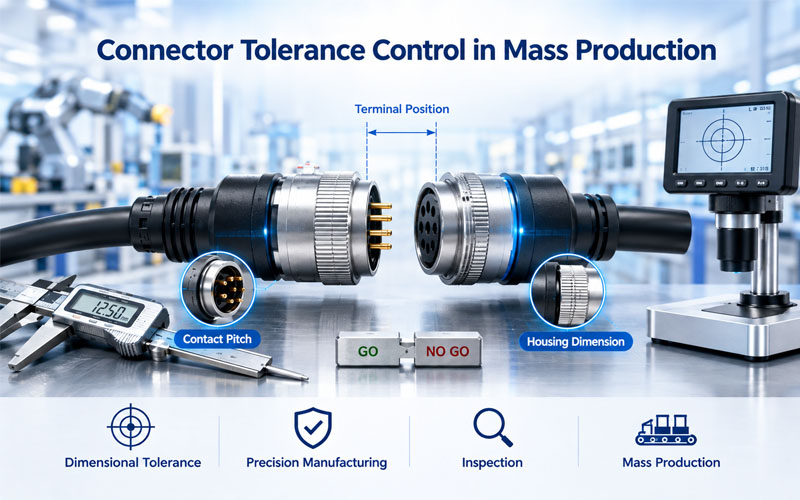
Typical controlled dimensions include:
- Terminal position
- Contact pitch
- Housing dimensions
- Locking features
- Connector alignment
- Seal compression
- Mounting dimensions
- Mating interfaces
For example, a connector may have a nominal terminal position specified on the drawing.
During manufacturing, the actual position will naturally vary within a defined tolerance.
The engineering challenge is ensuring that this variation does not negatively affect:
Mating + Electrical Contact + Mechanical Retention + Sealing
Why Nominal Dimensions Are Not Enough
One common mistake is designing around nominal dimensions without considering actual manufacturing variation.
Suppose two mating connector components each have dimensional tolerances.
Even if both are individually within specification, their combined variation may produce:
- Excessive interference
- Excessive clearance
- Misalignment
- Increased insertion force
This is known as tolerance stack-up.
Mass production makes this issue especially important because thousands or millions of parts may be produced.
A small dimensional issue that occurs only occasionally can become a significant quality problem at production scale.
1.Tolerance Stack-Up Can Affect Mating Performance
Connector mating requires several features to align correctly.
For example:
Housing → Guide Feature → Terminal → Contact Interface
Each feature contributes to the final position.
If multiple tolerances shift in the same direction, the accumulated variation can become significant.
Potential consequences include:
- Difficult mating
- Excessive insertion force
- Connector misalignment
- Terminal deformation
- Housing interference
Engineers should therefore evaluate tolerance stack-up during the design phase.
2.Terminal Position Tolerance Is Critical
Terminal position directly affects electrical and mechanical performance.
If terminals are not positioned consistently:
- Contact alignment may change
- Mating force may vary
- Contact wipe may become inconsistent
- Adjacent terminals may have reduced clearance
This becomes particularly important for:
- High-density connectors
- Fine-pitch connectors
- Multi-pin automotive connectors
- Signal connectors
Precise terminal positioning helps maintain consistent contact behavior across production lots.
3.Housing Tolerance Affects Alignment
The connector housing provides the mechanical framework for the terminal system.
Important dimensions can include:
- Terminal cavities
- Guide rails
- Keying features
- Locking structures
- Mating interfaces
- Mounting holes
If housing dimensions vary excessively, the terminal system may not remain in the intended position.
This can affect:
- Mating accuracy
- Contact alignment
- Connector retention
- Assembly consistency
4.Contact Tolerance Affects Electrical Reliability
Electrical performance depends on stable contact geometry.
Small dimensional changes can influence:
- Contact force
- Contact area
- Contact wipe
- Contact resistance
For example, if a terminal beam is slightly outside its intended geometry, the resulting spring force may differ from the design target.
This can create variation in electrical performance between individual connectors.
Therefore:
Dimensional Control → Contact Geometry → Contact Force → Electrical Reliability
5.Seal Tolerance Affects Waterproofing
For sealed connectors, dimensional tolerance becomes even more important.
Sealing performance depends on controlled compression between:
- Seal
- Housing
- Cable
- Mating connector
Insufficient compression may cause leakage.
Excessive compression may cause:
- High insertion force
- Seal deformation
- Assembly difficulty
- Premature seal wear
Proper tolerance analysis helps ensure that the sealing system remains within its intended operating range.
This is especially important for:
- Automotive connectors
- Outdoor equipment
- Industrial machinery
- Agricultural equipment
- IP67/IP68 applications
6.Locking Features Require Consistent Tolerances
Connector locks need to provide reliable retention while remaining practical for assembly and service.
If the locking geometry is inconsistent:
Too Tight
The operator may experience:
- Difficult locking
- High assembly force
- Component deformation
Too Loose
Potential problems include:
- Insufficient retention
- Connector separation
- Poor vibration resistance
Tolerance control helps maintain the intended balance between retention force and usability.
7.Tolerance Control Improves Assembly Consistency
Mass production requires thousands of assemblies to behave similarly.
If connector dimensions vary too much, operators may encounter:
- Different insertion forces
- Different locking forces
- Different terminal positions
- Different connector fit
This can increase:
- Assembly time
- Rework
- Scrap
- Production complaints
Consistent dimensional control improves manufacturing repeatability.
8.Tolerance Control Supports Interchangeability
OEM customers often expect components manufactured at different times to remain interchangeable.
For example:
- Connector A from Lot 1
- Connector B from Lot 2
should still mate correctly when both comply with the approved design.
This requires consistent control of critical dimensions.
Interchangeability is particularly important for:
- Service replacement
- Global manufacturing
- Multiple production lines
- Multiple suppliers
9.Critical-to-Function Dimensions Need More Attention
Not every connector dimension has the same impact on performance.
A practical approach is to identify:
Critical Dimensions
Dimensions directly affecting:
- Contact performance
- Mating
- Sealing
- Retention
- Safety
Important Dimensions
Dimensions affecting:
- Assembly
- Positioning
- Manufacturing consistency
General Dimensions
Dimensions with relatively low functional impact.
This allows engineering and quality teams to focus measurement resources where they create the greatest value.
10.Statistical Process Control Helps Maintain Tolerance
Mass production requires more than checking finished parts.
Manufacturing processes should be monitored continuously.
Common methods include:
- SPC
- Process capability analysis
- Control charts
- Sampling inspection
- Automated dimensional inspection
Two commonly discussed capability indicators are:
Cp
and
Cpk
These help evaluate whether a manufacturing process can consistently produce parts within specification.
The specific acceptance criteria should be defined according to the product, drawing requirements, customer standards, and quality plan.
11.Measurement Equipment Matters
Tolerance control is only meaningful when measurement systems are appropriate.
Depending on the feature, manufacturers may use:
- Calipers
- Micrometers
- Height gauges
- Coordinate measuring machines
- Optical measurement systems
- Vision inspection
- Go/No-Go gauges
For high-volume connector production, automated optical inspection can help monitor dimensional features efficiently.
Measurement systems should also be properly calibrated and maintained.
12.Mold and Stamping Processes Affect Connector Tolerances
Connector mass production often involves multiple manufacturing processes.
Injection Molding
Housing dimensions can be affected by:
- Material shrinkage
- Mold condition
- Processing temperature
- Injection parameters
- Cooling conditions
Terminal Stamping
Terminal geometry can be influenced by:
- Tool wear
- Material thickness
- Stamping accuracy
- Progressive die condition
Assembly
Final connector dimensions can also be affected by:
- Terminal insertion
- Seal installation
- Locking components
- Assembly fixtures
Tolerance control therefore requires coordination across the entire manufacturing process.
13.Design for Manufacturability Starts With Tolerance Analysis
Tolerance control should begin before mass production.
During DFM review, engineers should ask:
- Which dimensions are function-critical?
- Which tolerances are realistically manufacturable?
- Where can tolerance stack-up occur?
- Which dimensions require automated inspection?
- Can the process maintain the required capability?
- Are overly tight tolerances adding unnecessary cost?
An unnecessarily tight tolerance can increase:
- Tooling cost
- Inspection requirements
- Production cycle time
- Scrap rate
The goal is not to make every dimension extremely precise.
The goal is to apply the right tolerance to the right feature.
14.Tolerance Control and Cost
Tolerance and cost are closely related.
In general, tighter tolerances may require:
- More precise tooling
- More process control
- More inspection
- Higher manufacturing cost
However, loose tolerances can create:
- Higher defect rates
- Assembly problems
- Field failures
- Customer complaints
Therefore, effective tolerance design balances:
Performance + Manufacturability + Cost
This is one of the most important principles of connector DFM.
Connector Tolerance Control Example
Consider a multi-pin connector with:
- Housing
- Terminals
- Seals
- Locking mechanism
The final mating condition depends on multiple dimensions.
A simplified tolerance chain might be:
Housing Position
↓
Terminal Position
↓
Contact Alignment
↓
Contact Force
↓
Electrical Reliability
If any critical dimension is poorly controlled, the final performance can shift.
This illustrates why connector tolerance control must be treated as a system-level engineering issue.
Common Connector Tolerance Control Mistakes
| Mistake | Potential Result |
|---|---|
| Designing only around nominal dimensions | Unexpected production variation |
| Ignoring tolerance stack-up | Mating problems |
| Overly tight tolerances | Higher cost and scrap |
| Loose terminal positioning | Contact instability |
| Poor seal tolerance control | Leakage |
| Insufficient process monitoring | Lot-to-lot variation |
| Inadequate measurement systems | Undetected dimensional problems |
| Ignoring tooling wear | Gradual dimensional drift |
Connector Tolerance Control Checklist
Before releasing a connector for mass production, engineering and quality teams should review:
Design
✔ Are critical dimensions identified?
✔ Has tolerance stack-up been analyzed?
✔ Are tolerances function-based?
Tooling
✔ Can the mold maintain the required dimensions?
✔ Is stamping-tool wear monitored?
Manufacturing
✔ Are critical dimensions measured?
✔ Are process parameters controlled?
✔ Is SPC applied where appropriate?
Assembly
✔ Are terminal positions consistent?
✔ Are seals correctly installed?
✔ Are locking features functioning consistently?
Validation
✔ Is mating force within the intended range?
✔ Is contact resistance stable?
✔ Is sealing performance validated?
✔ Is interchangeability verified?
How FPIC Controls Connector Quality in Mass Production
FPIC applies engineering and manufacturing controls throughout connector production.
Quality management can include:
✔ Dimensional inspection
✔ Terminal position control
✔ Injection molding process control
✔ Stamping process monitoring
✔ Assembly verification
✔ Electrical testing
✔ Visual inspection
✔ Reliability validation
For automotive connector production, FPIC operates under IATF 16949 quality requirements and applies controlled manufacturing processes to support consistent product performance.
For customers requiring demanding cleanliness requirements, mass production can also be managed in accordance with VDA 19.1 / ISO 16232 practices where applicable.
The objective is not simply to produce connectors within drawing dimensions.
It is to maintain consistent performance across production batches.
Final Thoughts
Connector tolerance control is one of the foundations of reliable mass production.
A connector is a system of interacting components, and small dimensional variations can influence:
- Mating
- Contact force
- Contact resistance
- Sealing
- Retention
- Assembly consistency
- Interchangeability
Effective tolerance engineering does not mean making every dimension as tight as possible.
It means identifying the dimensions that matter most and controlling them with the right manufacturing and inspection methods.
The best connector designs balance:
Function + Tolerance + Process Capability + Cost
When these elements are aligned from the beginning, manufacturers can achieve more consistent production and OEM customers can gain greater confidence in connector performance.
FAQ
Why is tolerance control important in connector manufacturing?
Tolerance control ensures that connector components consistently fit, mate, seal, and maintain electrical performance throughout mass production.
What is connector tolerance stack-up?
Tolerance stack-up is the cumulative effect of dimensional variations from multiple components or features that contribute to a final functional dimension.
Does tighter tolerance always mean better connector quality?
No. Excessively tight tolerances can increase manufacturing cost and scrap without providing additional functional benefits. Tolerances should be based on actual performance requirements.
Which connector dimensions are most critical?
Terminal position, contact geometry, mating features, locking structures, sealing interfaces, and other dimensions directly affecting electrical, mechanical, or sealing performance are typically critical.
How is connector dimensional tolerance controlled during mass production?
Manufacturers can use calibrated measurement equipment, automated inspection, SPC, process capability analysis, tooling control, and defined quality control plans.
Looking for Consistent Connector Quality in Mass Production?
FPIC supports OEM customers with connector design, tooling, precision manufacturing, assembly, testing, and quality control.
From DFM and tolerance analysis to mass production and inspection, our engineering team focuses on consistent connector performance and manufacturing reliability.
Contact FPIC to discuss your custom connector project.
Resources
- IATF 16949 – Automotive Quality Management Systems
https://www.iatfglobaloversight.org/
Quality management framework widely used across the automotive supply chain. - ISO 9001 – Quality Management Systems
https://www.iso.org/iso-9001-quality-management.html
International framework for quality management and process control. - ISO 16232 / VDA 19.1 – Technical Cleanliness
https://www.iso.org/
Standards and practices for technical cleanliness in automotive components. - AIAG Core Tools
https://www.aiag.org/
Industry resources covering APQP, PPAP, FMEA, MSA, SPC, and related quality methodologies.