
Low-Voltage Automotive Connectors Design for Lighting, Seats and Body Electronics
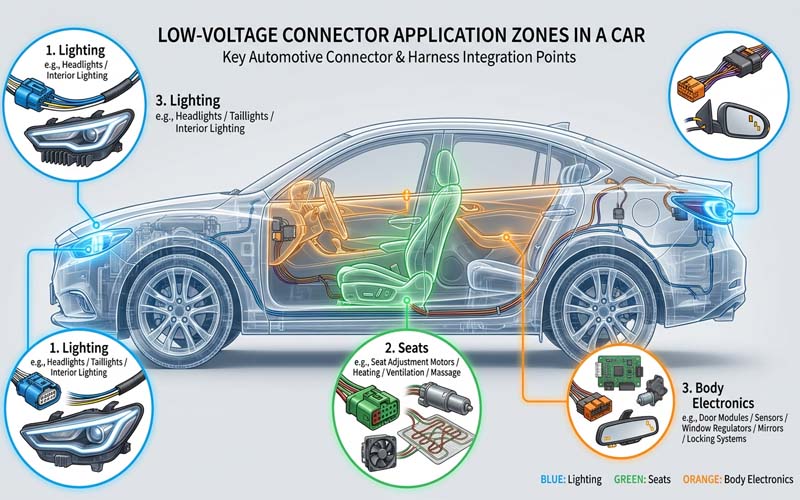
Low-voltage automotive connectors are widely used across vehicle systems such as lighting, seating, and body electronics. Although these applications typically operate below 60V, their reliability requirements are just as critical as high-voltage systems.
Failures in low-voltage connectors can lead to malfunctioning lights, seat control issues, or body system errors—impacting both user experience and vehicle quality perception.
This article explores how to design low-voltage automotive connectors for real-world applications, focusing on performance, reliability, and cost efficiency.
Why Low-Voltage Connector Design Still Matters
Compared to high-voltage systems, low-voltage connectors may seem less demanding. However, they face their own unique challenges:
- high connector count across the vehicle
- frequent mating and service requirements
- cost sensitivity in high-volume production
- exposure to vibration, moisture, and temperature
In many cases, low-voltage connectors are used in large quantities, meaning even small design issues can scale into significant reliability or warranty problems.
Typical Application Areas
Lighting Systems
- headlights and taillights
- interior lighting
- signal and indicator systems
Key Requirements:
- stable electrical contact
- resistance to moisture and condensation
- compact design
Seat Systems
- seat adjustment motors
- heating and ventilation
- occupancy sensors
Key Requirements:
- flexibility under movement
- resistance to repeated mechanical stress
- secure locking under vibration
Body Electronics
door modules
window control systems
dashboard and control units
Key Requirements:
signal integrity
space efficiency
ease of assembly
Key Design Considerations
Contact Stability
Even in low-voltage systems, stable contact resistance is essential.
Design should ensure:
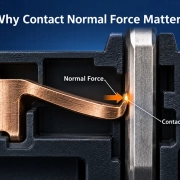
- sufficient and consistent contact force
- resistance to fretting corrosion
- long-term electrical stability
Connector Size and Packaging
Space is often limited in lighting modules and seat structures.
Design priorities include:
- compact housing design
- optimized pin layout
- ease of routing within tight spaces
Vibration Resistance
Low-voltage connectors are frequently installed in areas with movement or vibration.
Design strategies:
- robust locking mechanisms
- anti-vibration contact design
- proper harness fixation
Environmental Protection
Depending on installation location, connectors may be exposed to:
- moisture or condensation
- dust and contaminants
- temperature fluctuations
Sealing level should be selected based on installation zone rather than over-specifying protection.
Ease of Assembly
High-volume production requires connectors that are easy to assemble.
Important factors:
- low insertion force
- clear locking feedback
- error-proofing (CPA/TPA if needed)
Common Design Challenges
Cost vs Reliability Trade-Off
Low-voltage connectors are highly cost-sensitive. Overdesign can increase cost, while underdesign can lead to failures.
High Mating Cycle Requirements
Applications such as seats and serviceable components may require connectors to withstand multiple mating cycles.
Mixed Signal and Power Transmission
Some connectors must handle both power and signal circuits, requiring careful design to avoid interference or instability.
Real-World Failure Risks
Even low-voltage connectors can fail due to:
- fretting corrosion in vibration environments
- water ingress in poorly protected areas
- contact resistance drift over time
- improper assembly or misalignment
These issues are often related to system-level design rather than connector specification alone.
Optimization Strategies
Right-Sizing the Connector
Avoid over-specification. Match connector capability to actual application requirements.
Material and Plating Selection
Choose materials that balance cost and performance:
- tin plating for cost efficiency
- gold plating for signal stability (where needed)
Harness Integration
Connector performance depends on the entire harness system:
- routing design
- strain relief
- fixation points
Validation Under Real Conditions
Testing should reflect real use cases:
- vibration with movement
- temperature cycling
- repeated mating cycles
How FPIC Supports Low-Voltage Applications
FPIC supports automotive and industrial customers with:
- connector and wire harness integration
- cost-optimized design solutions
- assembly process optimization
- validation aligned with real-world conditions
By focusing on both design and manufacturing, low-voltage systems can achieve reliable performance at scale.
Final Thoughts
Low-voltage connectors may not carry high power, but they are critical to overall vehicle functionality and user experience.
A successful design balances:
- reliability
- cost efficiency
- manufacturability
- real-world performance
Understanding application-specific requirements is key to making the right design decisions.
FAQ
What voltage is considered low voltage in automotive systems?
Typically below 60V DC, including most body electronics and auxiliary systems.
Are low-voltage connectors less critical than high-voltage ones?
No. Failures can still affect safety, comfort, and system functionality.
What is the biggest risk in low-voltage connector design?
Misalignment between connector design and real installation conditions.
When should sealed connectors be used in low-voltage systems?
When exposure to moisture or contaminants is expected.
How can reliability be improved?
Through proper design, material selection, and validation under real conditions.
Optimize Your Low-Voltage Connector Design
If you are developing lighting, seat, or body electronics systems, the right connector design can improve reliability while controlling cost.
FPIC provides customized connector and wire harness solutions tailored to your application needs.
Contact us to discuss your project requirements.
Resources
- USCAR-2 – Automotive Connector Performance Specification: defines durability and performance requirements for automotive connectors.
- TE Connectivity – Automotive Low Voltage Connectors: provides design insights for LV connector applications.
- Molex – Automotive Connector Systems: covers connector solutions for body electronics and interior systems.
- Amphenol – Automotive Interconnect Solutions: discusses connector design considerations across vehicle applications.
- IEC 60512 – Connector Test Methods: standard for testing electrical connector performance.
 FPIC
FPIC