Terminal Retention Force in Automotive Connectors: Why It Should Not Be Overlooked
In automotive connectors systems, engineers often focus on contact resistance, sealing performance, and current capacity. However, one mechanical parameter is frequently underestimated despite its major impact on reliability: terminal retention force.
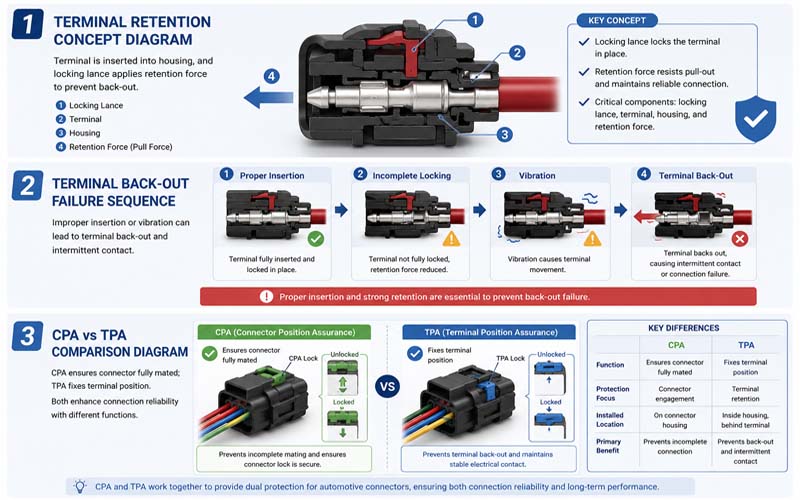
Terminal retention force refers to the force required to pull a terminal out of the connector housing once it has been properly inserted and locked.
Although it may seem like a simple mechanical specification, insufficient retention force can lead to intermittent electrical failure, terminal back-out, assembly issues, and long-term reliability problems—especially in vibration-intensive automotive environments.
This article explains why terminal retention force matters, how failures occur, and what engineers should consider during connector specification and validation.
What Is Terminal Retention Force?
Automotive connectors consist of:
- housing
- terminals
- locking structures
- sealing components (if applicable)
Once a terminal is inserted into the housing, a locking feature secures it in position.
Terminal retention force measures how securely the terminal remains locked under mechanical stress.
The value is typically defined as the axial pull force required to disengage or remove the terminal from the connector housing.
Why Terminal Retention Force Is Critical
Preventing Terminal Back-Out
One of the most common connector assembly failures is terminal back-out.
This occurs when the terminal partially or completely moves out of position due to:
- vibration
- harness tension
- improper assembly
- thermal expansion and contraction
Even slight terminal movement can reduce contact engagement and create intermittent electrical connections.
Maintaining Stable Contact Position
Connector reliability depends on consistent terminal positioning.
If retention force is insufficient:
- contact force may decrease
- electrical resistance may fluctuate
- signal integrity may become unstable
In high-vibration automotive environments, stable positioning is essential for long-term performance.
Supporting Automated Assembly
Modern automotive manufacturing relies heavily on automated harness assembly.
Insufficient terminal retention may cause:
- terminal displacement during handling
- insertion errors
- increased rework rates
Proper retention design improves assembly robustness and manufacturing consistency.
Where Retention Force Becomes Most Critical
High-Vibration Zones
Applications exposed to continuous vibration require higher retention stability.
Examples include:
- engine compartment
- chassis-mounted systems
- underbody harnesses
- seat systems with movement
Heavy Wire Applications
Larger cables create additional mechanical load on terminals.
Examples:
- power distribution systems
- battery connections
- motor control circuits
Wire weight and harness movement can continuously stress the retention system.
Serviceable Connectors
Connectors that experience repeated mating/unmating cycles may experience gradual wear in locking features.
Retention performance must remain stable over the connector lifecycle.
Common Causes of Retention Failure
Improper Terminal Insertion
Incomplete insertion during assembly may prevent the locking lance from fully engaging.
This is one of the most common manufacturing-related issues.
Weak Locking Structure Design
Poorly designed locking features may:
- deform under stress
- lose elasticity over time
- fail under vibration conditions
Material Creep and Thermal Aging
Plastic housing materials can experience:
- creep
- stress relaxation
- thermal degradation
Over time, this may reduce locking effectiveness.
Excessive Harness Stress
Poor harness routing or insufficient strain relief can apply continuous pulling force on terminals.
This accelerates long-term retention degradation.
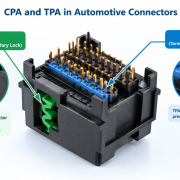
CPA and TPA: Secondary Retention Systems
To improve retention reliability, automotive connectors often include secondary locking systems.
CPA (Connector Position Assurance)
CPA ensures the connector halves are fully mated before locking.
Benefits include:
- reduced incomplete mating risk
- improved assembly verification
TPA (Terminal Position Assurance)
TPA secures terminals inside the housing and helps prevent terminal back-out.
Benefits include:
- additional retention security
- improved vibration resistance
- enhanced assembly reliability
In many automotive applications, TPA is essential rather than optional.
Retention Force Testing
Retention performance is typically validated through pull-force testing.
Common Test Conditions
Testing may include:
- axial terminal pull tests
- post-vibration retention tests
- thermal aging followed by pull tests
- repeated mating cycle evaluation
Standards and Specifications
Retention requirements are commonly defined in:
- USCAR-2
- LV214
- OEM-specific specifications
Required values vary depending on terminal size, wire gauge, and application environment.
Design Strategies to Improve Retention Reliability
Optimize Locking Geometry
The locking lance design should maintain:
- sufficient engagement depth
- elastic recovery capability
- resistance to vibration-induced movement
Use Appropriate Housing Materials
Housing materials must resist:
- thermal aging
- creep deformation
- mechanical fatigue
Reduce Harness Stress
Good harness design helps minimize retention load:
- proper fixation points
- strain relief design
- controlled wire routing
Validate Under Real Conditions
Retention performance should be tested under combined stress:
- vibration + temperature
- harness movement simulation
- real installation orientation
Why Retention Issues Are Often Misdiagnosed
Many intermittent electrical failures are incorrectly attributed to:
- poor terminals
- contact resistance
- software or signal issues
In reality, slight terminal movement caused by insufficient retention force may be the root cause.
Because the connector may appear visually intact, retention-related failures are often difficult to diagnose without detailed analysis.
How FPIC Supports Connector Reliability
FPIC supports customers with:
- connector and harness integration optimization
- terminal retention evaluation
- assembly process consistency control
- vibration-resistant connector solutions
- validation support for harsh automotive environments
By combining mechanical reliability with electrical performance, long-term connector stability can be significantly improved.
Final Thoughts
Terminal retention force may seem like a secondary mechanical detail, but it plays a critical role in automotive connector reliability.
Without sufficient retention:
- terminals can move
- contact stability can degrade
- intermittent failures can occur over time
As vehicles become more electrified and vibration-sensitive, retention reliability becomes increasingly important.
A robust connector design must ensure not only electrical performance—but also long-term mechanical stability under real-world conditions.
FAQ
What is terminal retention force?
It is the force required to pull a terminal out of the connector housing after proper insertion.
Why is terminal retention important?
Because insufficient retention can lead to terminal back-out and intermittent electrical failures.
What causes terminal back-out?
Common causes include vibration, improper insertion, weak locking design, and harness stress.
What is the difference between CPA and TPA?
CPA ensures connector mating position, while TPA secures terminal position inside the housing.
How is retention force tested?
Typically through pull-force testing before and after environmental stress testing.
Improve Connector Mechanical Reliability
Terminal stability is just as important as electrical performance in automotive systems.
FPIC provides connector and wire harness solutions designed for vibration resistance, secure terminal retention, and long-term reliability.
Contact us to discuss your application requirements.
Resources
- USCAR-2 – Automotive Connector Performance Specification: defines terminal retention and mechanical durability requirements.
- LV214 – Automotive Connector Standard: includes retention force validation requirements for automotive connectors.
- TE Connectivity – Terminal Retention and Connector Reliability: explains terminal locking mechanisms and vibration resistance.
- Molex – Connector Terminal Position Assurance: discusses TPA systems and assembly reliability.
- IEC 60512 – Connector Mechanical Testing: provides standardized mechanical test methods for electrical connectors.

 FPIC
FPIC