
Amphenol, TE and Molex: 2026 H1 Connector Trends
2026 H1 Connector Trends
The first half of 2026 did not produce one uniform connector-market story. It produced several.
Amphenol reported exceptional growth as AI-related IT and data communications demand combined with a major acquisition program. TE Connectivity delivered a more balanced performance across transportation and industrial markets, with particularly strong momentum in data infrastructure and energy. Molex, which is privately held, did not publish comparable half-year financial results, but its product launches and acquisitions reveal a clear emphasis on near-chip connectivity, optical switching, power delivery, liquid cooling, and high-reliability systems.
Taken together, the three companies point to the same broad conclusion: the next stage of interconnect growth is being driven by the simultaneous movement of more data and more power through smaller, hotter, and more demanding systems. Connector development is therefore becoming more closely linked to thermal design, signal integrity, insulation coordination, modular architecture, manufacturing automation, and long-term supply resilience.
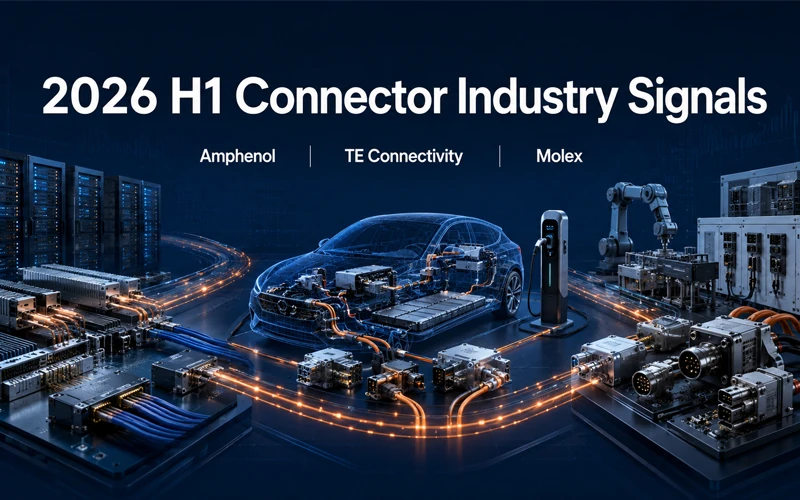
2026 H1 connector trends
How This 2026 H1 Comparison Was Prepared
The reporting periods are not identical, so the figures should be read with care.
- Amphenol’s figures cover the six months ended June 30, 2026.
- TE Connectivity uses a fiscal year that does not match the calendar year. For a calendar-aligned view, this article adds TE’s fiscal second quarter ended March 27 and fiscal third quarter ended June 26. The result is an analytical calculation, not a separately published TE half-year figure.
- Molex has been a privately held subsidiary of Koch since 2013 and does not publish a standalone half-year income statement. Molex is therefore compared through disclosed products, acquisitions, market direction, and manufacturing scale rather than unavailable revenue or margin data.
The source cut-off date for this analysis is September 1, 2026.
2026 H1 Results at a Glance
| Company | Period Used | Net Sales | Reported Growth | Organic Growth | Orders and Margin Signal | Main Growth Message |
|---|---|---|---|---|---|---|
| Amphenol | Six months ended June 30 | US$16.38 billion | 56.6% | 32% | About US$20.1 billion of orders; quarterly book-to-bill of 1.24 and 1.23 | Exceptional IT datacom demand plus acquisition-led portfolio expansion |
| TE Connectivity | Fiscal Q2 + fiscal Q3, approximately calendar H1 | US$9.90 billion | 14.1% calculated | 7% in fiscal Q2; 12% in fiscal Q3 | About US$11.0 billion of orders; calculated combined adjusted operating margin of 21.8% | Broad industrial growth, AI infrastructure, grid modernization and next-generation transportation |
| Molex | No comparable public period | Not disclosed | Not disclosed | Not disclosed | Standalone sales, orders and margin are not publicly reported | Product-led expansion in AI data centers, thermal management, aerospace and defense, and modular connectivity |
Comparison note: Amphenol’s second-quarter adjusted operating margin included a US$80 million net benefit from tariff recoveries. TE’s US$9.90 billion sales figure and 21.8% adjusted margin are calculated by combining two reported fiscal quarters. Neither derived figure should be presented as a company-issued calendar-half result.
Amphenol: Scale, Datacom Growth and Acquisitions
Amphenol produced the strongest disclosed growth of the group. Sales reached US$16.38 billion in the first six months of 2026, compared with US$10.46 billion in the same period of 2025. Reported growth was approximately 57%, while organic growth was 32%. Acquisitions contributed 24 percentage points, showing that the result came from both market demand and a deliberate expansion strategy.[1][2]
Communications Solutions generated US$9.92 billion, or about 61% of first-half sales. The segment grew 86% on a reported basis and 44% organically. Harsh Environment Solutions reached US$3.55 billion, with 22% organic growth, while Interconnect and Sensor Systems reached US$2.91 billion, with 15% organic growth.[1]
These figures show that AI-related IT datacom was the largest accelerator, but it was not the only contributor. Aerospace, defense, industrial, automotive, communications infrastructure, sensors, and rugged interconnects continued to provide diversification.
Product and Strategic Highlights
Amphenol’s acquisition of CommScope’s Connectivity and Cable Solutions business materially expanded its communications and fiber infrastructure position. During the second quarter, the company also acquired El.Com, a manufacturer of complex interconnect solutions and high-voltage cable assemblies for industrial, defense, and commercial aerospace markets. Wilder Technologies added test and measurement capabilities for high-speed digital, RF, and signal-integrity applications.[1][2]
The product message is clear: Amphenol is building a wider system-level portfolio around high-speed communications, rugged interconnects, high-voltage assemblies, sensors, and test capability rather than relying on individual connector families alone.
Strengths and Factors to Watch
Amphenol’s main strengths are its scale, diversified end markets, decentralized operating model, acquisition execution, and ability to combine organic product development with rapid portfolio expansion. Strong orders and a book-to-bill ratio above 1.2 in both quarters also indicate that demand was running ahead of recognized sales.
The trade-off is that acquisition activity now has a material effect on reported growth. Approximately 24 percentage points of first-half growth came from acquisitions, and Communications Solutions represented about 61% of sales. This is not evidence of a weakness, but it means investors and customers should watch integration execution, datacom capital-spending cycles, and the durability of exceptional AI-related demand. The second-quarter margin should also be interpreted in light of the tariff-recovery benefit.
TE Connectivity: A Balanced Industrial and Transportation Mix
TE Connectivity’s closest calendar-first-half view produced approximately US$9.90 billion in sales by adding fiscal Q2 and Q3. This was about 14.1% higher than the comparable two quarters a year earlier. Fiscal Q2 sales increased 15% on a reported basis and 7% organically, while fiscal Q3 increased 14% reported and 12% organically.[3][4]
The portfolio was almost evenly divided. Transportation Solutions contributed approximately US$5.00 billion, or 50.5% of the two-quarter total, while Industrial Solutions generated about US$4.90 billion, or 49.5%. This balance is strategically important because it reduces dependence on a single market cycle.
TE reported US$5.3 billion of orders in fiscal Q2 and US$5.7 billion in fiscal Q3. Its calculated combined adjusted operating margin was about 21.8%. In fiscal Q3, Industrial Solutions grew by more than 20%, while Transportation Solutions delivered 5% organic growth.[3][4]
Product and Strategic Highlights
TE identified three major demand drivers during the period: AI, next-generation transportation, and electric-grid modernization. Its Industrial Solutions portfolio connects data centers, energy infrastructure, automation equipment, aerospace and defense systems, and medical applications. Transportation Solutions covers automotive, commercial transportation, and sensor technologies.
This combination allows TE to participate in both the data and power sides of electrification. AI infrastructure requires higher-speed data transmission, but it also creates new requirements for power distribution, thermal performance, and energy availability. Grid modernization and vehicle electrification add further demand for high-voltage, high-current, sealed, miniaturized, and sensor-enabled interconnects.
Strengths and Factors to Watch
TE’s strength lies in its nearly equal exposure to transportation and industrial markets, deep engineering resources, global customer coverage, and ability to supply connectors, sensors, and power solutions across complex platforms. Strong order growth in both segments suggests that the momentum was broader than one product group.
The main factor to watch is the different growth pace inside the portfolio. Industrial Solutions was the faster engine in fiscal Q3, while transportation growth was more moderate. This reflects the reality that automotive production, model launches, and qualification cycles do not move at the same speed as AI infrastructure investment. TE’s reporting calendar also means that any calendar-half comparison must remain clearly labeled as an analytical approximation.
Molex: Product-Led Expansion Without Public Financial Data
Molex cannot be compared with Amphenol and TE on revenue growth or profitability because it does not release a standalone half-year report. The absence of public financial data is a comparison limitation, not evidence of weak performance.
Its first-half announcements nevertheless show where capital and engineering attention are going.
In February, Molex launched Impress Co-Packaged Copper solutions for near-ASIC connectivity in AI data centers. In March, it demonstrated its XPO interconnect architecture supporting 224Gbps PAM-4 per differential pair and highlighted optical switching, bandwidth density, power delivery, and thermal management. In June, it introduced a multi-channel liquid-cooled busbar concept for high-density racks and AI workloads.[6][7][8]
Molex also expanded beyond data centers. The acquisition of Smiths Interconnect, completed in April, strengthened high-reliability capabilities in aerospace and defense, medical, semiconductor test, and industrial markets. Molex said the transaction expanded its footprint to more than 90 plants in 22 countries and its workforce to more than 55,000 people.[5]
Its AirBorn SInergy platform further illustrates the move toward integrated systems. The modular connector can combine high-power, high-speed data, and RF contacts within one configurable platform for space-constrained and harsh-environment applications.[9]
Strengths and Factors to Watch
Molex’s strengths include a very broad connector and cable portfolio, long-term ownership under Koch, strong positions in data centers and automotive electronics, and growing aerospace and defense capabilities. Its recent products show an ability to connect electrical, optical, RF, power, and thermal technologies at the system level.
The principal limitation for external comparison is financial transparency. Customers and market analysts can observe products, factories, acquisitions, and technology direction, but they cannot independently compare Molex’s half-year sales growth or margins with public peers. The company must also integrate several acquired technology organizations while continuing to qualify highly specialized products for demanding markets.
What the Three Companies Reveal About Connector Growth
1. AI Infrastructure Is Both a Data and Power Market
AI data centers are frequently discussed as a high-speed signal opportunity, but the first-half evidence shows a wider engineering problem. Higher compute density increases data rates, power demand, heat generation, and the consequences of interconnect loss. Growth is therefore spreading across copper and optical links, busbars, high-current power interfaces, test systems, cooling infrastructure, and monitoring components.
2. Power Density Is Becoming a Primary Design Constraint
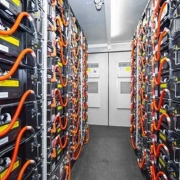
Power connectors can no longer be evaluated only by a headline current rating. Contact resistance, temperature rise, conductor size, terminal geometry, airflow or liquid cooling, derating, and installation conditions determine real performance. This is relevant not only to data centers, but also to battery energy storage systems, charging infrastructure, industrial power equipment, and transportation.
3. Grid Modernization and Energy Storage Support High-Voltage Demand
TE’s emphasis on electric-grid modernization and Amphenol’s expansion into high-voltage cable assemblies support a broader market direction: power-generation, conversion, storage, and distribution equipment requires increasingly specialized interconnects. For energy storage, higher system voltage may reduce current at the same power level, but it also creates stricter insulation, creepage, clearance, material, and validation requirements.
4. Modular Platforms Are Replacing Multiple Discrete Interfaces
TE and Molex are both developing around integrated architectures, while Amphenol continues to broaden its interconnect systems through organic development and acquisitions. Combining power, signal, data, or RF functions can reduce part count and installation space. It also makes interface design, manufacturability, repair strategy, and supplier qualification more important at the beginning of a project.
5. Reliability and Supply Resilience Remain Growth Enablers
High-speed and high-power specifications attract attention, but customers still need stable manufacturing, repeatable contacts, sealing, vibration resistance, traceability, and product availability. The acquisition activity of all three groups shows that market leadership increasingly depends on offering a connected set of engineering, manufacturing, testing, and supply capabilities.
What These Trends Mean for Connector Buyers
For OEM engineering and procurement teams, the practical lesson is not to select a supplier by company size or catalog breadth alone. The supplier must fit the project.
Before approving a connector or cable assembly, buyers should confirm:
- Operating voltage, continuous current, transient load, and derating conditions
- Contact resistance and allowable temperature rise
- Cable size, conductor material, terminal geometry, and crimping process
- Creepage, clearance, insulation material, and pollution environment
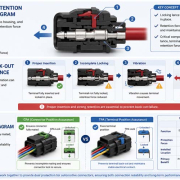
- Mating cycles, locking method, vibration, shock, and retention requirements
- Sealing level, humidity, corrosion, thermal cycling, and chemical exposure
- Signal-integrity or EMC requirements where data transmission is involved
- Applicable product, automotive, industrial, or customer-specific standards
- Prototype, validation, PPAP, test-report, and traceability expectations
- Tooling ownership, production capacity, change control, and supply continuity
The largest supplier may be the right choice for a standardized global platform. A focused custom manufacturer may be more suitable when the project requires close engineering communication, structural modification, integrated tooling, connector-and-cable coordination, or flexible production transfer.
Where FPIC Fits in the 2026 Market
FPIC operates in a more focused segment than Amphenol, TE, or Molex. Rather than competing across their full global portfolios, the company supports defined connector and cable-assembly projects where customization, manufacturability, and production coordination are important.
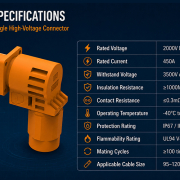
Its relevant areas include BESS interfaces up to 2000V and 450A within verified product scopes, automotive and PCB connectivity, circular and push-pull interfaces, and precision metal and plastic components. FPIC integrates product development, tooling, stamping, molding, assembly, cable processing, and testing. This positioning reflects a broader market pattern: specialized manufacturers can complement global connector groups by addressing specific OEM requirements, subject to application review and validation.
A More Specialized Connector Market Is Emerging
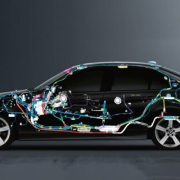
The first half of 2026 shows a healthy connector market, but growth is concentrating in demanding applications. AI infrastructure is accelerating high-speed data, power delivery, and thermal innovation. Grid modernization and energy storage are raising high-voltage and high-current requirements. Transportation platforms are becoming more connected, electrified, modular, and space-constrained. Aerospace, defense, and industrial equipment continue to demand ruggedized performance and long qualification cycles.
Amphenol leads the disclosed comparison in scale and growth. TE demonstrates the value of a balanced industrial and transportation portfolio. Molex shows how a privately held company can pursue long-horizon product and acquisition strategies even without public quarterly reporting.
For FPIC, the opportunity is selective rather than universal: develop reliable custom interconnects for the applications where its engineering, tooling, manufacturing, and testing capabilities are directly relevant. That positioning is more credible—and more useful to OEM customers—than attempting to imitate the full catalog of a global connector conglomerate.
Discuss Your Custom Connector Project with FPIC
FPIC supports technical evaluation for custom connectors, energy storage interfaces, automotive PCB headers, circular connectors, cable assemblies, terminals, and precision components.
To receive a more accurate evaluation, please provide available drawings or samples, voltage and current requirements, cable specifications, pin assignment, installation space, operating environment, applicable standards, target quantity, and validation expectations.
Email: info@fpiconn.com
Website: https://fpiconn.com/
Frequently Asked Questions
1. Which connector company reported the fastest growth in the first half of 2026?
Amphenol reported the fastest disclosed growth, with first-half sales increasing approximately 57% year over year and organic growth of 32%. Acquisitions contributed 24 percentage points to reported growth.
2. Why is Molex revenue not included in the financial table?
Molex is privately held by Koch and does not publish a standalone half-year income statement. Its position is therefore evaluated through official product, acquisition, and operational announcements rather than unavailable financial figures.
3. What were the main connector growth areas in 2026 H1?
The strongest themes were AI data infrastructure, high-speed copper and optical links, power delivery, thermal management, grid modernization, next-generation transportation, and rugged high-reliability systems.
4. How does AI data-center growth affect connector design?
AI systems require higher bandwidth and greater power density in limited space. This increases requirements for signal integrity, current capacity, heat dissipation, contact stability, cable routing, and system-level validation.
5. Are high-voltage connectors becoming more important outside electric vehicles?
Yes. Battery storage, power-conversion equipment, grid infrastructure, industrial power systems, and high-density computing all create demand for specialized high-voltage or high-current interconnects, subject to application-specific verification.
6. How can FPIC support a custom connector project?
FPIC can support requirement review, product design, tooling, stamping, injection molding, assembly, cable processing, testing, quality control, and scalable production. Customers should provide drawings, specifications, application conditions, target volume, and compliance needs for evaluation.
Resources
- Amphenol, “Amphenol Reports Record Second Quarter 2026 Results,” July 29, 2026.
- Amphenol, “Amphenol Reports Record First Quarter 2026 Results,” April 29, 2026.
- TE Connectivity, “TE Connectivity Delivers Results Above Guidance with 15% Sales Growth,” April 22, 2026.
- TE Connectivity, “TE Connectivity Delivers Results Above Guidance with 14% Sales Growth,” July 22, 2026.
- Molex, “Molex Completes Acquisition of Smiths Interconnect,” April 1, 2026.
- Molex, “Molex Launches Impress Co-Packaged Copper Solutions,” February 17, 2026.
- Molex, “Molex Showcases Next-Generation Pluggable Architectures at OFC 2026,” March 17, 2026.
- Molex, “Molex Unveils Multi-Channel Liquid Cooled Busbar Capability,” June 2, 2026.
- Molex, “Molex Expands AirBorn SInergy Modular High-Speed Hybrid Connectors,” June 15, 2026.
- Koch, “v,” accessed September 1, 2026.
 FPIC
FPIC