Tag Archive for: Energy Storage Connectors

High-Voltage Connectors for BESS Cabinets

Battery energy storage is moving fast, and the connector conversation is changing with it. In BESS cabinets, buyers are no longer looking only at whether a connector can carry power. They are also paying closer attention to electrical safety, temperature rise, installation speed, serviceability, and system-level risk control.

As BESS projects become larger and more power-dense, connector selection is becoming part of core system design rather than a late-stage component decision.

Why High-Voltage Connector Selection Is Changing in BESS

For many years, connector selection in energy storage projects often focused on a small set of basic questions: voltage class, current rating, and physical fit. That is no longer enough.

Today, BESS cabinet developers need to think about how each connection point behaves in real operating conditions. A connector sits inside a power path that may involve battery modules, busbars, rack interfaces, cabinet-level routing, and maintenance access. In that context, the connector affects much more than electrical continuity.

A high-voltage connector can influence:

  • connection stability under continuous load
  • temperature rise in compact cabinet layouts
  • installation consistency on the production floor
  • protection against polarity or mating mistakes
  • service efficiency during maintenance or replacement
  • long-term reliability in demanding operating environments

That is why the market is shifting from simple part supply toward more integrated thinking around safety, operability, and lifecycle risk.

Safety Comes First in BESS Cabinet Connection Design

In BESS cabinets, a power connection is not just a mechanical joint. It is part of a high-energy system where safety must be designed in from the start.

This is why high-voltage connectors are increasingly evaluated for features such as:

1. Touch-Proof Protection

In cabinet-level power systems, exposed conductive points create avoidable handling risk. A touch-proof connector structure helps reduce exposure during assembly, maintenance, and replacement.

2. Polarity Control and Mechanical Keying

As systems become more modular, polarity clarity and anti-misplug design become more important. Mechanical keying can help prevent mating errors and improve installation discipline in large-volume production and field service.ZED

3. Secure Mating and Locking

A connector should not only mate electrically. It should also provide a reliable mechanical connection that helps maintain stable contact under vibration, cable movement, and long-term use.

4. System-Level Compliance Readiness

For customers developing certified battery equipment, component selection increasingly needs to align with safety and compliance expectations early in the design process.

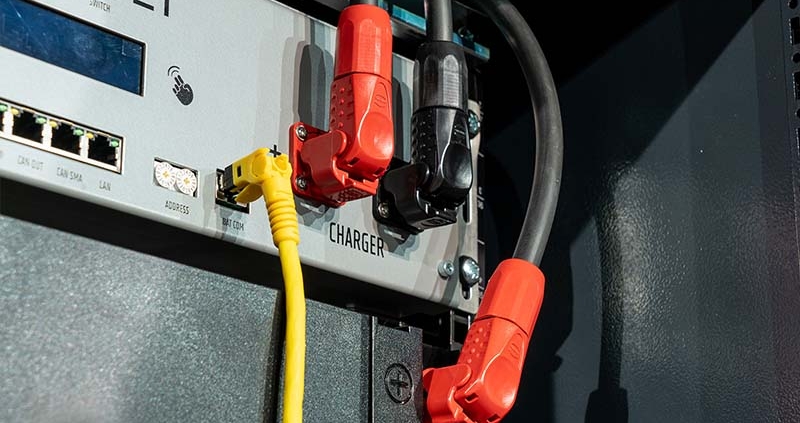
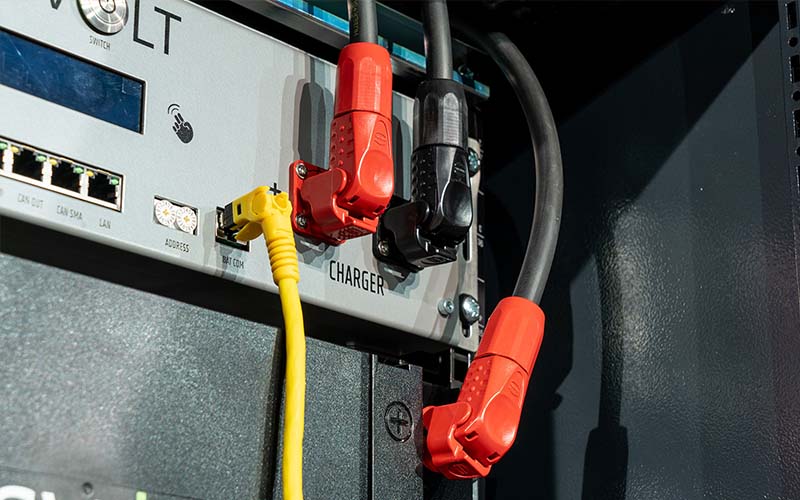
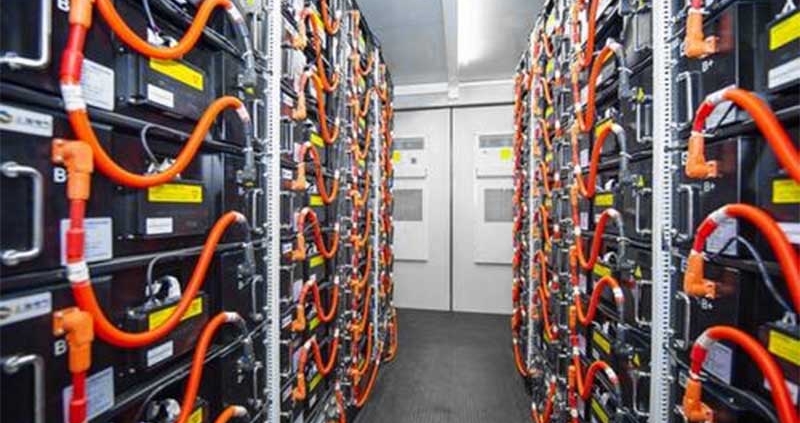
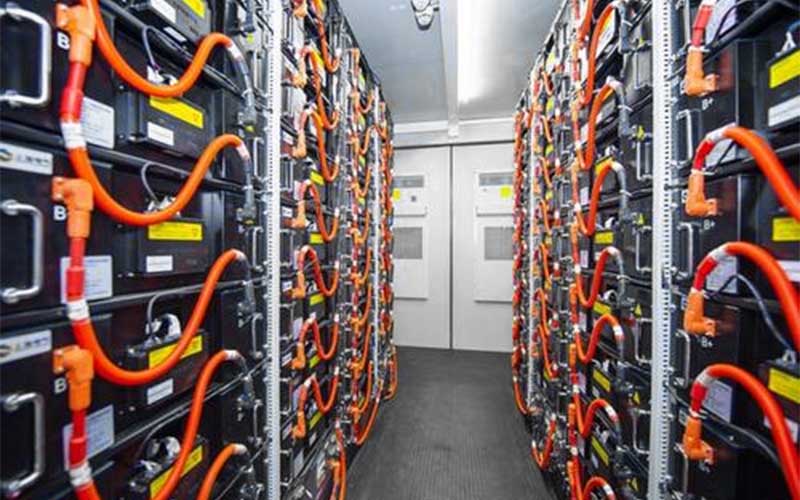
High-current connector used in BESS cabinet energy storage system

Current Rating Is Important, but It Is Not the Whole Story

Current rating is still a critical starting point, but it should never be treated as the only selection criterion.

In BESS cabinet design, the real question is not simply “What current is printed in the catalog?” It is “Can this connector carry the required current stably, safely, and repeatedly in the actual cabinet environment?”

That means engineers and sourcing teams should look at current rating together with:

  • contact resistance stability
  • conductor matching
  • termination quality
  • temperature rise performance
  • insulation coordination
  • practical routing constraints
  • installation and maintenance conditions

A connector that looks sufficient on paper may still create heat, service complexity, or reliability risk if the rest of the interface design is not well matched.

Installation Efficiency Is Becoming a Competitive Advantage

As BESS cabinet production scales, installation logic matters more.

A connector that supports clearer mating, easier routing, faster assembly, and reduced torque-based work can improve both productivity and consistency. In high-volume cabinet production, even small improvements in connection time can create meaningful gains in labor efficiency and quality control.

Installation-friendly connector design can also help reduce:

  • assembly errors
  • cable strain
  • rework time
  • maintenance complexity later in the project lifecycle

This is one reason why the market is paying closer attention to connector structure, not just electrical data.

What Engineers Should Evaluate in a BESS High-Voltage Connector

When selecting a high-voltage connector for BESS cabinets, a more complete evaluation usually includes the following questions:

1. Is the voltage platform right for the target system?

The connector should match the actual architecture, whether the project is centered on 1000V, 1500V, or higher-voltage development.

2. Is the current rating suitable for continuous system conditions?

The connector should fit the expected current path without creating unnecessary thermal pressure or overdesign cost.

3. Does the structure improve safety?

Touch-proof features, polarity control, and reliable locking all contribute to safer installation and operation.

4. Does the connector fit cabinet integration needs?

Panel mounting, cable exit direction, keying, and space use all affect cabinet design quality.

5. Will service and replacement be practical later?

A connector should not make maintenance harder than it needs to be.

Where FPIC’s 2000V 450A Connector Fits

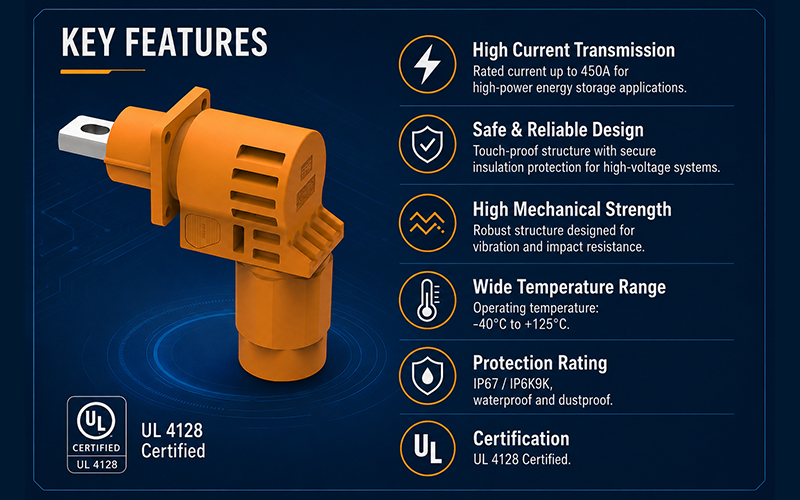
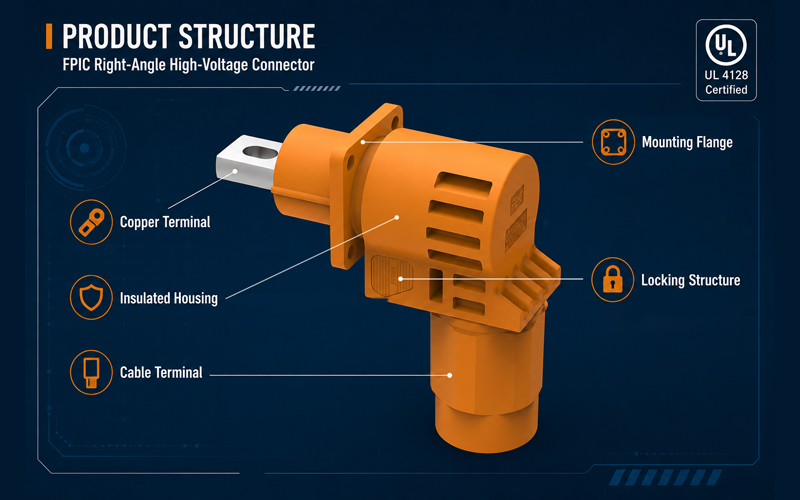
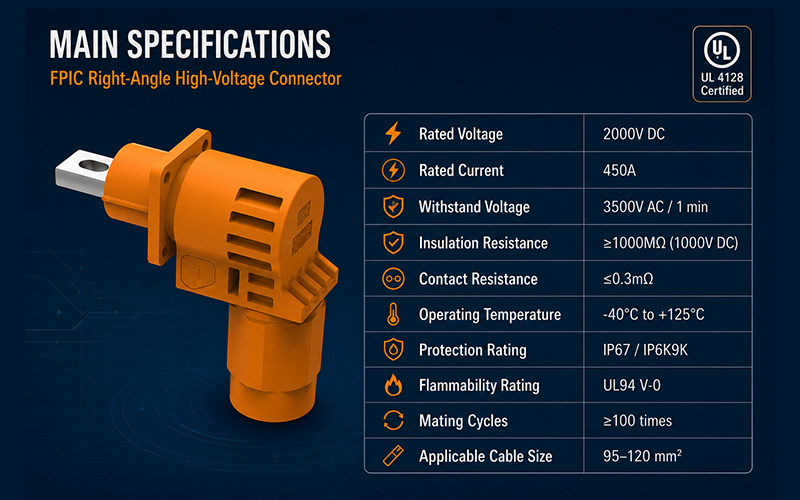
For higher-power BESS cabinet applications, FPIC’s 2000V 450A energy storage connector is positioned for customers who need a stronger high-voltage, high-current interconnection solution with a safety-oriented structure and system-integration logic.

This connector direction is particularly relevant where designers are looking for:

  • higher-voltage platform support
  • cabinet-level high-current interfaces
  • safer handling through touch-proof structure
  • clearer polarity and keying control
  • more flexible routing and installation

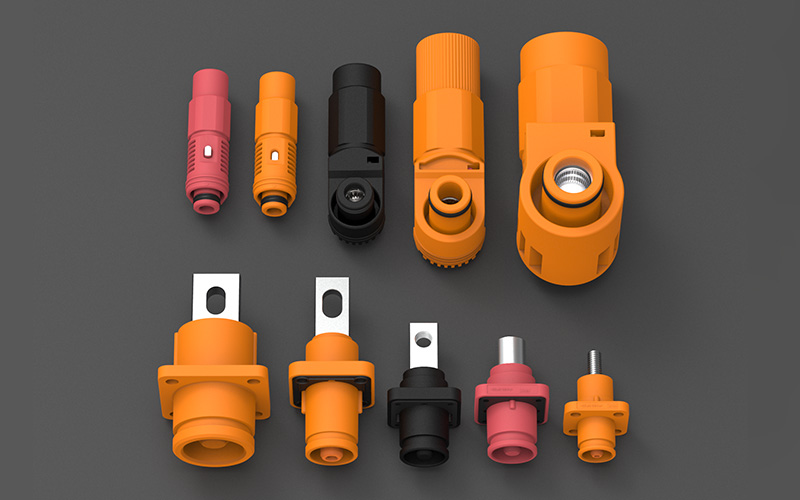
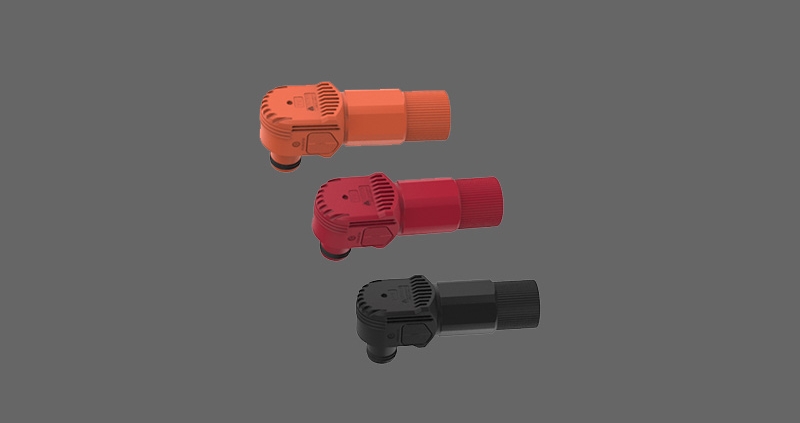
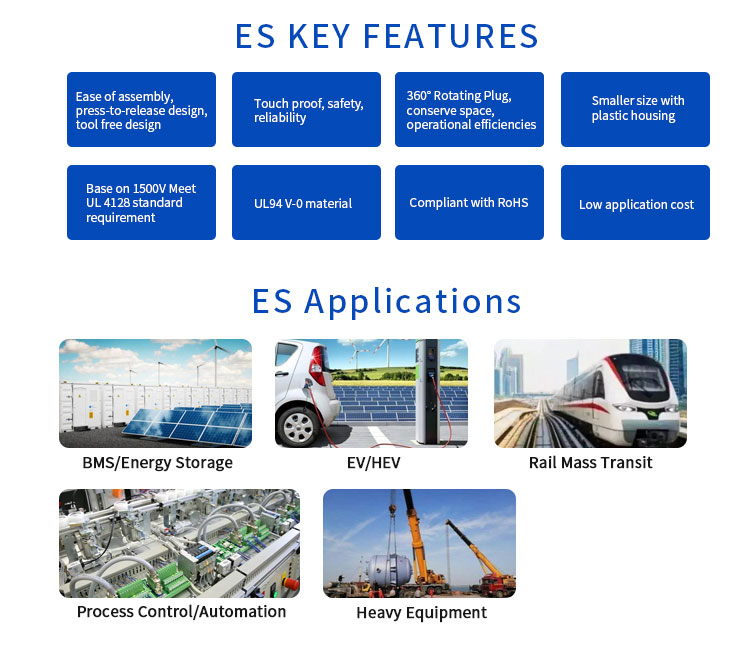
FPIC’s energy storage connector development already includes features such as touch-proof design, 360-degree rotating plug structure, multiple connection methods, and different installation keying options, which directly support the practical needs of BESS cabinet integration.

For customers moving beyond basic current transfer and toward safer, more maintainable cabinet power architecture, this matters.

Why 2000V 450A Matters in the Current Market Context

As the market shifts toward larger and more demanding storage projects, high-power connector platforms become more relevant for two reasons.

First, they help support the design of higher-density cabinet systems with more demanding power interfaces.

Second, they show that connector suppliers are not only following the storage trend, but also investing in the next layer of interconnection capability.

FPIC’s 2000V 450A series is part of that move. It is not positioned as a generic connector. It is better understood as a high-power energy storage interconnection solution for battery-system applications where safety, current path stability, and system integration all matter.

FPIC Energy Storage Connector Capability

FPIC supports energy storage connector development across multiple platform levels, including 1000V, 1500V, and higher-voltage product directions for battery-system applications.

Our energy storage connector portfolio is built around real application needs such as:

  • battery module interfaces
  • battery rack and cabinet connections
  • high-current DC distribution paths
  • safer installation and service access

For customers developing BESS cabinets, battery packs, or related high-voltage storage equipment, FPIC can support product communication and connector matching based on application requirements.

High-Voltage Connectors for BESS Cabinets

Conclusion

The role of high-voltage connectors in BESS cabinets is getting bigger, not smaller. As storage systems scale, connector selection is increasingly tied to safety, temperature control, installation efficiency, and long-term operating risk.

That is why the market is moving beyond simple part supply toward more integrated interconnection thinking.

For projects that need a stronger high-power solution, FPIC’s 2000V 450A energy storage connector provides a relevant option to support safer and more capable BESS cabinet design.

Contact FPIC

Looking for a high-voltage connector solution for BESS cabinets, battery racks, or high-current storage systems?

Contact FPIC to discuss your project requirements and connector platform options.

Email: info@fpiconn.com
Website: fpiconn.com

Resources

Reuters. Lithium producers bet on battery storage as demand shifts beyond EVs. June 24, 2026.
Molex. Designing Battery Energy Storage Systems (BESS).
Molex. Battery Pack Connections for Energy Storage Systems.
Molex. BESS Inverter Connectors.
Phoenix Contact. Connectors for Energy Storage Systems.
TE Connectivity. Battery Energy Storage Systems (BESS).
TE Connectivity. HPC 350A Connector for BESS Applications.

High-current connector used in BESS cabinet energy storage system

Introduction

Battery energy storage systems (BESS) are rapidly expanding as global demand for grid stability and renewable integration increases.

In modern BESS cabinet architecture, high-current connectors are no longer secondary components—they directly influence system safety, thermal behavior, installation efficiency, and long-term reliability.

For engineers and system integrators, connector selection has become a key design decision rather than a simple component choice.

The Role of High-Current Connectors in BESS Systems

High-current connectors serve as the critical electrical interface between battery modules, busbars, and power distribution units inside a BESS cabinet.

Their performance affects:

  • Current transmission stability
  • Temperature rise under load
  • System insulation safety
  • Installation efficiency
  • Maintenance accessibility

A weak connection point can become the limiting factor of an otherwise well-designed energy storage system.


Why Current Rating Alone Is Not Enough

Many connector selections are based only on rated current and voltage. However, in real BESS applications, this is not sufficient.

Engineering considerations must also include:

  • Contact resistance stability over time
  • Heat dissipation in confined cabinet spaces
  • Mechanical locking reliability
  • Mating cycle durability
  • Assembly consistency in mass production

In high-density energy storage systems, thermal behavior and connection stability are often more critical than nominal electrical ratings.


Thermal Stability and System Safety

One of the most important risks in BESS cabinet design is localized heating at connection points.

If contact resistance is unstable:

  • Heat accumulation increases
  • Insulation aging accelerates
  • Nearby components may be affected
  • System reliability decreases over time

Properly engineered high-current connectors help maintain stable thermal performance under continuous load, reducing long-term system risk.


Installation Efficiency and Manufacturing Impact

BESS systems are increasingly built in modular and scalable architectures.

High-current connectors can significantly improve:

  • Cabinet assembly speed
  • Cable routing efficiency
  • Reduction of wiring errors
  • Standardization of production processes

For large-scale energy storage deployment, even small improvements in installation efficiency can translate into major cost and time savings.


Maintenance and Lifecycle Considerations

Energy storage systems are long-life assets.
Therefore, maintainability is a critical design factor.

A well-designed connector system supports:

  • Easy replacement of modules
  • Clear mating orientation
  • Reduced risk of incorrect reconnection
  • Faster service operations

This directly impacts total lifecycle cost and system uptime.


FPIC Energy Storage Connector Capability

FPIC develops high-current connector solutions for energy storage and battery system applications, including:

These solutions are designed for BESS cabinet, battery module, and power distribution applications.

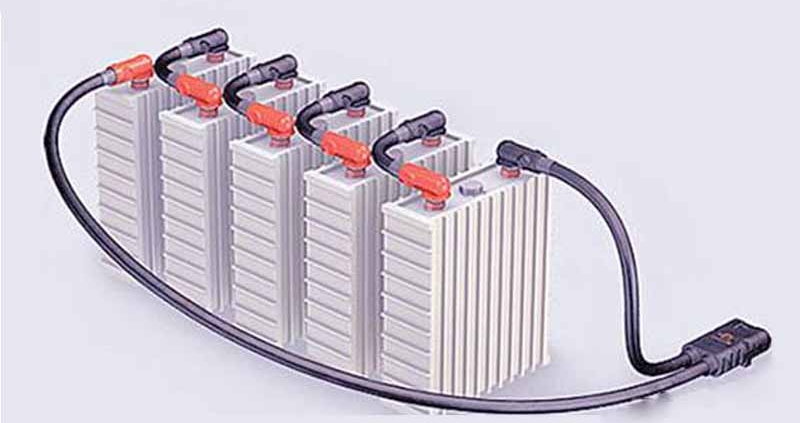
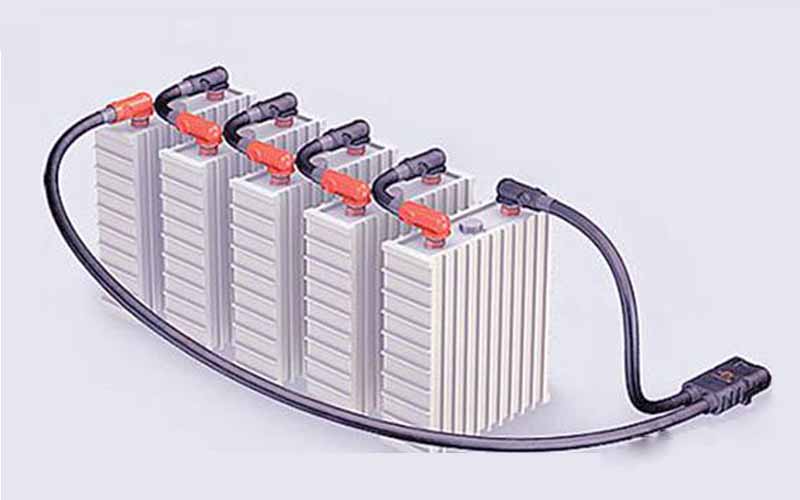
High-current connector used in BESS cabinet energy storage system


Application Areas

FPIC high-current connectors are suitable for:


Conclusion

As BESS systems scale in power density and deployment volume, connector design becomes a fundamental part of system engineering.

High-current connectors are no longer just electrical accessories—they are core components that influence safety, efficiency, and system lifecycle performance.

Selecting the right connector early in the design stage helps ensure a more reliable and scalable energy storage solution.


Contact FPIC

For energy storage connector development or 450A / 2000V high-current applications, FPIC provides engineering support and customized connector solutions.

Website: https://fpiconn.com/
Email: info@fpiconn.com


FAQ

1. What is a high-current connector used for in BESS?

It is used to connect battery modules, busbars, and power distribution systems inside energy storage cabinets.

2. Why are high-current connectors important in energy storage systems?

They affect thermal performance, safety, installation efficiency, and long-term system reliability.

3. Is current rating enough when selecting a connector for BESS?

No. Contact resistance, thermal behavior, and mechanical stability are equally important.

2000V 450A BESS Connectors

Selecting a 2000V 450A energy storage connector for BESS cabinets requires more than checking current and voltage ratings. Engineers should verify UL certification, temperature rise performance, creepage and clearance design, IP protection, touch-proof safety, locking reliability, anti-misplug structure, and cable assembly compatibility before platform design is finalized.

To select a 2000V 450A BESS connector, focus on seven factors: certified safety, stable temperature rise, high-voltage insulation, IP protection, secure locking, anti-misplug design, and reliable cable assembly support. These requirements should be confirmed early because connector platforms are usually locked during cabinet design.

Why 2000V 450A BESS Connectors Matter

Battery energy storage systems are moving toward higher voltage, higher current, and more standardized cabinet architecture. As system integrators pursue higher energy density and faster installation, the connector is no longer a simple accessory. It becomes a safety-critical and maintenance-critical interface inside the BESS cabinet.

A 2000V 450A energy storage connector must support stable high-current transmission while helping reduce installation risk, service complexity, and long-term field failure. For this reason, connector selection should happen early in the cabinet design stage, not after the power architecture is already fixed.

For BESS cabinet designers, the right connector can help improve:

  • High-voltage safety
  • Installation efficiency
  • Maintenance convenience
  • System reliability
  • Cabinet standardization
  • Cable assembly consistency
  • Long-term platform scalability

This is why UL certification, temperature rise, sealing, locking, and cable integration should be treated as core selection criteria.

1. Start with UL Certification and Safety Compliance

For high-voltage BESS applications, certification is one of the first items customers should verify. A connector used in a 2000V 450A system must not only carry current; it must prove that its insulation, materials, structure, and safety design can support demanding electrical conditions.

UL certification gives customers stronger confidence during project evaluation, especially when the connector will be used in energy storage cabinets, battery racks, power distribution modules, or system-level platforms that require safety documentation.

When reviewing a connector, ask these questions:

  • Is the connector UL certified?
  • Is the certification aligned with the intended voltage and current platform?
  • Are materials suitable for high-voltage energy storage systems?
  • Does the supplier provide documentation for project review?
  • Can the connector be introduced into customer platforms early?

FPIC’s 2000V 450A UL energy storage connector is designed for high-voltage BESS cabinet applications where safety, compliance, and long-term reliability are essential.

2000V 450A BESS Connectors

2. Check Temperature Rise Under High Current

Temperature rise is one of the most important performance indicators for high-current connectors. At 450A, even small contact resistance can create heat. If heat is not controlled, the system may face higher power loss, material aging, or reliability risk.

When choosing a 2000V 450A BESS connector, engineers should not only ask for the rated current. They should also review the connector’s temperature rise performance under realistic working conditions.

Important factors include:

  • Contact resistance
  • Terminal structure
  • Contact material
  • Plating quality
  • Cable size
  • Crimping or termination quality
  • Ambient temperature
  • Cabinet ventilation conditions

A good high-current connector should maintain stable electrical performance and avoid localized overheating. For BESS cabinets, this is especially important because connectors often operate inside enclosed or semi-enclosed power systems.

FPIC supports connector and cable assembly integration, helping customers match the connector with suitable cable specifications and assembly methods to improve current-carrying stability.

3. Verify High-Voltage Insulation, Creepage, and Clearance

In a 2000V energy storage system, insulation design is critical. The connector must maintain enough electrical separation between conductive parts to reduce the risk of arcing, breakdown, or short circuit.

Three terms are especially important:

Creepage distance
The shortest path along the insulating surface between conductive parts.

Clearance distance
The shortest air distance between conductive parts.

Insulation resistance
The ability of insulating materials to prevent unwanted current leakage.

For high-voltage BESS cabinets, these parameters are often considered early in platform design. Once the cabinet layout, busbar direction, cable routing, and connector interface are fixed, changing the connector later can be costly.

That is why connector selection should be part of the system architecture review, not only a purchasing decision.

4. Choose IP Protection for Real Cabinet Conditions

BESS cabinets may operate in indoor, outdoor, or semi-outdoor environments. Even when the cabinet itself has protection, connectors may still face dust, humidity, condensation, vibration, or maintenance exposure.

A suitable energy storage connector should offer strong environmental protection. IP-rated sealing helps protect the connection area from water and dust ingress, supporting more stable long-term operation.

When evaluating IP protection, consider:

  • Cabinet installation environment
  • Indoor or outdoor exposure
  • Humidity and condensation risk
  • Maintenance frequency
  • Cable outlet direction
  • Sealing structure after assembly

For energy storage connectors, IP protection is not only about passing a test. It is about maintaining stable performance throughout installation, operation, inspection, and maintenance.

FPIC’s energy storage connector solutions are designed with environmental protection in mind, including sealing structures suitable for demanding power storage applications.

5. Pay Attention to Locking and Serviceability

High-current connectors used in BESS cabinets must remain secure during operation. Vibration, cable tension, installation stress, and maintenance handling can all affect connection stability.

A reliable locking design helps prevent accidental loosening and supports safer field operation.

For BESS cabinet applications, a good locking design should provide:

  • Secure mating
  • Clear locking feedback
  • Convenient unlocking during maintenance
  • Stable connection under cable stress
  • Reduced risk of improper operation

Serviceability is becoming increasingly important in energy storage systems. Traditional bolted connections and busbar systems may require more assembly time and tool access. In many modern BESS platforms, maintainable connector solutions can help improve installation and maintenance efficiency.

FPIC energy storage connectors are designed to support practical cabinet installation and field maintenance requirements, helping customers improve system operation convenience.

6. Use Anti-Misplug Design to Reduce Installation Risk

In high-voltage BESS cabinets, incorrect mating can create serious safety risks. Anti-misplug design helps prevent wrong polarity connection, incorrect position matching, or mismatched connector pairing.

Key anti-misplug features may include:

  • Different keying positions
  • Color identification
  • Positive and negative polarity distinction
  • Mechanical coding
  • Dedicated plug and receptacle matching

For cabinet standardization, this becomes especially valuable. When multiple connectors are installed in similar cabinet positions, clear anti-misplug design helps reduce assembly errors and maintenance mistakes.

FPIC energy storage connector solutions can support different keying and identification designs to help customers improve installation safety and platform consistency.

7. Evaluate Cable Assembly Capability

A high-voltage connector is only as reliable as its cable assembly. For a 2000V 450A connector, cable selection, stripping, crimping, sealing, strain relief, and final testing all affect long-term performance.

Customers should evaluate whether the supplier can provide complete connector and cable assembly support, not just separate components.

Important cable assembly factors include:

  • Cable size compatibility
  • Crimping process control
  • Contact resistance control
  • Pull force performance
  • Sealing after assembly
  • Polarity and labeling
  • 100% electrical testing
  • Packaging and installation protection

This is where FPIC can provide stronger project value. With connector manufacturing and cable assembly capability, FPIC can support customers from connector selection to finished cable assembly delivery, helping reduce supplier coordination and improve project consistency.

Selection Checklist for 2000V 450A BESS Connectors

Before confirming a connector platform, review this checklist:

Selection FactorWhat to Check
Voltage RatingSuitable for 2000V system design
Current RatingStable 450A current-carrying performance
CertificationUL certification and project documentation
Temperature RiseControlled heating under high current
Creepage & ClearanceSafe high-voltage insulation design
IP ProtectionProtection against dust and moisture
Locking DesignSecure mating and safe maintenance
Anti-Misplug DesignKeying, color, and polarity protection
Cable AssemblyCable size, crimping, sealing, and testing
Supplier SupportEngineering review and mass production capability

This checklist helps engineering and sourcing teams evaluate energy storage connectors more systematically.

Where FPIC Adds Value

FPIC’s 2000V 450A UL energy storage connector is developed for BESS cabinet applications where high-voltage safety, current stability, and serviceability matter.

FPIC supports customers with:

  • 2000V 450A UL energy storage connector solutions
  • High-current connector design support
  • IP protection and sealing design
  • Secure locking and anti-misplug structures
  • Cable assembly and harness integration
  • Customization for cabinet and platform requirements
  • Engineering support from sample development to mass production

With 23 years of connector and cable assembly manufacturing experience, FPIC understands that BESS projects require more than a connector part number. Customers need a stable platform, certified product support, and a supplier capable of practical engineering cooperation.

Conclusion

Selecting a 2000V 450A energy storage connector for BESS cabinets requires a full system view. Voltage and current ratings are only the starting point. UL certification, temperature rise, insulation design, IP protection, locking, anti-misplug structure, and cable assembly capability all influence long-term safety and reliability.

If you are developing BESS cabinets, battery racks, or high-voltage energy storage platforms, FPIC can support your connector selection, customization, and cable assembly requirements.

Contact FPIC to discuss your 2000V 450A energy storage connector project.

Resources / References

  1. Future Market Insights – Energy Storage High Voltage Connector Market, 2026–2036 forecast.
  2. Connector Supplier – High-current connector specification trends for industrial equipment.
  3. FPIC internal and product information – energy storage connector features, safety design, IP protection, and cable assembly capability.

References / Notes

This article is originally written for FPIC based on energy storage connector market trends, FPIC’s product development direction, and general engineering selection principles for high-voltage BESS cabinet connectors. External market information is referenced and should be cited when published.

energy storage connectors

As energy storage systems continue to expand across renewable energy, grid stabilization, and industrial applications, selecting the right energy storage connectors has become critical to system safety, efficiency, and long-term reliability.

A connector is more than a simple connection point—it directly affects power transmission stability, thermal performance, installation safety, and maintenance efficiency. Below are key tips to help customers choose the right solution and understand what to look for in a reliable supplier.


1. Understand Current and Voltage Requirements

The first step in choosing an energy storage connector is defining electrical ratings:

  • Rated current and peak current capacity

  • Rated voltage level (low or high voltage systems)

  • Continuous power transmission capability

Connectors must safely handle high current loads over long operating periods without excessive temperature rise. Underrated connectors increase the risk of overheating and power loss.


2. Focus on Safety and Locking Design

Energy storage systems often operate in environments where safety is non-negotiable. Key safety features include:

  • Secure locking or anti-mis-mating design

  • Touch-proof or finger-safe contact structures

  • Reliable grounding solutions

A well-designed locking mechanism ensures stable connections during vibration, transportation, or long-term operation.


3. Consider Environmental Resistance

Energy storage installations may be exposed to:

  • Dust and humidity

  • Temperature variation

  • Outdoor or semi-outdoor conditions

Choosing connectors with appropriate IP protection levels, corrosion-resistant materials, and robust housings helps extend service life and reduce maintenance risks.


4. Evaluate Contact Materials and Conductivity

High-quality contact materials are essential for stable energy transfer. Important factors include:

  • Low contact resistance

  • High conductivity materials

  • Reliable plating for long-term performance

Good contact design improves energy efficiency and reduces heat generation during high-current operation.


5. Think About Installation and Maintenance Efficiency

In large energy storage projects, installation speed and serviceability matter. Consider:

  • Easy mating and unmating

  • Clear polarity and orientation

  • Compatibility with cable assemblies

Efficient connector design reduces installation time and simplifies future maintenance or system upgrades.


FPIC Energy Storage Connector Specifications & Advantages

With 23 years of connector and cable assembly manufacturing experience, FPIC provides energy storage connector solutions designed for real-world system demands.

Key Advantages of FPIC Energy Storage Connectors

  • Designed for high-current and stable power transmission

  • Secure and reliable connection structures

  • Durable materials suitable for long-term operation

  • Support for customized connector and cable assembly solutions

  • Stable mass production capability with strict quality control

FPIC energy storage connectors are widely used in battery energy storage systems (BESS), power distribution modules, and integrated energy solutions.


Customization Support for Energy Storage Projects

Every energy storage system has unique requirements. FPIC supports end-to-end customization, including:

  • Connector structure and pin design

  • Cable integration and harness assembly

  • Electrical and mechanical performance optimization

Our engineering team works closely with customers to ensure the connector solution fits the system, not the other way around.

energy storage connectors


Choose the Right Partner for Long-Term Reliability

Choosing the right energy storage connector is not just about specifications—it’s about choosing a manufacturer with experience, engineering capability, and production stability.

📩 Contact FPIC today to discuss your energy storage connector requirements.
We welcome inquiries and are ready to support your project from design to mass production.

1500v connector

1500V Connector: The Future of High-Voltage Connectivity: Energy storage connectors like 1500V models play a key role in renewable energy, electric vehicles, and industrial automation. These connectors ensure efficient, safe power transmission, supporting solar, EV charging, and grid systems with advanced materials and design.

The Future of High-Voltage Connectivity: Trends in 1500V Connector Technology Explained

The world of high-voltage connectivity is undergoing a transformation, and at the heart of this revolution lies a seemingly simple but incredibly powerful component: the energy storage connector. As industries race towards smarter, more sustainable solutions, these connectors are rapidly becoming the backbone of everything from renewable energy systems to electric vehicles (EV) charging connectors and industrial energy storage connectors. With the demand for higher power, faster speeds, and increased safety, 1500V energy storage connectors are no longer just an option—they are a necessity.

In this rapidly evolving landscape, the question is no longer if but how these high voltage energy storage connectors will shape the future. These energy storage system connectors are not just powering today’s innovations—they’re enabling the breakthroughs of tomorrow. But what trends are driving this shift? From cutting-edge materials to groundbreaking design innovations, the next generation of battery storage connectors promises to unlock new levels of efficiency and safety in some of the world’s most demanding industries.

This is the future of connectivity, and it’s electrifying.

1500v connector


Understanding 1500V Connector Technology: What Makes It Special?

High-voltage connectors are not just another component in a power system; they are the lifeblood of modern electrical infrastructure, enabling safe, efficient, and reliable power transmission across industries. Among them, 1500V energy storage connectors stand out due to their ability to handle higher voltage levels while maintaining safety and performance. But what exactly makes these connectors unique?

At their core, 1500V connectors are designed to support high-energy systems that require precision, durability, and advanced materials. Unlike standard connectors, they are built to withstand extreme temperatures, resist corrosion, and endure high-frequency usage without compromising the integrity of the connection. These features are essential when dealing with the massive power demands in industries like solar energy, grid energy connectors, battery storage, and electric vehicle (EV) charging connectors.

A typical 1500V energy storage connector consists of robust insulating materials that help prevent electrical faults and arcing. They are crafted using high-quality metals like copper and aluminum, which provide excellent conductivity and minimal resistance. However, the key difference lies in their design, which focuses on minimizing energy loss and ensuring that each connection is stable—even under the most demanding conditions.

This technology is not just about higher voltage; it’s about creating connectors that promise reliability, safety, and efficiency across a wide range of applications. And as the need for cleaner energy solutions and more powerful electronics grows, these energy storage system connectors are becoming more indispensable than ever.


The Role of 1500V Connectors in the Renewable Energy Revolution

The surge in renewable energy adoption has created an unprecedented demand for more efficient, durable, and scalable power systems. As industries strive to harness the power of solar, wind, and other green technologies, 1500V connectors are becoming a critical enabler of this energy revolution.

Solar energy connectors, in particular, have seen a massive shift toward higher voltage systems. Traditionally, solar power systems used 600V or 1000V connectors, but as solar farms scale up, there’s a pressing need to increase voltage to optimize power output and reduce energy loss. Enter the high voltage energy storage connector—a key component that allows solar systems to deliver more power over longer distances without sacrificing performance or safety.

These connectors are engineered to handle the higher voltage demands of next-generation solar panels and inverter systems. They offer superior insulation and enhanced protection against electrical faults, ensuring the reliability of power transmission in environments that can be subject to extreme weather conditions. With their high power handling capability, 1500V energy storage connectors are not only facilitating the growth of larger, more efficient solar farms but also contributing to a reduction in maintenance costs and system downtime.

Similarly, wind energy applications, which often require robust and long-distance connectivity solutions, are benefiting from the higher voltage capabilities of industrial energy storage connectors. These connectors are essential for the safe transmission of electricity from offshore wind turbines to land-based power grids, ensuring that the energy harvested from the wind can be distributed efficiently to the grid, even over great distances.

In summary, energy storage solutions such as 1500V connectors are playing an integral role in making renewable energy systems more efficient, cost-effective, and reliable. As the global transition to clean energy continues, these connectors will be indispensable for scaling renewable energy infrastructure to meet the world’s growing power demands.


High-Voltage Connectors in Electric Vehicles: The Future of Automotive Power

Electric vehicles (EVs) are no longer the future—they are the present. With the global push toward sustainable transportation, the demand for fast, efficient, and safe charging solutions has never been higher. Here, 1500V energy storage connectors are emerging as the game-changer in powering EVs, ensuring quicker charging times, longer battery life, and greater energy efficiency.

One of the main challenges in the EV market has always been the slow charging speed. Traditional connectors struggled to meet the demands of fast-charging systems, but with the advent of high voltage energy storage connectors, the automotive industry is now poised to break through these barriers. By increasing the voltage capacity, these connectors allow electric vehicles to charge more quickly, reducing the wait time for drivers and promoting the widespread adoption of EVs.

The shift to battery management system connectors is not just about speed; it’s also about safety and reliability. EV charging stations must handle high voltages without risking overheating, short circuits, or damage to the vehicle’s electrical systems. With their superior insulation and fault protection capabilities, power connectors for batteries ensure that power is transmitted safely and reliably, even in high-demand situations.

Beyond fast-charging infrastructure, energy storage system connectors are also revolutionizing the design of EV batteries. They support higher voltage batteries, which are crucial for improving the range and efficiency of electric vehicles. By allowing for better energy density and faster charging cycles, these connectors play a key role in enhancing the overall performance of EVs, driving the transition towards more sustainable and cost-effective transportation solutions.

As electric vehicles become more mainstream, the role of 1500V connectors in their development will only continue to grow, helping to shape a cleaner, more efficient future for the automotive industry.


The Role of 1500V Connectors in Industrial Automation and Robotics

As industries embrace automation and advanced robotics to increase productivity, industrial energy storage connectors are proving to be an essential component in powering these high-tech systems. Whether it’s industrial robots on the production line, high-powered machinery in factories, or large-scale automation systems, these connectors enable precise and reliable power delivery to meet the increasing demands of automation.

One of the key advantages of 1500V connectors in industrial settings is their ability to handle the higher power levels needed to support automated equipment that operates 24/7. As automation technologies become more advanced, machines are required to process and control larger amounts of data and perform tasks that demand substantial electrical power. The increased voltage capacity of energy storage system connectors ensures that these systems remain stable, efficient, and able to operate without interruption.

In addition to their power capabilities, high voltage energy storage connectors are designed to thrive in the harsh environments typical of industrial settings. Whether it’s extreme temperatures, high humidity, or exposure to dust and chemicals, these connectors provide the durability and resilience necessary to keep systems running smoothly in tough conditions.

Moreover, the rapid advancement of industrial robots—especially those designed for tasks like welding, assembly, and materials handling—requires connectors that can handle high-frequency switching and large-scale energy demands. 1500V connectors meet these needs by providing reliable, continuous power flow, making them an integral part of industrial automation’s evolution.

Looking to the future, the adoption of energy storage solutions like 1500V connectors will likely expand as more industries invest in automation and AI-driven systems. The flexibility, durability, and high power capabilities of these connectors make them the ideal choice for powering the next generation of industrial robots and automated systems, driving efficiency and lowering operational costs across industries.


Safety and Durability: Key Design Features in 1500V Connector Technology

When it comes to high-voltage systems, safety and durability are non-negotiable. 1500V connectors are built to not only handle the demands of high power but also to protect both people and equipment from potential hazards. From preventing electrical faults to ensuring long-term reliability, these connectors are designed with safety and durability as top priorities.

Energy storage connectors employ advanced materials and design techniques to offer superior insulation and fault protection. Insulating materials, such as thermoplastic elastomers and silicone, are used to prevent electrical short circuits and ensure that the connectors remain safe even in extreme conditions. Additionally, the design of these connectors often incorporates features like pressure relief mechanisms and arc-fault detection to protect against electrical arcing, a common issue in high-voltage systems.

Beyond safety, the durability of 1500V connectors is critical for minimizing downtime and maintenance costs. These connectors are built to resist wear and tear caused by harsh environmental factors, including high temperatures, moisture, and corrosive substances. This makes them ideal for use in industries like renewable energy, where energy storage system connectors must withstand outdoor conditions for extended periods.

In high-voltage systems, a failure to properly insulate and protect connectors can lead to catastrophic consequences. Therefore, 1500V energy storage connectors are designed with multiple layers of protection to guarantee that they maintain their performance over time and can withstand the rigors of industrial, automotive, and energy applications.

By focusing on safety, durability, and high performance, energy storage connectors are helping to set new standards in high-voltage connectivity, ensuring that both power systems and their operators remain safe and efficient.

The Push for Miniaturization: Compact 1500V Connectors for Smaller, Smarter Devices

As technology continues to evolve at an exponential rate, there is an increasing demand for smaller, smarter, and more efficient devices. The rise of miniaturization in electronics has prompted the development of 1500V connectors that not only meet higher voltage requirements but also fit into more compact spaces. This trend toward miniaturization is reshaping the landscape of energy storage connectors, enabling innovations in consumer electronics, industrial systems, and even wearable technology.

One of the key drivers behind this shift is the need for power efficiency in a smaller footprint. As devices become more powerful, they also become more compact. This means battery storage connectors and energy storage system connectors must evolve to provide the same high performance without occupying excessive space. 1500V connectors are now being designed to achieve higher energy density, making them suitable for compact applications where space is at a premium.

In industries like automotive and consumer electronics, where miniaturized systems are critical, these small-form connectors allow for faster power transmission and reduce energy loss. Whether in electric vehicles (EV) charging connectors, drones, or small-scale industrial machinery, 1500V connectors are enabling these devices to operate at their optimal capacity without sacrificing power or efficiency.

Miniaturization also brings challenges, particularly when it comes to ensuring safety and performance in smaller connectors. However, advances in materials and design have enabled manufacturers to create compact 1500V energy storage connectors that not only maintain their high voltage capabilities but also offer enhanced insulation, shock resistance, and long-term durability.

In short, as industries demand smaller, more powerful devices, 1500V connectors are stepping up to meet those needs—helping to power the next generation of miniaturized technology without compromising on performance or safety.


Future Trends: How 1500V Connectors Are Evolving in 2025 and Beyond

The world of 1500V connectors is evolving rapidly, driven by technological advancements, shifting industry demands, and an ever-increasing focus on sustainability. As we look toward 2025 and beyond, several emerging trends are poised to shape the future of high-voltage connectivity. These trends promise not only to improve the efficiency and reliability of energy storage connectors, but also to push the boundaries of what is possible in industries like renewable energy, electric vehicles, and industrial automation.

One of the most significant trends is the integration of artificial intelligence (AI) and machine learning (ML) into the design and maintenance of 1500V connectors. These technologies can help predict potential failure points, optimize connector designs, and even automate the process of fault detection and response. By leveraging AI and ML, manufacturers can create more intelligent battery management system connectors that adapt to real-time conditions, improving overall system efficiency and reducing downtime.

Another key trend is the use of advanced materials to further enhance the performance of 1500V energy storage connectors. The next generation of connectors will likely incorporate lightweight, ultra-durable materials such as carbon composites or graphene. These materials will not only improve the performance of energy storage system connectors but also make them more eco-friendly, supporting the global push for sustainable technologies.

Furthermore, the growing adoption of 5G and IoT will create new opportunities for energy storage solutions. As these technologies rely heavily on high-speed data transfer and reliable power distribution, the demand for high-performance grid energy connectors will rise significantly. 1500V connectors will play an essential role in enabling the infrastructure needed for these technologies to thrive.

As we move toward 2025, the future of 1500V connectors looks incredibly promising. With continuous advancements in materials, design, and technology integration, these connectors will play a pivotal role in powering the world’s most innovative systems and driving the future of high-voltage connectivity.


Challenges Facing 1500V Connector Technology: Overcoming Obstacles in Design and Production

While the future of 1500V connector technology is undoubtedly bright, it’s not without its challenges. From complex design requirements to material shortages and manufacturing hurdles, several obstacles must be overcome before the full potential of 1500V connectors can be realized. Understanding these challenges is essential to driving innovation and improving performance in the coming years.

One of the biggest hurdles is ensuring safety at such high voltages. As energy storage connectors are designed to handle significantly more power than traditional connectors, the risk of electrical faults, short circuits, and overheating increases. Engineers must design connectors that not only meet high voltage standards but also ensure safe operation under extreme conditions. Continuous innovation in insulation materials, sealing technologies, and fault detection systems will be essential to overcoming these safety challenges.

Another challenge lies in the supply chain. As demand for high voltage energy storage connectors grows, manufacturers are faced with the pressure of sourcing high-quality materials that can withstand high-voltage environments. The availability of critical components, such as high-grade metals and specialized insulating materials, can be a limiting factor in the production of these connectors. Manufacturers must address these supply chain vulnerabilities to meet the rising demand for battery storage connectors and other energy storage solutions.

Lastly, the cost of manufacturing high-performance 1500V connectors can be prohibitive. Advanced materials, precision manufacturing, and rigorous testing all contribute to the high cost of these components. For industries looking to integrate 1500V connectors into their systems, cost-effectiveness is often a key consideration. As technology improves and economies of scale come into play, the price of these connectors is expected to decrease, making them more accessible to a wider range of applications.

Despite these challenges, the future of 1500V connector technology is bright. With ongoing research, investment, and collaboration across industries, these obstacles will be overcome, paving the way for even more advanced and reliable connectors in the years to come.


Conclusion: Why 1500V Connectors Are Paving the Way for a More Connected, Efficient Future

In an increasingly electrified world, 1500V connectors are at the forefront of high-voltage connectivity, enabling industries to meet the growing demand for power, efficiency, and safety. From renewable energy systems and electric vehicles (EV) charging connectors to industrial automation and robotics, these connectors are playing a vital role in powering the technologies of tomorrow.

As we look toward the future, the continued evolution of 1500V connectors will be driven by innovation in materials, design, and integration with emerging technologies. Whether it’s through faster charging times in EVs, more efficient energy transmission in solar farms, or the development of smarter, more compact industrial robots, 1500V connectors are shaping the way we connect, power, and innovate.

With their ability to support higher voltage, reduce energy loss, and ensure safety, 1500V energy storage connectors are setting the stage for a more connected, efficient, and sustainable future. As industries continue to evolve, these connectors will remain indispensable in powering the systems that drive our modern world.

The future of high-voltage connectivity is here, and it’s electrifying.

Energy Storage Connector

The energy storage market is evolving rapidly, and connectors play a pivotal role in the seamless operation of these systems. Amphenol, a renowned name in the connector industry, has been a preferred choice due to its high reliability, compliance with international standards, and innovative technologies like RADSOK®. However, the competitive landscape is shifting, and FPIC’s energy storage connectors, boasting UL and TUV certifications along with high-spec 1500V 350A capabilities, are poised to not only match but potentially surpass Amphenol’s offerings.

Energy Storage Connector

Advantages of FPIC Energy Storage Connectors:


  1. Certified Safety: FPIC connectors have passed rigorous UL and TUV certifications, ensuring product safety and reliability.
  2. High-Spec Performance: The 1500V 350A specification means FPIC connectors can operate under higher voltages and currents, suitable for large-scale energy storage applications.
  3. Technological Innovation: FPIC continually innovates to enhance connector performance and durability, meeting the market’s demand for efficient energy transmission.
  4. Cost-Effectiveness: FPIC offers high-quality connectors at competitive prices, creating greater value for customers.


Applications of FPIC Connectors:


FPIC’s connectors are extensively used in various domains, including:


  •  Residential Energy Storage Systems: Stable energy supply for smart homes, paired with AC/DC inverters.


  •  Commercial and Industrial Energy Storage Systems: Supporting large commercial ESS for continuous operation in industrial applications.


  •  Electric Vehicle Charging Stations: Efficient and reliable charging solutions for electric vehicles.


  •  Power Converters: Suitable for high-voltage operations in power converters, enhancing energy conversion efficiency.


  •  Personal Mobility Devices: Safe energy connections for electric bikes, scooters, and electronic forklifts.


FPIC’s connectors are not only equipped to meet current market demands but are also forward-looking, anticipating future technological advancements. We are committed to becoming a leader in the energy storage field through continuous innovation and exceptional customer service. Choosing FPIC means opting for a reliable, efficient, and visionary energy connection solution.


Conclusion:


As renewable energy continues to grow and the energy transition deepens, the significance of energy storage systems becomes increasingly apparent. With its superior performance and certifications, FPIC’s energy storage connectors are well-equipped to replace existing market products, offering a superior choice for customers. We look forward to partnering with you to embark on a new chapter in energy storage.

energy storage connector

As the world shifts towards renewable energy sources, energy storage solutions are becoming increasingly important. Energy storage connectors play a critical role in connecting energy storage systems to power grids, ensuring reliable and efficient energy transfer. At FPIC, we offer a range of high-quality energy storage connectors to meet the needs of the renewable energy industry.

Our energy storage connectors are designed to meet the unique demands of energy storage systems. They are available in various sizes, current ratings, and voltage classes to accommodate different applications. Our connectors are also made from high-quality materials, such as copper and aluminum, to ensure durability and reliability.

Energy storage connectors

Energy storage connectors

Energy storage connectors are critical components of energy storage systems. They enable the transfer of electrical energy from the storage system to the grid, ensuring a stable and reliable power supply. The connectors must be able to handle high current levels and withstand the harsh operating conditions of energy storage systems.

At FPIC, we understand the importance of energy storage connectors in renewable energy systems. That’s why we offer a range of connectors that meet the highest quality standards. Our connectors are tested for reliability, durability, and performance, ensuring that they can handle the demands of energy storage systems.

In addition to energy storage connectors, we also offer a range of other electronic components, including automotive wire harnesses, pin headers, and other cables. Our company has been serving the renewable energy industry for many years, and we have built a reputation for providing high-quality products and excellent customer service.

If you need energy storage connectors or any other electronic components, don’t hesitate to contact FPIC. Our team of experts is always ready to help you find the perfect solution for your renewable energy needs.