How to Choose Circular Connectors for Medical, Industrial and Outdoor Equipment
Circular connectors are widely used because they combine compact size, reliable electrical performance, and excellent environmental protection. From medical imaging systems and industrial robots to outdoor automation and renewable energy equipment, they provide dependable connections for power, signal, and data transmission.
However, there is no universal circular connector suitable for every application. A connector designed for a surgical device may not survive on construction machinery, while an outdoor waterproof connector may be unnecessarily large for laboratory equipment.
Selecting the right connector requires balancing electrical performance, environmental protection, mechanical reliability, and maintenance requirements.
This guide explains the most important factors engineers should consider when choosing circular connectors for different industries.
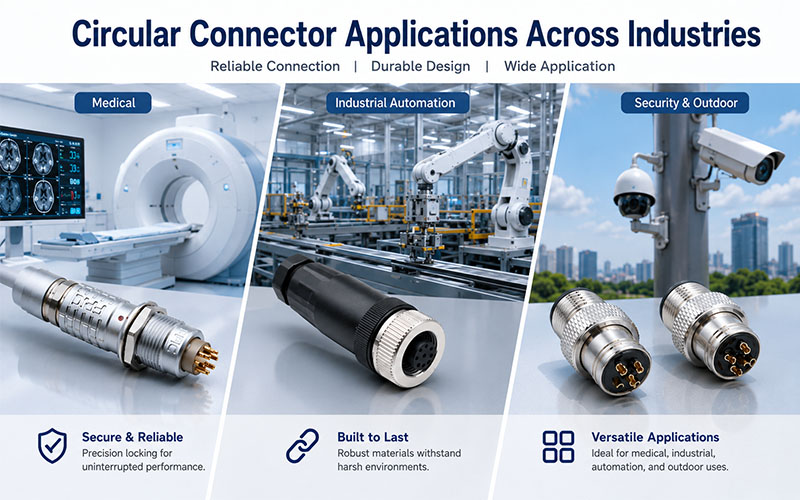
Start with the Application Environment
Before comparing connector specifications, first understand where the connector will operate.
Typical environments include:
Medical Equipment
- Diagnostic systems
- Patient monitoring devices
- Surgical equipment
- Laboratory instruments
Design priorities:
- Compact size
- Frequent cleaning
- High mating reliability
- Excellent signal integrity
Industrial Automation
Typical applications include:
- Industrial robots
- Servo motors
- PLC control systems
- Machine tools
- Factory automation
Design priorities:
- Vibration resistance
- EMC performance
- High mating durability
- Reliable locking
Outdoor Equipment
Typical applications include:
- Renewable energy systems
- Agricultural machinery
- Construction equipment
- Rail transportation
- EV charging infrastructure
Design priorities:
- Waterproof sealing
- UV resistance
- Corrosion resistance
- Wide operating temperature
Different environments require different connector designs.
Choose the Appropriate Locking Mechanism
Connector locking directly affects operational reliability.
Common options include:
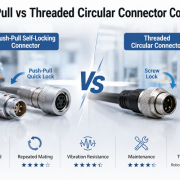
Push-Pull Locking
Advantages:
- Fast connection
- One-hand operation
- Easy maintenance
- Secure automatic locking
Ideal for:
- Medical equipment
- Laboratory systems
- Collaborative robots
Threaded Locking
Advantages:
- Excellent vibration resistance
- Strong mechanical retention
- Long-term stability
Ideal for:
- Industrial automation
- Servo systems
- Heavy equipment
Bayonet Locking
Advantages:
- Quick quarter-turn locking
- Reliable positioning
- Outdoor suitability
Ideal for:
- Portable equipment
- Field instruments
- Mobile machinery
Consider Environmental Protection
Environmental sealing is critical when connectors are exposed to dust, water, oil, or cleaning chemicals.
Common protection levels include:
IP Rating Typical Applications
IP67 Industrial automation, robotics
IP68 Outdoor automation, renewable energy
IP69K Food processing, washdown equipment, heavy-duty vehicles
The required protection level should match the actual operating conditions rather than simply selecting the highest rating available.
Evaluate EMC Requirements
Modern equipment often combines:
- Power transmission
- Industrial Ethernet
- CAN Bus
- High-speed data
- Precision sensors
Shielded circular connectors help:
- Reduce EMI
- Improve signal integrity
- Maintain communication stability
- Support reliable automation
For high-speed communication, connector shielding should include proper 360° shield termination.
Select the Right Contact Configuration
Connector selection also depends on:
- Number of contacts
- Signal type
- Power rating
- Mixed power and signal transmission
Many applications combine:
- Power contacts
- Signal contacts
- Data contacts
- Ground contacts
Hybrid connectors simplify installation while reducing cable complexity.
Consider Mating Cycle Requirements
Some connectors remain installed for years.
Others are connected and disconnected daily.
Typical examples include:
Low Mating Frequency
- Wind turbines
- Energy storage systems
- Control cabinets
High Mating Frequency
- Medical devices
- Test equipment
- Portable instruments
Applications with frequent reconnection should prioritize connectors designed for thousands of mating cycles.
Material Selection Matters
Connector housing materials influence durability and EMC performance.
Common choices include:
Metal Housing
Advantages:
- Better shielding
- Higher mechanical strength
- Improved heat dissipation
Engineering Plastic Housing
Advantages:
- Lightweight
- Corrosion resistant
- Cost-effective
Material selection should reflect the environmental and mechanical demands of the application.
Validate Before Production
Connector selection should always be verified through testing.
Recommended evaluations include:
- Mating cycle testing
- Vibration testing
- Salt spray testing
- IP protection testing
- Contact resistance testing
- EMC verification
- Temperature cycling
Testing complete connector assemblies under actual operating conditions provides the highest confidence in long-term performance.
How FPIC Supports Circular Connector Applications
FPIC develops circular connectors, push-pull self-locking connectors, waterproof connectors, and customized connectivity solutions for medical equipment, industrial automation, robotics, renewable energy, and outdoor applications.
With more than 23 years of manufacturing experience, our engineering team helps customers select the right connector based on electrical performance, environmental requirements, mechanical reliability, and application-specific standards. From prototype development to mass production, FPIC provides dependable connector solutions designed for long-term performance.
Final Thoughts
Choosing the right circular connector involves much more than selecting the correct number of contacts.
Engineers must consider the operating environment, locking mechanism, environmental sealing, EMC performance, durability, and maintenance requirements together
Whether designing a medical device, an industrial robot, or an outdoor energy system, selecting the appropriate connector improves equipment reliability, simplifies maintenance, and reduces lifecycle costs.
FAQ
What factors should be considered when choosing a circular connector?
Key factors include application environment, IP protection, locking mechanism, shielding, contact configuration, mating cycles, and environmental durability.
Which locking mechanism is best for medical equipment?
Push-pull connectors are widely used in medical equipment because they provide fast, secure, one-handed operation and support frequent mating cycles.
Is IP69K always better than IP67?
Not necessarily. The appropriate IP rating should match the operating environment. Higher protection levels may increase size and cost without adding practical benefits.
When are shielded circular connectors required?
Shielded connectors are recommended for applications involving Industrial Ethernet, CAN Bus, servo systems, or environments with significant electromagnetic interference.
Why is mating cycle life important?
Applications requiring frequent connection and disconnection need connectors with high mating durability to maintain reliable electrical performance over time.
Looking for the Right Circular Connector for Your Application?
Whether you’re designing medical equipment, industrial automation systems, or outdoor electrical installations, FPIC provides high-quality circular connectors, push-pull self-locking connectors, and waterproof connectivity solutions tailored to your application. Our engineering team can help you select the ideal connector for reliable performance in demanding environments.
Contact FPIC today to discuss your circular connector requirements.
Resources
- IEC 61076 – Connectors for Electrical and Electronic Equipment
https://webstore.iec.ch/
Provides international standards for the design, performance, and testing of circular and industrial connectors. - IEC 60529 – Degrees of Protection Provided by Enclosures (IP Code)
https://webstore.iec.ch/
Defines IP67, IP68, and IP69K protection ratings for connectors used in industrial and outdoor environments. - IEC 60601-1 – Medical Electrical Equipment
https://webstore.iec.ch/
Specifies general safety and essential performance requirements for medical electrical equipment, including connector-related considerations. - Phoenix Contact – Circular Connectors for Industrial Applications
https://www.phoenixcontact.com/
Provides technical information on circular connector selection, industrial connectivity, and environmental protection. - TE Connectivity – Circular Connector Solutions
https://www.te.com/
Offers engineering resources on circular connectors for medical devices, industrial automation, transportation, and energy applications.