Connector Material Selection: Housing Resin, Seals and Contact Alloys Explained
Selecting the right connector is not only about choosing the correct pin count, current rating, or mating interface.
The materials used inside a connector directly influence its reliability, durability, and performance throughout the product lifecycle.
A connector operating in a factory automation system, outdoor equipment, medical device, or energy storage application may face completely different challenges, including:
- High temperature
- Vibration
- Moisture exposure
- Chemical contamination
- Mechanical stress
- Frequent mating cycles
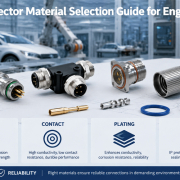
To achieve stable performance, engineers must carefully evaluate three major material categories:
- Housing resin
- Seal materials
- Contact alloys and plating
Each material plays a different role in protecting electrical performance and mechanical reliability.
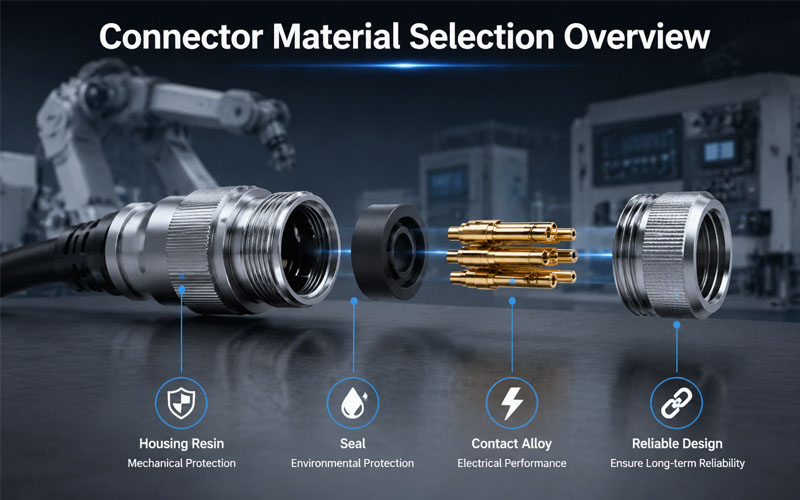
Why Connector Material Selection Matters
A connector is a combination of mechanical, electrical, and environmental protection components.
Poor material selection can lead to:
- Cracked connector housings
- Seal degradation
- Increased contact resistance
- Corrosion
- Signal instability
- Reduced mating life
For high-reliability applications, connector materials must match the actual operating environment rather than only meeting basic specifications.
A connector designed for indoor electronics may not perform reliably in outdoor or industrial conditions.
1.Connector Housing Resin Selection
The connector housing provides mechanical support and protects internal contacts.
Important properties include:
- Mechanical strength
- Temperature resistance
- Chemical resistance
- Dimensional stability
- Flame retardancy
- Insulation performance
Common housing materials include:
PA (Polyamide / Nylon)
PA is widely used for industrial and automotive connectors.
Advantages:
✔ Good mechanical strength
✔ Good wear resistance
✔ Cost-effective
✔ Suitable for many general applications
Limitations:
- Absorbs moisture
- Dimensional changes may occur in humid environments
Typical applications:
- Automotive connectors
- Industrial equipment
- Wire harness systems
PBT (Polybutylene Terephthalate)
PBT is commonly used where dimensional stability and electrical insulation are important.
Advantages:
✔ Low moisture absorption
✔ Good chemical resistance
✔ Stable dimensions
✔ Good electrical performance
Typical applications:
- Automotive electronics
- Industrial connectors
- Control systems
PPS (Polyphenylene Sulfide)
PPS is selected for demanding environments.
Advantages:
✔ Excellent temperature resistance
✔ High dimensional stability
✔ Strong chemical resistance
✔ Low moisture absorption
Typical applications:
- High-temperature equipment
- Industrial machinery
- Automotive engine environments
PC (Polycarbonate)
PC provides high impact resistance.
Advantages:
✔ Excellent toughness
✔ Transparent options available
✔ Good impact strength
Typical applications:
- Protective housings
- Specialized electronic connectors
2.Connector Seal Material Selection
For outdoor and harsh environments, sealing materials are critical.
Seals protect connectors from:
- Water
- Dust
- Oil
- Chemicals
- Humidity
Common sealing materials include:
Silicone Rubber
Advantages:
✔ Wide temperature range
✔ Excellent flexibility
✔ Long-term elasticity
✔ Good weather resistance
Applications:
- Outdoor connectors
- Medical equipment
- High-temperature environments
EPDM Rubber
Advantages:
✔ Excellent water resistance
✔ Good ozone resistance
✔ Good weather durability
Applications:
- Automotive
- Outdoor industrial equipment
Fluorosilicone
Advantages:
✔ Chemical resistance
✔ Fuel and oil resistance
✔ Wide temperature capability
Applications:
- Aerospace
- Automotive
- Harsh chemical environments
3.Contact Alloy Selection
The contact system determines electrical performance.
A contact must provide:
- Stable conductivity
- Low contact resistance
- Mechanical durability
- Corrosion resistance
Common contact materials include:
Copper Alloys
Copper alloys are widely used because they provide:
✔ Good electrical conductivity
✔ Good mechanical strength
✔ Reliable spring characteristics
Common materials:
- Brass
- Phosphor bronze
- Copper alloy
Phosphor Bronze
Advantages:
✔ Excellent spring performance
✔ Good fatigue resistance
✔ Stable contact force
Applications:
- High mating cycle connectors
- Industrial connectors
Beryllium Copper
Beryllium copper is used for high-performance contact systems.
Advantages:
✔ Excellent elasticity
✔ High contact force retention
✔ Excellent fatigue resistance
Applications:
- Precision connectors
- High-cycle applications
4.Contact Plating Selection
The base alloy is only part of the contact performance.
Surface plating affects:
- Contact resistance
- Corrosion resistance
- Mating cycle life
Common plating options:
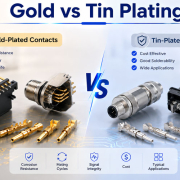
Gold Plating
Advantages:
✔ Excellent corrosion resistance
✔ Stable electrical performance
✔ Suitable for high mating cycles
Applications:
- Medical equipment
- Communication systems
- Precision electronics
Tin Plating
Advantages:
✔ Cost-effective
✔ Good solderability
✔ Suitable for many power applications
Limitations:
- Lower corrosion resistance compared with gold
Applications:
- General industrial connections
- Power terminals
5.Matching Materials to Application Environments
Different applications require different material combinations.
Different applications require different material combinations.
| Application | Housing | Seal | Contact |
|---|---|---|---|
| Industrial Automation | PA/PBT | Silicone/EPDM | Copper Alloy + Plating |
| Outdoor Equipment | PBT/PPS | EPDM/Silicone | Corrosion-resistant contacts |
| Medical Equipment | Engineering Plastic | Silicone | Gold-plated contacts |
| Robotics | PBT/PA | Flexible Seals | High-cycle contact alloys |
| Energy Storage | High-strength Resin | High-temperature Seal | High-current Copper Alloy |
Material selection should always consider:
- Temperature range
- Current load
- Mechanical movement
- Environmental exposure
- Required service life
6.Material Selection and Connector Reliability Testing
Material selection should be supported by validation testing.
Common tests include:
Environmental Testing
- Temperature cycling
- Humidity testing
- Salt spray testing
Mechanical Testing
- Insertion and extraction force
- Mating cycle testing
- Vibration testing
Electrical Testing
- Contact resistance testing
- Insulation resistance
- High-voltage testing
Testing confirms that the selected materials can perform reliably under real operating conditions.
How FPIC Approaches Connector Material Selection
FPIC develops and manufactures connector solutions for industrial automation, energy storage, automotive, robotics, and other demanding applications.
Our connector designs consider:
- Housing material performance
- Contact reliability
- Environmental requirements
- Mechanical durability
- Application-specific testing
By combining material selection with engineering validation, FPIC helps customers achieve reliable connector performance from prototype development through mass production.
Final Thoughts
Connector reliability begins with material selection.
The housing resin protects the structure, sealing materials prevent environmental damage, and contact alloys ensure stable electrical performance.
Choosing the right combination requires understanding the application’s:
- Temperature
- Environment
- Electrical requirements
- Mechanical stress
- Service life expectations
For engineers and OEM buyers, evaluating connector materials early in the design process can significantly reduce field failures and improve long-term system reliability.
The best connector is not only designed correctly—it is built with the right materials.
FAQ
What is the most important material in a connector?
There is no single most important material. Housing resin, seals, and contact materials work together to determine connector performance.
Why does connector housing material matter?
The housing provides mechanical protection, insulation, and environmental resistance for internal contacts.
What is the difference between gold and tin contacts?
Gold provides better corrosion resistance and longer mating life, while tin is more cost-effective for many general applications.
Which seal material is best for outdoor connectors?
Silicone and EPDM are commonly used because of their weather resistance and durability.
How do engineers select connector materials?
Engineers evaluate temperature, environment, electrical load, mating cycles, mechanical stress, and reliability requirements.
Need a Connector Designed for Your Application?
FPIC provides customized connector solutions for industrial automation, robotics, energy storage, automotive, and other demanding applications.
From material selection and connector design to testing and mass production, FPIC helps customers build reliable interconnection systems.
Contact FPIC today to discuss your connector requirements.
Resources
- IEC 60529 – Degrees of Protection Provided by Enclosures (IP Code)
https://www.iec.ch/
International standard defining protection levels against dust and water ingress. - IPC/WHMA-A-620 – Requirements and Acceptance for Cable and Wire Harness Assemblies
https://www.ipc.org/
Industry standard covering cable assembly workmanship and acceptance criteria. - IEC 60512 – Connectors for Electronic Equipment – Tests and Measurements
https://www.iec.ch/
Provides test methods for connector electrical and mechanical performance. - UL Solutions – Connector and Electrical Component Safety
https://www.ul.com/
Technical resources related to electrical component safety and reliability. - ISO 16750 – Road Vehicles Environmental Conditions and Testing
https://www.iso.org/
Environmental testing guidance for automotive electrical and electronic components.