Connector Failure Analysis in Vehicles: Fretting, Water Ingress and Thermal Stress
Automotive connectors are designed to operate reliably for more than a decade under demanding conditions. However, many field failures are not caused by design flaws alone, but by a combination of environmental stress, installation conditions, and long-term degradation mechanisms.
Understanding how and why connectors fail is critical for improving system reliability, reducing warranty costs, and optimizing design decisions early in development.
Among the most common and impactful failure mechanisms in vehicles are fretting corrosion, water ingress, and thermal stress. These factors often act together, accelerating degradation beyond what isolated testing may predict.
Why Connector Failure Analysis Matters
Connector failures rarely occur as sudden events. Most are the result of gradual degradation processes that evolve over time.
Without proper failure analysis:
- root causes may be misidentified
- corrective actions may be ineffective
- the same issues may repeat across projects
A structured failure analysis approach helps engineers link symptoms to underlying mechanisms and implement targeted improvements.
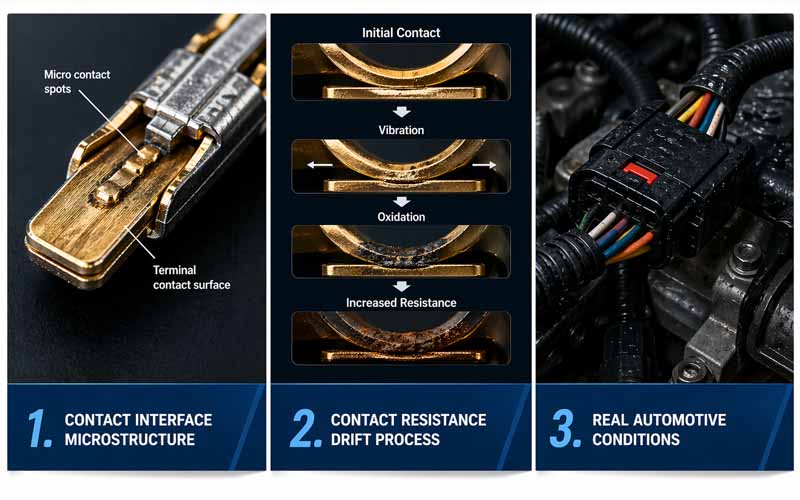
Fretting Corrosion: The Hidden Failure Mechanism
Fretting corrosion is one of the most common causes of intermittent electrical failure in automotive connectors.
How It Happens
- vibration causes micro-motion between contact surfaces
- protective plating wears away
- oxide debris forms at the interface
- electrical resistance increases
This process is often invisible from the outside, making it difficult to detect during inspection.
Typical Symptoms
- intermittent signal loss
- unstable electrical performance
- increased contact resistance
- no visible mechanical damage
Where It Occurs
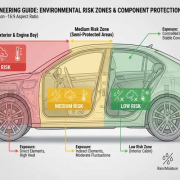
- engine bay connectors
- chassis-mounted harnesses
- high-vibration zones
Water Ingress: The Silent Reliability Killer
Water ingress occurs when moisture penetrates the connector interface or wiring system.
Causes
- insufficient sealing design
- damaged or misassembled seals
- improper connector orientation
- aging of sealing materials
Effects
- corrosion of terminals
- increased contact resistance
- short circuits or leakage paths
- long-term degradation of insulation
High-Risk Scenarios
- underbody applications
- areas exposed to road spray or pressure washing
- connectors with compromised sealing integrity
Even connectors with high IP ratings can fail if sealing is not maintained during assembly or service.
Thermal Stress: Long-Term Degradation Driver
Thermal stress results from repeated temperature changes and heat generation during operation.
Sources
- ambient temperature variation
- heat from nearby components
- current-induced heating (I²R losses)
Effects on Connectors
- material expansion and contraction
- loss of contact force
- seal degradation
- accelerated aging of materials
Combined Effects
Thermal stress often amplifies other failure mechanisms:
- increased temperature accelerates corrosion
- material softening reduces mechanical stability
- cycling creates micro-movements that lead to fretting
Why Failures Are Often Multi-Factor
In real automotive environments, failures are rarely caused by a single factor.
For example:
- vibration → fretting corrosion
- moisture → oxidation
- temperature → material degradation
These factors interact, creating compounded effects that are more severe than individual stresses.
This is why connectors that pass standard tests may still fail in field conditions.
Failure Analysis Methods
A systematic approach to connector failure analysis typically includes:
Visual Inspection
- check for corrosion, discoloration, or damage
Electrical Testing
- measure contact resistance
- check continuity and insulation
Microscopic Analysis
- identify fretting wear or oxide layers
Environmental Testing
- reproduce failure under controlled stress conditions
Prevention Strategies
Design Level
- select appropriate materials and plating
- ensure sufficient contact force
- design for sealing and environmental protection
System Level
- optimize harness routing to reduce vibration
- avoid water accumulation points
- ensure proper connector orientation
Manufacturing and Assembly
- ensure correct seal installation
- maintain consistent crimp quality
- control assembly processes
Validation
- include combined stress testing
- simulate real installation conditions
- perform long-term aging tests
How FPIC Supports Failure Prevention
Preventing connector failure requires integration across design, manufacturing, and validation.
FPIC supports customers with:
- connector and harness design optimization
- sealing and routing strategy review
- controlled assembly processes
- validation aligned with real-world conditions
By addressing failure mechanisms early, long-term reliability can be significantly improved.
Final Thoughts
Connector failures in vehicles are rarely random. They are the result of predictable physical and environmental processes.
Fretting corrosion, water ingress, and thermal stress are among the most critical factors affecting long-term reliability—and they often work together.
Understanding these mechanisms allows engineers to move from reactive troubleshooting to proactive design improvement.
FAQ
What is the most common cause of connector failure in vehicles?
Fretting corrosion caused by vibration is one of the most common causes, especially in high-vibration environments.
Can sealed connectors prevent all water ingress issues?
No. Sealing effectiveness depends on design, assembly quality, and long-term material performance.
How does temperature affect connector reliability?
Thermal cycling can reduce contact force, degrade materials, and accelerate other failure mechanisms.
Why do connectors fail even after passing tests?
Because real-world conditions often involve combined stresses that are not fully replicated in standard testing.
How can connector failures be reduced?
Through proper design, material selection, assembly control, and realistic validation testing.
CTA
Reduce Connector Failure Risk in Your System
Understanding failure mechanisms is the first step toward building reliable systems.
FPIC provides connector and wire harness solutions designed for real-world conditions, helping reduce failure risk and improve long-term performance.
Contact us to discuss your application challenges.
Resources
- USCAR-2 – Automotive Connector Performance Specification: defines durability and environmental testing methods for connectors.
- TE Connectivity – Fretting Corrosion in Electrical Contacts: explains vibration-induced degradation mechanisms.
- Molex – Sealed Connector Design and Water Ingress: discusses sealing strategies and failure risks.
- Amphenol – Thermal Effects on Connector Systems: covers temperature-related reliability challenges.
- IEC 60512 – Connector Testing Standards: provides standard test methods for electrical connectors.