How to Select High-Voltage Connectors for BESS Cabinets
BESS cabinets are getting more powerful, more compact, and more demanding. That is changing the way engineers and sourcing teams evaluate high-voltage connectors. What used to be treated as a simple power connection is now part of a broader discussion about safety, thermal stability, installation efficiency, and long-term operating risk.
If you are selecting connectors for a battery energy storage cabinet, the right question is no longer just “What voltage and current do I need?” A better question is “Which connector platform helps the cabinet operate more safely, integrate more cleanly, and remain easier to build and maintain over time?”
Why Connector Selection in BESS Cabinets Is Becoming More Strategic
A BESS cabinet is not just a box full of batteries. It is a system-level power architecture that must manage electrical load, temperature, mechanical layout, installation logic, maintenance access, and compliance expectations at the same time.
Inside that architecture, the connector sits in a critical position. It can link battery modules, racks, busbars, cabinet-level power paths, and distribution interfaces. That means connector selection affects much more than the simple ability to pass current.
A poorly chosen connector can create avoidable problems such as:
- excess temperature rise at the interface
- difficult routing in compact cabinet layouts
- inconsistent installation on the production floor
- polarity or mating mistakes during assembly or service
- poor maintenance access during replacement
- lower long-term reliability under real operating conditions
By contrast, a well-selected high-voltage connector helps make the cabinet safer, cleaner to integrate, and easier to manage over the full system lifecycle.
Start with the Real Application, Not Just the Catalog Spec
One of the most common mistakes in connector selection is to begin and end with rated voltage and rated current. Those values matter, but they do not tell the full story.
In BESS cabinet design, you should first define the real application environment:
1. Where is the connector used in the system?
A connector used for a battery rack interface does not always face the same requirements as one used for an internal cabinet power path or a service interface.
2. What load conditions will it actually see?
A catalog rating may look sufficient, but the real question is whether the connector can support the required current with stable contact behavior and acceptable temperature rise in the actual cabinet environment.
3. How will the connector be installed and serviced?
If the design requires fast, repeatable installation or easier field replacement, connector structure becomes just as important as electrical performance.
Selection becomes much easier when you treat the connector as a system interface rather than a standalone part.
Safety Should Be the First Screening Standard
In a high-voltage BESS cabinet, safety is not a secondary attribute. It is a first-level filter.
When reviewing connector options, teams should evaluate whether the design supports safer installation and operation in real conditions.
1. Touch-Proof Structure
Touch-proof design helps reduce the risk of accidental contact with energized conductive points. This is especially valuable during cabinet assembly, maintenance, and replacement operations.
2. Polarity Clarity and Anti-Misplug Design
In modular energy storage systems, polarity mistakes create unnecessary risk. Mechanical keying, coding, and clear positive/negative differentiation can help reduce installation errors.
3. Secure Mating Logic
A connector should provide stable electrical and mechanical engagement. Secure mating improves confidence during assembly and helps maintain contact stability during operation.
4. Application-Appropriate Compliance Direction
Many customers now consider compliance readiness earlier in the design cycle. Even when the final certification belongs to the complete system, connector selection still affects the path toward safer and more credible product integration.
Current Rating Must Be Evaluated Together with Thermal Performance
Current rating is still a basic selection parameter, but in BESS cabinets it should always be considered together with thermal performance.
Why? Because a connector that carries current on paper can still become a weak point in the cabinet if contact resistance is unstable or if heat builds up in a tight installation space.
That is why engineers should evaluate:
- rated current
- conductor compatibility
- contact resistance stability
- termination method
- expected temperature rise
- real cabinet airflow and space constraints
This is where high-current connector design becomes more than a numbers exercise. It becomes a thermal and reliability decision.
Installation Efficiency Matters More Than Many Teams Expect
In large-scale BESS deployment, installation speed and consistency matter. Connector design directly affects both.
A connector that supports a cleaner mating process, better cable routing, and clearer installation logic can help reduce:
- assembly time
- operator error
- rework risk
- field service time later
This is why the market is paying more attention to connector systems that improve installation, not only electrical transfer.
For BESS cabinet builders, connection efficiency can influence both production cost and long-term service experience.
Do Not Ignore Serviceability and Maintenance Access
BESS systems are long-life assets. That means maintainability should be part of connector selection from the beginning.
A connector that is difficult to reach, hard to disconnect, or easy to reconnect incorrectly may create future service cost even if it performs acceptably on day one.
Good high-voltage connector selection should therefore consider:
- access during inspection
- clarity during remating
- replacement convenience
- compatibility with modular cabinet design
In practice, the best connector is often the one that supports both stable operation and more predictable service work.
What to Look for in a High-Voltage Connector for BESS Cabinets
A practical selection checklist usually includes the following questions:
- 1. Is the voltage platform aligned with the target system?
The connector should fit the actual platform requirement, whether the project is centered on 1000V, 1500V, or higher-voltage development.
- 2. Is the current rating suitable for real cabinet conditions?
Do not treat rated current as an isolated number. Confirm the connector matches the true load path and thermal expectations.
- 3. Does the structure support safer use?
Look for features such as touch-proof protection, mechanical keying, polarity control, and stable locking.
- 4. Does it integrate well into the cabinet design?
Panel mounting logic, cable routing, space efficiency, and mating orientation all affect integration quality.
- 5. Will the connector support installation and maintenance efficiency?
Selection should support not only the first assembly, but also future service and replacement.
Where FPIC’s 2000V 450A Energy Storage Connector Fits
For customers developing higher-voltage and higher-current BESS cabinet systems, FPIC’s 2000V 450A energy storage connector offers a strong option for projects that need more than a basic power interface.
This connector direction is relevant when the application requires:
- higher-voltage connector capability
- stronger high-current support
- cabinet-level safety-oriented connection design
- structured installation logic
- improved routing flexibility
- support for more advanced battery-system integration
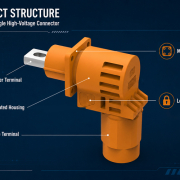
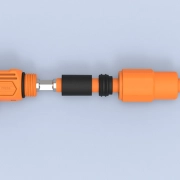
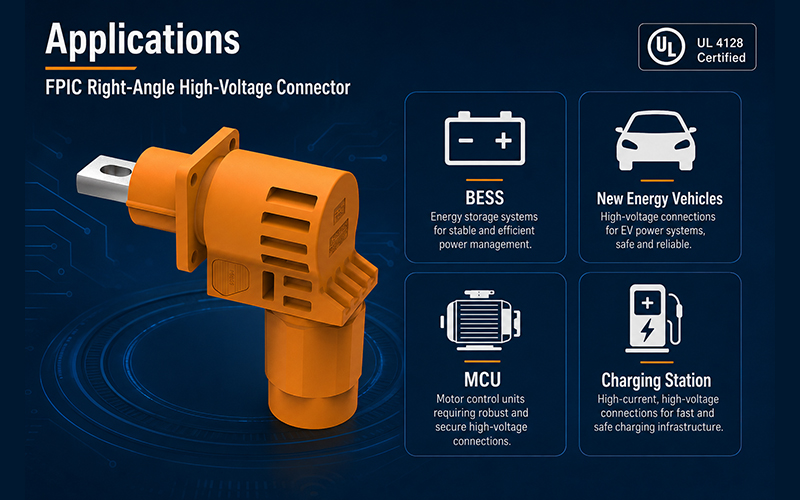
FPIC’s energy storage connector development already includes features such as touch-proof design, 360° rotating plug structure, different installation keying options, and multiple connection methods, which are directly relevant to the practical needs of BESS cabinet integration.
That makes the product easier to position not just as a connector, but as part of a safer and more serviceable cabinet interconnection solution.
How FPIC Supports Broader Energy Storage Connector Needs
FPIC’s energy storage connector portfolio is not limited to one flagship product. Internal product materials already cover multiple platform levels, including 1000V and 1500V ES series configurations, with different current ranges and structural options for energy storage applications.
This broader platform logic matters because BESS customers do not all need the same interface level. Some projects focus on mainstream 1500V cabinet architectures. Others increasingly move toward higher-voltage, higher-current platforms where the 2000V 450A direction becomes more attractive.
That gives FPIC a stronger story in content marketing and customer communication:
- 1000V and 1500V platforms support broader application coverage
- 2000V 450A supports higher-power differentiation
- safety-oriented structure supports BESS cabinet messaging
- UL-related product positioning supports stronger credibility in global discussions
Final Recommendation
If you are selecting a high-voltage connector for a BESS cabinet, do not reduce the decision to voltage and current alone.
Instead, evaluate the connector from five angles:
- safety
- current and thermal stability
- installation efficiency
- cabinet integration fit
- maintenance practicality
That approach leads to better system decisions and reduces the risk of solving one problem while creating another.
As the BESS market keeps moving toward safer, more integrated, and more serviceable systems, high-voltage connector selection will continue to play a larger role in overall cabinet design quality.
Contact FPIC
Looking for a high-voltage connector solution for BESS cabinets, battery racks, or high-current storage systems?
FPIC can support connector communication and product matching for energy storage applications, including higher-power projects that require stronger safety and integration logic.
Email: info@fpiconn.com
Website: fpiconn.com
Resources
- Reuters. Lithium producers bet on battery storage as demand shifts beyond EVs. June 24, 2026.
- Molex. Designing Battery Energy Storage Systems (BESS).
- Phoenix Contact. Connectors for Energy Storage Systems.
- Connector Supplier. Battery Connectors: The Unsung Heroes of BESS Applications.