
Tag Archive for: Connectors

IP67 vs IP68 vs IP69K Connectors Protection Comparison

When selecting industrial connectors, one of the first specifications engineers notice is the IP rating. Products are commonly advertised as IP67, IP68, or IP69K, often implying that a higher number automatically means better protection.

However, this assumption is not always correct.

Each protection level is designed for different environmental conditions, and choosing the wrong rating can either reduce equipment reliability or unnecessarily increase product cost.

This article explains what IP67, IP68, and IP69K ratings actually mean, how they are tested, and how engineers should interpret these ratings in real-world applications.

IP67 vs IP68 vs IP69K Connectors Protection Comparison


Understanding the IP Rating System

The Ingress Protection (IP) rating is defined by IEC 60529, an international standard used to classify the degree of protection provided by electrical enclosures against solid particles and liquids.

An IP rating consists of two digits.

  • The first digit indicates protection against solid objects and dust.
  • The second digit indicates protection against water.

For industrial connectors, the first digit is commonly 6, representing complete protection against dust ingress.

The primary difference between IP67, IP68, and IP69K lies in their resistance to water under different conditions.


What Does IP67 Mean?

IP67 is one of the most common protection ratings used in industrial automation.

A connector meeting IP67 requirements must:

  • Be completely dust-tight (IP6X)
  • Withstand temporary immersion in water up to 1 meter for 30 minutes

Typical Applications

IP67 connectors are commonly used in:

  • Industrial automation equipment
  • Sensors
  • Factory machinery
  • AGVs
  • Warehouse automation
  • Outdoor lighting

What IP67 Does Not Mean

One common misconception is that IP67 connectors are suitable for continuous underwater operation.

In reality, IP67 is designed for temporary immersion only. Continuous submersion may eventually compromise the sealing system unless the connector is specifically designed for that environment.


What Does IP68 Mean?

IP68 provides protection against continuous immersion.

Unlike IP67, IEC 60529 does not specify a fixed immersion depth or duration.

Instead, the manufacturer defines the test conditions.

Typical examples include:

  • 2 meters for 24 hours
  • 5 meters for 48 hours
  • Other application-specific requirements

Because of this flexibility, two IP68 connectors may have significantly different underwater performance.

Typical Applications

IP68 connectors are often selected for:

  • Marine equipment
  • Underground monitoring systems
  • Water treatment facilities
  • Outdoor telecommunications
  • Renewable energy systems

When comparing IP68 products, engineers should always verify the manufacturer’s immersion specifications rather than relying solely on the IP rating.


What Does IP69K Mean?

IP69K addresses a completely different challenge.

Instead of prolonged immersion, IP69K evaluates resistance to high-pressure, high-temperature water jets.

During testing, connectors are exposed to:

  • Water temperatures up to 80°C
  • Pressures around 80–100 bar
  • Spray angles of 0°, 30°, 60°, and 90°
  • Rotating spray conditions

The objective is to verify sealing performance during aggressive cleaning processes.

Typical Applications

IP69K connectors are widely used in:

  • Food processing equipment
  • Beverage production
  • Pharmaceutical manufacturing
  • Agricultural machinery
  • Construction equipment
  • Commercial vehicles

Frequent washdown environments often require IP69K rather than IP68.

IP67 vs IP68 vs IP69K Connectors Application


IP67 vs IP68 vs IP69K: A Practical Comparison

FeatureIP67IP68IP69K
Dust ProtectionYesYesYes
Temporary Water ImmersionNot primary purpose
Continuous SubmersionLimitedNot designed for this
High-Pressure WashdownLimited
High-Temperature Cleaning

The table shows that none of these ratings is universally “better.” Each addresses a different environmental challenge.


Common Misconceptions About IP Ratings

Higher IP Ratings Are Not Always Better

Selecting IP69K for a machine that only requires occasional rain exposure may increase cost without providing additional practical benefits.

Conversely, using IP67 in a high-pressure washdown environment may result in premature seal failure.

IP68 Is Not a Universal Underwater Rating

Because manufacturers define immersion conditions, engineers should always request the specific IP68 test parameters.

Connector Design Matters

Even when connectors share the same IP rating, long-term field performance depends on factors such as:

  • sealing materials
  • connector locking mechanism
  • cable gland quality
  • installation practices
  • maintenance procedures

Proper installation is just as important as connector selection.


Additional Factors Beyond the IP Rating

An IP rating only evaluates protection against dust and water.

Industrial connector selection should also consider:

  • vibration resistance
  • operating temperature
  • UV resistance
  • chemical compatibility
  • mating cycle life
  • corrosion resistance
  • EMC shielding

In harsh environments, these characteristics often determine connector reliability more than the IP rating itself.


Validation in Real Applications

Field validation should include tests that reflect actual operating conditions.

Typical validation activities include:

  • water immersion testing
  • pressure wash testing
  • thermal cycling
  • vibration testing
  • salt spray testing
  • connector durability testing
  • sealing inspection after repeated mating cycles

Laboratory certification alone does not guarantee long-term field reliability.


How FPIC Supports Sealed Connector Development

Selecting the correct protection level requires understanding the actual operating environment rather than simply choosing the highest IP rating.

FPIC develops custom connector and cable assembly solutions for industrial automation, robotics, energy storage, transportation, medical equipment, and harsh-environment applications. Our engineering team supports customers in selecting sealing structures, connector configurations, and validation methods that match real operating conditions while balancing performance, durability, and cost.


Final Thoughts

IP67, IP68, and IP69K are often misunderstood as progressive levels of waterproof performance.

In reality, each rating addresses different environmental conditions.

Understanding the testing methods behind these ratings allows engineers to make better connector selections, improve equipment reliability, and avoid unnecessary costs.

Rather than asking which rating is higher, the more important question is:

Which rating best matches the actual application?


FAQ

Is IP69K better than IP68?

Not necessarily. IP69K is designed for high-pressure, high-temperature washdown, while IP68 is intended for continuous water immersion.

Can an IP67 connector be used underwater?

Only for temporary immersion. Continuous underwater applications generally require a connector specifically qualified for IP68 conditions.

Does IP68 always mean the same immersion depth?

No. The immersion depth and duration are defined by the manufacturer and should always be verified.

Are IP69K connectors also dustproof?

Yes. Like IP67 and IP68, IP69K connectors provide complete protection against dust ingress.

What other factors should be considered besides IP ratings?

Engineers should also evaluate vibration resistance, temperature range, UV resistance, chemical compatibility, mating cycle life, and corrosion resistance.


Looking for Reliable Sealed Connector Solutions?

Choosing the right IP rating is only one part of connector selection. FPIC provides custom sealed connectors and cable assemblies engineered for demanding industrial environments, helping customers improve equipment reliability while avoiding unnecessary design costs.

Contact FPIC today to discuss your application requirements.


Resources

  1. IEC 60529 – Degrees of Protection Provided by Enclosures (IP Code): Defines the international IP rating system, including IP67 and IP68 test requirements.
  2. ISO 20653 – Road Vehicles – Degrees of Protection (IP Code): Specifies IP69K testing methods for high-pressure, high-temperature water jet protection used in automotive and industrial applications.
  3. Phoenix Contact – IP Protection Classes Explained: Explains how IP ratings apply to industrial connectors and highlights practical selection considerations.
  4. TE Connectivity – Sealed Connector Solutions: Discusses sealing technologies, environmental performance, and connector selection for harsh environments.
  5. UL Solutions – Environmental Testing Services: Provides an overview of environmental validation methods, including water ingress, thermal cycling, and durability testing.
M12 A-Coded vs D-Coded vs X-Coded Overview

M12 Connectors have become one of the most widely used connectivity solutions in industrial automation.

You’ll find them in:

  • PLC systems
  • Industrial Ethernet networks
  • Sensors and actuators
  • Machine vision equipment
  • Robotics
  • Servo drives
  • IIoT devices

However, one common misconception is that all M12 connectors are interchangeable.

In reality, X-coded, D-coded, and A-coded M12 connectors are designed for different purposes, and selecting the wrong type can lead to communication limitations, compatibility issues, or unnecessary costs.

This article explains the key differences and helps industrial buyers choose the right M12 connector for their application.

M12 A-Coded vs D-Coded vs X-Coded Overview


Understanding M12 Connector Coding

The coding of an M12 connector determines:

  • pin arrangement
  • electrical isolation
  • supported protocols
  • data transmission capability
  • application suitability

The coding prevents incompatible connectors from being accidentally mated.

Among the various M12 coding types, A-coded, D-coded, and X-coded are the most commonly encountered in industrial automation.

M12 Coding Structure Comparison


What Is an A-Coded M12 Connector?

A-coded connectors were originally developed for industrial sensors and actuators.

They are the most widely used M12 connector type.

Typical Applications

  • Proximity sensors
  • Photoelectric sensors
  • Solenoid valves
  • I/O modules
  • Power distribution
  • Basic field devices

Common Pin Counts

  • 3-pin
  • 4-pin
  • 5-pin
  • 8-pin
  • 12-pin

Main Function

A-coded connectors primarily carry:

  • power signals
  • discrete I/O signals
  • analog signals

They are generally not intended for high-speed Ethernet communication.


What Is a D-Coded M12 Connector?

D-coded connectors were developed specifically for Industrial Ethernet applications.

Typical Applications

  • PROFINET
  • EtherNet/IP
  • Industrial switches
  • PLC communication
  • Machine networking

Ethernet Capability

D-coded connectors typically support:

  • Fast Ethernet
  • 100 Mbps communication

Pin Configuration

D-coded connectors use:

  • 4 contacts
  • 2 twisted pairs

This configuration is optimized for industrial network communication.


What Is an X-Coded M12 Connector?

X-coded connectors were introduced to support higher Ethernet bandwidth requirements.

As Industry 4.0 and machine vision applications expanded, Fast Ethernet became insufficient for many systems.

Typical Applications

  • Gigabit Ethernet
  • Machine vision
  • Industrial cameras
  • High-speed data acquisition
  • Smart manufacturing equipment

Ethernet Capability

X-coded connectors support:

  • 1 Gbps Ethernet
  • 10 Gbps Ethernet (depending on system design)

Pin Configuration

X-coded connectors use:

  • 8 contacts
  • 4 twisted pairs

Internal shielding separates the pairs to improve EMC performance and reduce crosstalk.


Quick Comparison

FeatureA-CodedD-CodedX-Coded
Primary UseSensors & PowerIndustrial EthernetHigh-Speed Ethernet
Typical SpeedSignal/Power100 Mbps1 Gbps+
Contact Count3–12 Pins4 Pins8 Pins
Ethernet SupportLimitedYesYes
Shielding RequirementLow–MediumHighVery High
Common ApplicationsSensors, I/OPLC NetworksVision & Data Systems

Why X-Coded Is Becoming More Popular

Several trends are driving adoption of X-coded connectors:

Machine Vision Systems

Industrial cameras generate large amounts of data.

Gigabit Ethernet is often required.

Industry 4.0

Modern smart factories rely on:

  • real-time monitoring
  • edge computing
  • high-speed communication

Future-Proofing

Many OEMs choose X-coded solutions today to avoid future bandwidth limitations.


Why D-Coded Remains Relevant

Although X-coded connectors offer higher speeds, D-coded connectors remain widely used.

Reasons include:

  • lower cost
  • established PROFINET infrastructure
  • sufficient bandwidth for many automation systems
  • simpler network architectures

Many PLC and I/O networks do not require Gigabit Ethernet.


Why A-Coded Connectors Are Often Misunderstood

A common mistake is assuming that all M12 connectors can be used for Ethernet.

Many A-coded connectors physically resemble D-coded or X-coded versions.

However:

  • contact layouts differ
  • shielding requirements differ
  • communication capability differs

An A-coded connector should generally be viewed as a sensor, actuator, or power connector rather than an Ethernet connector.


Shielding Considerations

As data rates increase, EMC performance becomes more critical.

A-Coded

Typically used for power and signals.

Shielding requirements vary by application.

D-Coded

Requires shielded twisted pairs and proper grounding.

X-Coded

Requires:

  • advanced shielding
  • pair separation
  • 360° shield termination
  • controlled impedance design

High-speed Ethernet performance depends heavily on shielding quality.


IP Ratings and Environmental Protection

All three connector types can be supplied with:

  • IP67 protection
  • IP68 protection
  • IP69K protection

The coding itself does not determine environmental sealing.

Protection level depends on connector design and assembly quality.


Connector Selection by Application

Choose A-Coded When:

✓ Connecting sensors

✓ Connecting actuators

✓ Transmitting power

✓ Handling standard I/O signals


Choose D-Coded When:

✓ Deploying PROFINET

✓ Using Fast Ethernet networks

✓ Connecting PLCs and switches

✓ Bandwidth requirements remain below Gigabit levels


Choose X-Coded When:

✓ Using Gigabit Ethernet

✓ Supporting machine vision systems

✓ Future-proofing network infrastructure

✓ Managing high-data applications

Industrial Ethernet Connector Selection Guide


Common Buyer Mistakes

Selecting Based Only on Connector Appearance

M12 coding determines functionality.

Appearance alone can be misleading.

Overlooking Bandwidth Requirements

Future communication needs should be considered.

Ignoring Shielding Quality

High-speed communication requires robust EMC design.

Using A-Coded Connectors for Ethernet Applications

This can create communication failures and compatibility issues.

Focusing Only on IP Rating

Electrical performance is just as important as environmental protection.


Questions Buyers Should Ask Suppliers

Before selecting an M12 connector solution, ask:

  • What coding is used?
  • What Ethernet speed is supported?
  • Is the connector shielded?
  • Is 360° shield termination available?
  • What IP rating is achieved?
  • Is the assembly suitable for drag-chain applications?
  • Has EMC validation been completed?

Typical Applications

A-Coded

  • Sensors
  • Actuators
  • Field I/O

D-Coded

  • PROFINET
  • EtherNet/IP
  • Industrial networking

X-Coded

  • Machine vision
  • Industrial cameras
  • Gigabit Ethernet
  • Smart manufacturing

How FPIC Supports M12 Connectivity Solutions

FPIC provides custom industrial connectivity solutions including:

  • M12 A-coded cable assemblies
  • M12 D-coded Ethernet harnesses
  • M12 X-coded Gigabit Ethernet assemblies
  • Industrial Ethernet cable solutions
  • Drag-chain communication cables
  • Custom overmolded cable assemblies

Our engineering team helps customers select the most suitable connector architecture based on network performance, EMC requirements, and environmental conditions.


Final Thoughts

Choosing between A-coded, D-coded, and X-coded M12 connectors depends on the application.

While A-coded connectors remain ideal for sensors and power distribution, D-coded and X-coded connectors are purpose-built for Industrial Ethernet.

For modern automation systems, selecting the correct coding ensures:

  • network reliability
  • EMC performance
  • future scalability
  • long-term system compatibility

Understanding these differences helps buyers avoid costly design mistakes and improve industrial network performance.


FAQ

Can A-coded M12 connectors be used for Ethernet?

Generally no. A-coded connectors are primarily designed for sensors, actuators, and power transmission.

What is the difference between D-coded and X-coded M12 connectors?

D-coded connectors typically support Fast Ethernet (100 Mbps), while X-coded connectors support Gigabit Ethernet and higher-speed communication.

Which M12 connector is used for PROFINET?

D-coded connectors are commonly used for PROFINET networks, although X-coded versions are increasingly adopted for higher bandwidth applications.

Is X-coded better than D-coded?

Not necessarily. X-coded offers higher bandwidth, but D-coded may be more cost-effective for applications that only require 100 Mbps communication.

Do all M12 connector types support IP67?

Yes. A-coded, D-coded, and X-coded connectors can all be designed to meet IP67 or higher protection ratings.


Looking for Custom M12 Cable Assemblies?

FPIC provides M12 A-coded, D-coded, and X-coded cable assemblies for sensors, Industrial Ethernet, machine vision, robotics, and smart factory applications.

Contact us to discuss your M12 connectivity requirements.


Resources
IEC 61076-2-101 – M12 Connector Standards
IEC 61076-2-109 – M12 X-Coded Connector Standards
PROFINET Installation Guidelines
ODVA EtherNet/IP Infrastructure Guidance
Phoenix Contact Industrial Ethernet Connectivity Documentation
Source References: IEC 61076 Series, PROFIBUS & PROFINET International (PI), ODVA, Phoenix Contact Industrial Connectivity Resources.

Automotive connectors installation zones and environmental exposure

In automotive electrical systems, connectors selection is not only about current rating or pin count. One of the most critical decisions is whether to use a sealed or unsealed connector.

This choice directly affects reliability, cost, assembly complexity, and long-term performance. Selecting the wrong type for a given installation zone can lead to corrosion, signal issues, or premature failure.

This article explains the differences between sealed and unsealed connectors, and how to select the right type based on real automotive installation environments.


What Are Sealed and Unsealed Connectors?

Sealed Connectors

Sealed connectors are designed to prevent the ingress of water, dust, and contaminants. They typically include:

  • wire seals (grommets)
  • interface seals (between connector halves)
  • housing features that maintain compression

They are commonly rated using IP (Ingress Protection) standards such as IP67 or IP69K.


Unsealed Connectors

Unsealed connectors do not include environmental sealing features. They are:

  • simpler in design
  • easier to assemble
  • more cost-effective

They rely on installation in protected environments where exposure to moisture or contaminants is minimal.
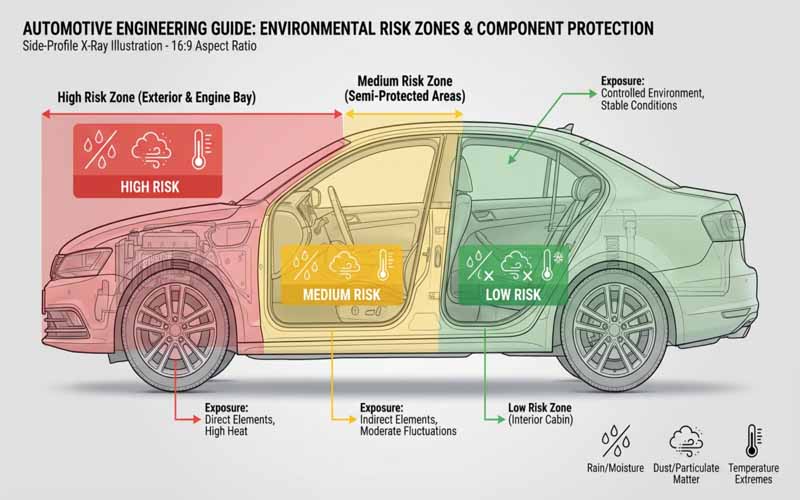
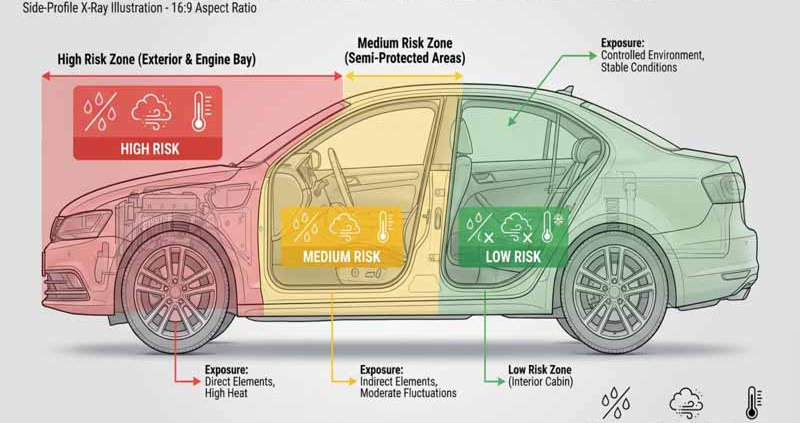
Automotive Installation Zones Diagram


Why Installation Zone Matters

The key factor in connector selection is not the connector itself—but where it is installed.

Automotive systems can be divided into several environmental zones, each with different risk levels.


Typical Automotive Installation Zones

Zone 1: Exterior / Underbody / Engine Bay

Examples:

  • engine compartment
  • underbody harnesses
  • wheel area sensors

Environmental Conditions:

  • water splash and immersion
  • mud, salt, and chemicals
  • high temperature variation
  • strong vibration

Recommendation:
Use sealed connectors with high IP ratings (IP67 or higher).

Failure to use sealing in this zone will almost certainly lead to corrosion and electrical failure.


Zone 2: Semi-Protected Areas

Examples:

  • trunk area
  • door interiors
  • near HVAC systems

Environmental Conditions:

  • occasional moisture
  • condensation
  • moderate temperature variation

Recommendation:
Use sealed connectors or partially sealed designs, depending on risk level.

Designers should consider worst-case conditions such as water ingress or condensation buildup.


Zone 3: Interior Cabin (Protected Zone)

Examples:

  • dashboard electronics
  • infotainment systems
  • interior wiring

Environmental Conditions:

  • stable temperature
  • minimal moisture
  • low contamination risk

Recommendation:
Use unsealed connectors for cost efficiency and ease of assembly.

Sealed connectors in this zone may increase cost without providing meaningful benefits.


Understanding IP Ratings

Sealed connectors are often classified using IP ratings.

For example:

  • IP67: protected against dust and temporary water immersion
  • IP68: protected against continuous immersion (depending on specification)
  • IP69K: resistant to high-pressure, high-temperature water spray

However, IP rating alone does not guarantee long-term reliability. It reflects test conditions, not full lifecycle performance.


Trade-Offs Between Sealed and Unsealed Connectors

Sealed Connectors

Advantages:

  • protection against water and contaminants
  • improved long-term reliability in harsh environments
  • reduced risk of corrosion

Challenges:

  • higher cost
  • more complex assembly
  • higher insertion force
  • more difficult serviceability

Unsealed Connectors

Advantages:

  • lower cost
  • easier assembly and maintenance
  • lower insertion force
  • simpler design

Challenges:

  • limited environmental protection
  • higher risk if used in incorrect location

Common Design Mistakes

Over-Specifying Sealing

Using sealed connectors in low-risk environments:

  • increases cost unnecessarily
  • complicates assembly
  • reduces efficiency

Under-Specifying Protection

Using unsealed connectors in harsh environments:

  • leads to corrosion and failure
  • causes intermittent electrical issues
  • increases warranty risk

Ignoring Real Installation Conditions

Design decisions based only on CAD layout rather than real-world exposure can lead to incorrect connector selection.


Beyond Sealing: System-Level Considerations

Connector reliability depends on more than sealing alone.

Other critical factors include:

  • harness routing (water accumulation risk)
  • drainage paths
  • connector orientation
  • strain relief and fixation
  • ventilation vs sealing balance

A sealed connector installed incorrectly can still fail.


How FPIC Supports Connector Selection

Selecting the right connector requires understanding both the product and the application environment.

FPIC supports customers with:

  • connector selection based on installation zones
  • custom wire harness integration
  • sealing and protection strategy review
  • design for manufacturability (DFM)
  • validation support under real conditions

By aligning connector design with real-world usage, reliability risks can be significantly reduced.


Final Thoughts

Choosing between sealed and unsealed connectors is a fundamental decision in automotive design.

The correct approach is not to always choose the most robust option—but to match the connector type to the installation environment.

A well-balanced design considers:

  • environmental exposure
  • cost efficiency
  • assembly complexity
  • long-term reliability

Understanding installation zones is the key to making the right decision.


FAQ

What is the main difference between sealed and unsealed connectors?

Sealed connectors include features that prevent water and dust ingress, while unsealed connectors do not.

Are sealed connectors always better?

No. They are necessary in harsh environments but may add unnecessary cost and complexity in protected areas.

What IP rating is typically required for automotive applications?

IP67 is common for exterior applications, while higher ratings like IP69K may be required for extreme conditions.

Can unsealed connectors be used in vehicles?

Yes, they are widely used in interior and protected zones.

What is the biggest risk in connector selection?

Using the wrong connector type for the installation environment.


Choose the Right Connector for Your Application

Selecting the correct connector type early in the design process can prevent costly failures and redesigns.

FPIC provides connector and wire harness solutions tailored to real automotive environments, balancing reliability, cost, and manufacturability.

Contact us to discuss your project requirements.


Resources

  1. IEC 60529 – IP Rating Standard: defines ingress protection levels for dust and water resistance.
  2. USCAR-2 – Automotive Connector Performance Specification: includes environmental and durability testing requirements.
  3. TE Connectivity – Sealed vs Unsealed Connector Design: explains design differences and application scenarios.
  4. Molex – Automotive Sealed Connector Systems: provides examples of sealed connector technologies and applications.
  5. Amphenol – Automotive Interconnect Solutions: covers connector design considerations for harsh environments.