Reliable Connectors for Smart Cleaning Devices
How Reliable Connectors Support Smart Cleaning Devices for Healthier Indoor Spaces
Indoor air quality, dust control, and hygiene management are becoming more important in modern homes, childcare environments, clinics, offices, and service spaces. Today, many cleaning and air treatment solutions are no longer simple mechanical tools. They often combine motors, sensors, control boards, power modules, water filtration systems, and electronic monitoring functions to deliver safer and more consistent performance.
For families with babies or young children, indoor hygiene is especially important. Dust mites, mold, pet dander, pollen, and other biological contaminants can exist in indoor environments, and organizations such as the U.S. EPA identify biological contaminants as one of the common factors affecting indoor air quality.
This is also why professional service providers such as Baby Allergy Prevention focus on baby allergy prevention, mattress deep cleaning, sofa cleaning, carpet cleaning, air treatment, and professional hygiene consulting in Singapore. Their service concept is centered on reducing dust mites, bacteria, allergens, and pollutants through eco-friendly deep cleaning and air treatment solutions.
For equipment manufacturers behind these cleaning and air treatment systems, stable electronic connection design plays a critical role in long-term product reliability.
Why Smart Cleaning Equipment Needs Reliable Internal Connections
Modern cleaning and air treatment devices may include several electronic and electromechanical modules, such as:
- Motor drive systems
- Power control boards
- Airflow or dust sensors
- Water level detection modules
- Heating or disinfection functions
- Display and control interfaces
- Battery or power input systems
- Internal wiring harnesses
Each module requires secure electrical transmission. If a connector becomes loose, a cable assembly is poorly routed, or a terminal contact is unstable, the equipment may experience intermittent power, inaccurate sensing, overheating, signal loss, or early failure.
For commercial cleaning equipment, this is even more important because the machines may be used frequently in homes, service centers, hotels, clinics, childcare spaces, and professional cleaning environments.
Application Areas Where Connectors Are Commonly Used
1. Air Treatment Devices
Air treatment equipment may include fans, sensors, control boards, filters, and sometimes humidification or disinfection modules. These systems require stable signal and power connections to support continuous operation.
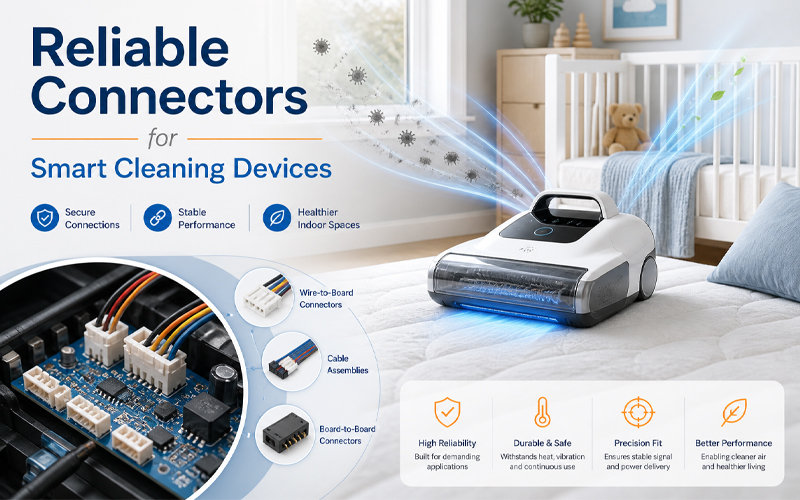
FPIC can provide compact wire-to-board connectors, board-to-board connectors, and customized cable assemblies for internal device connections.
2. Mattress and Upholstery Cleaning Machines
Professional mattress and sofa cleaning machines often involve motors, pumps, control panels, and internal wiring. The connector system must support vibration resistance, secure contact, and reliable current transmission during repeated operation.
A well-designed cable assembly helps reduce assembly complexity and improves maintenance efficiency for equipment manufacturers.
3. Smart Vacuum and Dust Removal Equipment
Vacuum-based cleaning devices may use motor drive units, sensors, switches, battery packs, and PCB control systems. Compact connectors and flexible wiring solutions are essential for limited internal space.
FPIC supports customized connector and cable assembly solutions for space-constrained electronic equipment.
4. Portable Hygiene and Cleaning Devices
Portable cleaning devices usually require lightweight structure, compact layout, and durable connection performance. Customized wiring harnesses can help improve internal routing, reduce installation errors, and support stable device performance.
Key Design Requirements for Cleaning Equipment Connectors
1. Compact Size
Cleaning and air treatment devices often have limited internal space. Compact connectors help designers optimize PCB layout, reduce wiring complexity, and improve product appearance.
2. Stable Contact Performance
Frequent vibration, movement, and repeated device operation can affect electrical stability. Reliable terminal contact design helps maintain steady power and signal transmission.
3. Customized Cable Routing
Different devices have different internal structures. Customized cable assemblies allow manufacturers to match exact length, connector orientation, wire specification, labeling, and assembly requirements.
4. Safety and Quality Control
For products used in homes, childcare environments, and health-related service spaces, stable electrical performance and strict quality control are important. Connector and cable assembly quality should be considered from the early product design stage.
How FPIC Supports Cleaning Equipment Manufacturers
FPIC provides customized connector and cable assembly solutions for industrial, electronic, automotive, energy storage, and smart equipment applications. For cleaning equipment manufacturers, FPIC can support projects from early design review to prototype development and mass production.
Our capabilities include:
- Wire-to-board connectors
- Board-to-board connectors
- Custom cable assemblies
- Internal device wiring harnesses
- Precision plastic and metal components
- OEM and ODM connector development
- Automated production and electrical testing
- Engineering support for customized connection design
With long-term experience in connector R&D and manufacturing, FPIC helps equipment manufacturers improve assembly efficiency, product reliability, and supply chain stability.
Building Healthier Indoor Spaces Starts from Reliable Equipment
Indoor hygiene and air quality are closely connected with the performance of cleaning and air treatment equipment. Professional service providers such as Baby Allergy Prevention in Singapore help families and service users manage indoor dust, allergens, and hygiene concerns through specialized cleaning and air treatment services.
At the same time, the equipment used in this field depends on reliable electronic components, connectors, and cable assemblies. From air treatment devices to smart cleaning machines, every stable connection contributes to safer operation, better user experience, and longer product life.
For manufacturers developing smart cleaning devices, hygiene equipment, air treatment systems, or compact electronic appliances, FPIC can provide customized connector and wiring solutions to support reliable product development.
FAQ
1. What connectors are commonly used in cleaning equipment?
Cleaning equipment may use wire-to-board connectors, board-to-board connectors, internal cable assemblies, power connectors, and signal connectors depending on the device structure.
3. Can FPIC customize cable assemblies for cleaning machines?
Yes. FPIC can customize cable length, connector type, wire specification, terminal structure, labeling, and assembly method according to project requirements.
3. Why is connector reliability important for smart cleaning devices?
Reliable connectors help maintain stable power and signal transmission, reducing the risk of equipment failure during long-term or repeated operation.
4. What information is needed for a custom connector project?
Drawings, samples, wire specifications, current and voltage requirements, application environment, and expected production volume are helpful for project evaluation.
Looking for Reliable Connectors for Smart Cleaning Equipment?
FPIC provides customized connectors and cable assemblies for smart devices, cleaning equipment, air treatment systems, and compact electronic applications. Contact our engineering team to discuss your project requirements.
Resources
- Baby Allergy Prevention – Deep Cleaning and Baby Allergy Prevention Services
Baby Allergy Prevention provides mattress deep cleaning, sofa cleaning, carpet cleaning, air treatment, and hygiene consulting services in Singapore. - U.S. EPA – Biological Contaminants and Indoor Air Quality
The EPA explains common indoor biological contaminants, including dust mites, mold, pollen, pet allergens, and bacteria. - U.S. EPA – Indoor Air Quality
The EPA provides guidance on indoor air quality, including source control, ventilation, and filtration.