Tag Archive for: HVIL Connector

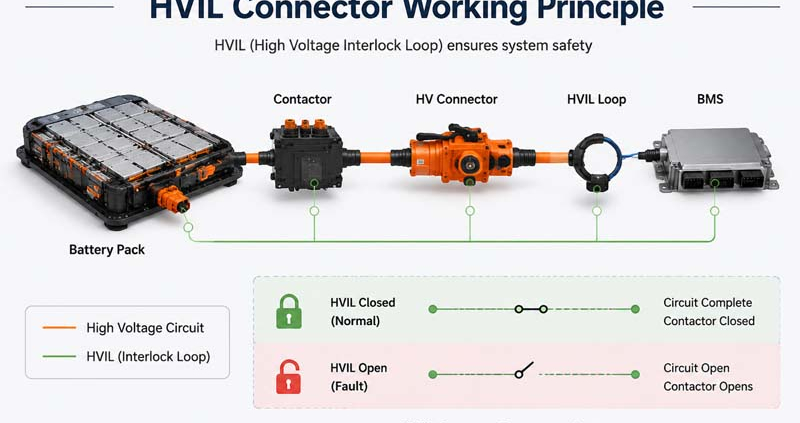
HVIL Connector Working Principle

In electric vehicles (EVs), battery energy storage systems (ESS), and other high-voltage applications, electrical safety extends far beyond insulation and creepage distance.

One of the most important safety mechanisms is the High Voltage Interlock Loop (HVIL).

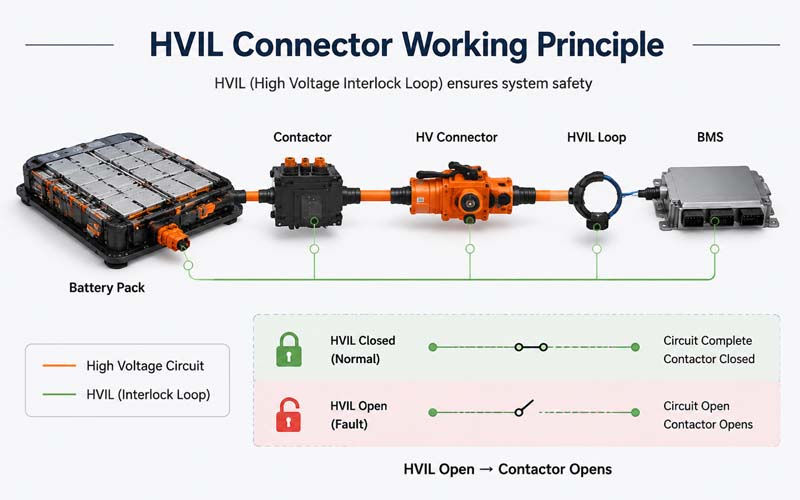
HVIL circuits continuously monitor whether high-voltage connectors, service disconnects, and enclosures are properly engaged. If the loop is interrupted, the control system immediately disables the high-voltage contactors.

Although the HVIL circuit carries only a low-voltage signal, its reliability is essential to the safe operation of the entire system.

This article explains how HVIL connectors work, common failure modes, and the validation tests used to ensure robust performance.
HVIL Connector Working Principle


What Is HVIL?

HVIL stands for High Voltage Interlock Loop.

It is a low-current monitoring circuit that passes through:

  • battery pack connectors
  • inverter connectors
  • onboard chargers
  • DC fast charging interfaces
  • service disconnects
  • high-voltage enclosures

When all connectors are fully mated and covers are closed, the loop remains intact.

If any component is opened or partially disconnected, the loop opens and the system shuts down high voltage.


Why HVIL Is Important

HVIL helps protect:

  • service technicians
  • assembly operators
  • end users
  • vehicle electronics

Typical safety functions include:

  • disabling contactors before connector separation
  • detecting incomplete mating
  • monitoring service access covers
  • preventing energized exposure

In most EV architectures, HVIL is part of the functional safety strategy.


Basic HVIL Operating Principle

The battery management system (BMS) or vehicle control unit injects a low-voltage signal through the interlock loop.

The controller monitors:

  • loop continuity
  • resistance value
  • voltage level

If the signal falls outside expected limits, a fault is triggered.

Some systems use simple open/closed detection, while others use resistor coding to identify specific components.


HVIL Connector Design Features

A dedicated HVIL connector typically includes:

  • two low-voltage interlock contacts
  • staggered contact lengths
  • early-break / late-make sequencing
  • CPA locking features
  • sealed housing
  • mechanical polarization

The HVIL contacts are usually designed to disconnect before the high-voltage power contacts separate.


Early-Break / Late-Make Concept

HVIL contacts are intentionally longer or shorter than power contacts.

During Unmating

The HVIL circuit opens first, allowing contactors to open before high-voltage contacts separate.

During Mating

Power contacts are fully engaged before the HVIL loop closes.

This sequencing is critical to system safety.


Common HVIL Failure Modes

1.Contact Fretting

Micro-motion can increase resistance and cause intermittent loop faults.

2.Incomplete Mating

If the connector is not fully seated, HVIL continuity may be unstable.

3.Terminal Back-Out

Improper terminal retention can interrupt the circuit.

4.Corrosion or Water Ingress

Moisture may increase resistance or cause open circuits.

5.Broken HVIL Wires

Small-gauge wires are vulnerable to fatigue and handling damage.

6.Contaminated Contacts

Debris or oxidation can degrade signal integrity.


Design Considerations for Reliable HVIL Performance

Key design priorities include:

  • stable low-current contact resistance
  • robust terminal retention
  • vibration-resistant locking
  • environmental sealing
  • clear mating confirmation
  • protected wire routing

Because HVIL circuits carry very low current, they are especially sensitive to contamination and fretting.


Validation Test Points

Typical validation activities include:

  • contact resistance measurement
  • mating and unmating force
  • terminal retention force
  • vibration testing
  • thermal cycling
  • humidity exposure
  • salt spray
  • sealing tests
  • mechanical shock

Functional monitoring should verify that the HVIL circuit opens and closes in the correct sequence.


Critical Functional Checks

During validation, engineers should confirm:

  • HVIL opens before power contacts disengage
  • HVIL closes only after full mating
  • resistance remains within specification
  • no intermittent opens occur during vibration
  • CPA and locking systems function correctly

Standards and Specifications

Relevant standards may include:

  • LV214
  • USCAR-2
  • OEM high-voltage connector specifications
  • ISO 6469
  • ISO 26262

Requirements vary by customer and application.


Typical Applications

HVIL connectors are widely used in:

  • EV battery packs
  • inverters
  • PDU (Power Distribution Units)
  • onboard chargers
  • DC fast charge systems
  • ESS battery cabinets

How FPIC Supports HVIL Connector Projects

FPIC provides custom high-voltage connector and cable assembly solutions with:

  • integrated HVIL circuits
  • sealed connector designs
  • CPA and TPA features
  • continuity, IR, and HiPot testing
  • application engineering support

We help customers develop reliable high-voltage interconnect systems for EV and energy applications.


Final Thoughts

HVIL connectors carry only a low-voltage signal, but they play a critical role in high-voltage safety.

  • A robust design requires:
  • correct contact sequencing
  • stable low-current performance
  • secure mechanical locking
  • environmental protection
  • thorough validation

In EV systems, the reliability of the HVIL circuit is essential to protecting both people and equipment.


FAQ

What does HVIL stand for?

High Voltage Interlock Loop.

What happens when the HVIL circuit opens?

The system commands the high-voltage contactors to open and disables high voltage.

Why are HVIL contacts sequenced differently from power contacts?

To ensure the safety circuit opens before high-voltage contacts separate.

Can corrosion cause HVIL faults?

Yes. Low-current circuits are highly sensitive to contamination and corrosion.

Is HVIL required in EV systems?

It is widely used as a core safety mechanism in high-voltage architectures.


Developing High-Voltage Connectors with HVIL?

FPIC provides custom high-voltage connectors and cable assemblies with integrated HVIL solutions for EV, ESS, and industrial applications.

Contact us to discuss your design and validation requirements.


Resources

  1. ISO 6469 – Electrically Propelled Road Vehicles Safety Specifications
    Safety requirements for EV high-voltage systems.
  2. LV214 – Environmental and Electrical Requirements for Automotive Connectors
    Automotive connector validation standard widely used by OEMs.
  3. USCAR-2 – Performance Specification for Automotive Connectors
    Defines connector reliability and environmental tests.
  4. ISO 26262 – Functional Safety for Road Vehicles
    Functional safety framework for automotive systems.
  5. TE Connectivity – HVIL Design Concepts
    Technical guidance on high-voltage interlock connector design.
HVIL Connector application

The HV800 HVIL (High Voltage Interlock) Connector is a critical component in high-voltage applications, particularly in sectors such as electric vehicles (EV), renewable energy systems, and industrial power applications. Specifically designed to meet the growing demand for safety, reliability, and performance in high-voltage systems, the HV800 HVIL connector offers innovative features that make it an excellent choice for various applications. In this article, we explore the primary applications for this connector and highlight the unique advantages offered by our HV800 HVIL connectors.

Key Applications of the HV800 HVIL Connector

1. Electric Vehicle (EV) Battery Systems

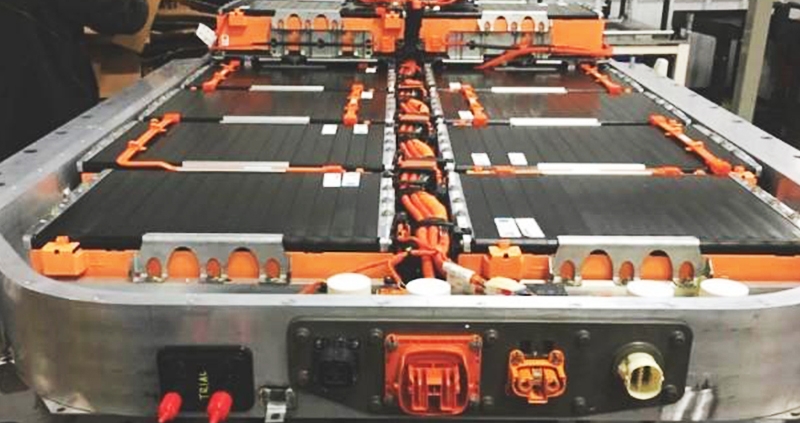
With the rapid advancement of electric vehicle technology, battery systems demand connectors that can support high-voltage and high-current requirements while ensuring driver and passenger safety. The HV800 HVIL connector is purposefully designed for EV battery packs, providing a secure and reliable high-voltage connection. The HVIL functionality is crucial in monitoring the integrity of high-voltage circuits, disconnecting power in the event of tampering or disconnection, and thus preventing potential hazards. The IP67-rated design of the HV800 HVIL connector ensures it remains free from water, dust, and other environmental contaminants, making it suitable for use in challenging automotive environments.

HVIL Connector application

2. Renewable Energy Systems

In renewable energy applications, such as solar power storage systems and wind energy equipment, high-voltage connectors are essential for handling the transmission of generated power. The HV800 HVIL connector supports the safe transmission of high-voltage power between storage systems and converters, while the HVIL feature enables critical monitoring and interlocking to prevent accidental disconnection. This capability not only enhances the safety of renewable energy systems but also ensures continuous and reliable energy supply, which is essential for uninterrupted power generation.

3. Industrial Power and Battery Storage Systems

In industrial environments, reliable power storage systems are critical for ensuring efficient operation, minimizing downtime, and enhancing productivity. The HV800 HVIL connector is ideal for high-power industrial applications that require durable and stable connections for high-voltage batteries and storage units. With its high current rating and interlocking capabilities, this connector provides both stability and protection in industrial power systems, preventing potential failures and ensuring smooth operational continuity.

4. Heavy-Duty Equipment and Off-Highway Vehicles

Heavy-duty vehicles, such as mining trucks, agricultural equipment, and construction machinery, are increasingly incorporating electric powertrains. The HV800 HVIL connector’s robust design and high IP rating make it suitable for use in such rugged and demanding environments. Its ability to handle high currents and voltages, combined with HVIL safety features, ensures that these heavy-duty applications operate safely and effectively under extreme conditions.

Unique Advantages of the HV800 HVIL Connector

At FPIC, we take pride in our HV800 HVIL connector’s engineering excellence and attention to detail. Here are some of the key advantages that set our product apart:

1. Robust and Stable Connectivity

The HV800 HVIL connector is specifically designed to ensure stable and secure connections. Its high-strength construction and IP67 rating protect it from environmental elements such as dust, moisture, and extreme temperatures. This robust design guarantees long-term reliability, making it suitable for use in high-demand applications such as EV battery systems and industrial power storage.

2. Safety and Compatibility

Safety is at the core of the HV800 HVIL connector’s design. The high-voltage interlock (HVIL) feature provides an additional layer of safety by monitoring the connector’s integrity and disconnecting the circuit if the connector is tampered with or disconnected. Additionally, the HV800 HVIL connector can accommodate a range of wire sizes, making it versatile for various power levels and ensuring compatibility with different system requirements.

3. End-to-End Manufacturing Excellence

As an industry-leading manufacturer, FPIC is committed to delivering quality at every stage of production. We provide end-to-end service that encompasses product design, mold design and manufacturing, component fabrication, automated assembly, rigorous testing, and packaging. This integrated approach allows us to maintain strict quality control across the entire production process, ensuring that every HV800 HVIL connector meets the highest standards for durability, performance, and safety.

4. High Current and Voltage Capabilities

The HV800 HVIL connector is rated for high current and voltage applications, supporting up to 850V DC. Its 8mm contact pin diameter and silver-plated contacts ensure excellent conductivity and reduced contact resistance, making it ideal for applications that require substantial power transfer with minimal energy loss.

5. Customization and Technical Support

We understand that every application is unique. That’s why FPIC offers customized solutions to meet specific project requirements. Our expert engineering team works closely with clients to adapt our HV800 HVIL connectors to their application’s particular needs, including connector configurations, material selection, and assembly methods. We also provide technical support throughout the project to ensure seamless integration and optimal performance.

Conclusion

The HV800 HVIL connector stands as a vital solution for high-voltage applications, combining durability, safety, and adaptability. Its extensive application in electric vehicles, renewable energy systems, industrial power storage, and heavy-duty machinery highlights its versatility and reliability. At FPIC, we remain committed to advancing connector technology and setting industry benchmarks for safety and performance. Our HV800 HVIL connector embodies our dedication to engineering excellence and customer satisfaction.

As we look toward the future, we continue to drive innovation and expand our range of high-voltage solutions. Whether you’re an automotive manufacturer, renewable energy provider, or industrial equipment producer, FPIC’s HV800 HVIL connectors are engineered to meet the rigorous demands of modern power systems. For further inquiries and to explore how our HV800 HVIL connectors can enhance your application, please reach out to our team. Let us be your trusted partner in high-voltage connectivity solutions.