
Introduction
Battery energy storage systems (BESS) are rapidly expanding as global demand for grid stability and renewable integration increases.
In modern BESS cabinet architecture, high-current connectors are no longer secondary components—they directly influence system safety, thermal behavior, installation efficiency, and long-term reliability.
For engineers and system integrators, connector selection has become a key design decision rather than a simple component choice.
The Role of High-Current Connectors in BESS Systems
High-current connectors serve as the critical electrical interface between battery modules, busbars, and power distribution units inside a BESS cabinet.
Their performance affects:
- Current transmission stability
- Temperature rise under load
- System insulation safety
- Installation efficiency
- Maintenance accessibility
A weak connection point can become the limiting factor of an otherwise well-designed energy storage system.
Why Current Rating Alone Is Not Enough
Many connector selections are based only on rated current and voltage. However, in real BESS applications, this is not sufficient.
Engineering considerations must also include:
- Contact resistance stability over time
- Heat dissipation in confined cabinet spaces
- Mechanical locking reliability
- Mating cycle durability
- Assembly consistency in mass production
In high-density energy storage systems, thermal behavior and connection stability are often more critical than nominal electrical ratings.
Thermal Stability and System Safety
One of the most important risks in BESS cabinet design is localized heating at connection points.
If contact resistance is unstable:
- Heat accumulation increases
- Insulation aging accelerates
- Nearby components may be affected
- System reliability decreases over time
Properly engineered high-current connectors help maintain stable thermal performance under continuous load, reducing long-term system risk.
Installation Efficiency and Manufacturing Impact
BESS systems are increasingly built in modular and scalable architectures.
High-current connectors can significantly improve:
- Cabinet assembly speed
- Cable routing efficiency
- Reduction of wiring errors
- Standardization of production processes
For large-scale energy storage deployment, even small improvements in installation efficiency can translate into major cost and time savings.
Maintenance and Lifecycle Considerations
Energy storage systems are long-life assets.
Therefore, maintainability is a critical design factor.
A well-designed connector system supports:
- Easy replacement of modules
- Clear mating orientation
- Reduced risk of incorrect reconnection
- Faster service operations
This directly impacts total lifecycle cost and system uptime.
FPIC Energy Storage Connector Capability
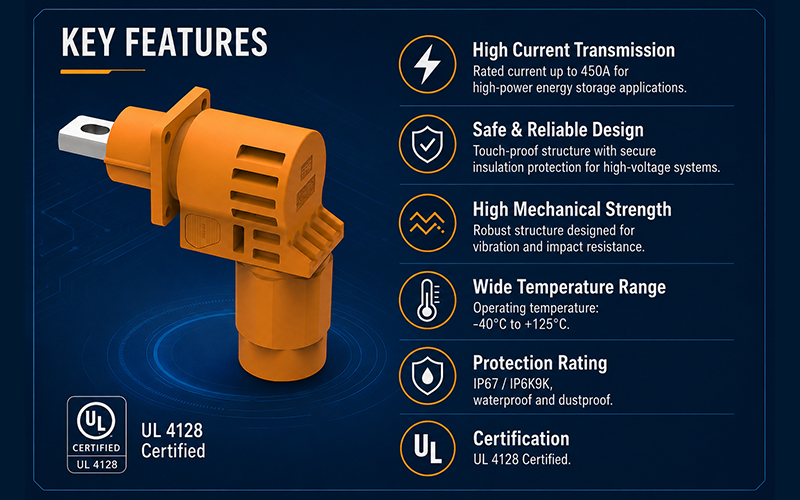
FPIC develops high-current connector solutions for energy storage and battery system applications, including:
- 2000V high-voltage connector platforms
- 450A high-current interconnection systems
- Touch-safe structural designs
- Multiple keying and polarity configurations
- Cabinet-level integration solutions
These solutions are designed for BESS cabinet, battery module, and power distribution applications.
Application Areas
FPIC high-current connectors are suitable for:
- Battery Energy Storage Systems (BESS)
- Energy storage cabinets
- Battery pack interconnection
- DC power distribution systems
- Industrial high-power equipment
Conclusion
As BESS systems scale in power density and deployment volume, connector design becomes a fundamental part of system engineering.
High-current connectors are no longer just electrical accessories—they are core components that influence safety, efficiency, and system lifecycle performance.
Selecting the right connector early in the design stage helps ensure a more reliable and scalable energy storage solution.
Contact FPIC
For energy storage connector development or 450A / 2000V high-current applications, FPIC provides engineering support and customized connector solutions.
Website: https://fpiconn.com/
Email: info@fpiconn.com
FAQ
1. What is a high-current connector used for in BESS?
It is used to connect battery modules, busbars, and power distribution systems inside energy storage cabinets.
2. Why are high-current connectors important in energy storage systems?
They affect thermal performance, safety, installation efficiency, and long-term system reliability.
3. Is current rating enough when selecting a connector for BESS?
No. Contact resistance, thermal behavior, and mechanical stability are equally important.