Mid-Autumn Festival Holiday and Traditions
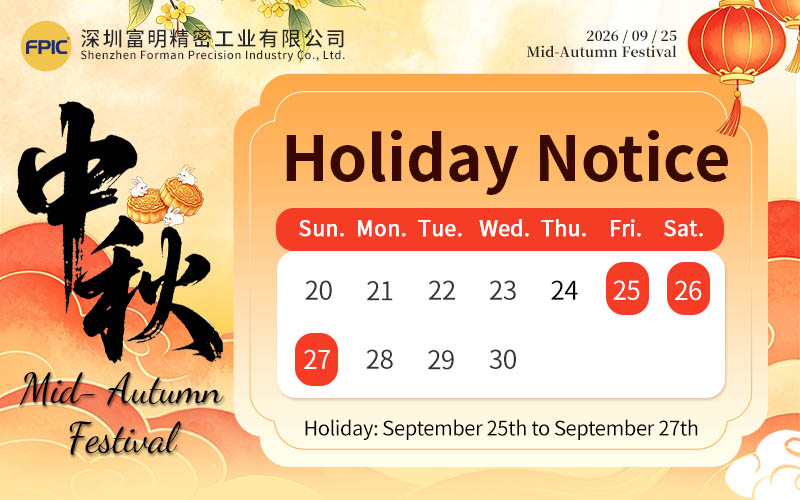
2026 Mid-Autumn Festival Holiday Notice
Dear Customers, Partners, and Friends,
To celebrate the Mid-Autumn Festival, FPIC will observe the following holiday schedule:
Holiday Period: September 25–27, 2026
Duration: 3 days
Work Resumes: September 28, 2026
According to the official 2026 public holiday arrangements issued by the General Office of the State Council, the Mid-Autumn Festival holiday will run from Friday, September 25, through Sunday, September 27, with no additional shifted working day for this holiday.
During the holiday, responses to emails, product inquiries, and customer requests may be delayed. We appreciate your understanding and will respond as soon as possible after the holiday.
For urgent business matters, please contact your regular FPIC account representative.
Thank you for your continued trust and support.
What Is the Mid-Autumn Festival?
The Mid-Autumn Festival (中秋节, Zhōngqiū Jié) is one of China’s major traditional festivals.
It takes place on the 15th day of the eighth month of the traditional Chinese lunar calendar, when the full moon is traditionally associated with the festival.
The name “Mid-Autumn” comes from its position in the traditional calendar: the eighth lunar month falls in autumn, and the 15th day is approximately in the middle of that month.
For this reason, the festival is closely connected with the ideas of:
- Family reunion
- Fullness and completeness
- Harvest
- Gratitude
- Long-distance remembrance
- Hope for a prosperous future
For people unfamiliar with Chinese culture, the easiest way to understand the Mid-Autumn Festival is as a traditional family and moon festival, with the full moon serving as an important cultural symbol of reunion.
When Is the Mid-Autumn Festival?
Unlike fixed-date holidays in the Gregorian calendar, the Mid-Autumn Festival follows the traditional Chinese lunar calendar.
As a result, its date changes each year on the Gregorian calendar.
In 2026, the Mid-Autumn Festival falls on September 25.
The official Chinese public holiday is September 25–27, 2026.
The Origins of the Mid-Autumn Festival
The history of the Mid-Autumn Festival is closely connected with ancient Chinese traditions of observing and worshipping the moon.
Moon-related ceremonies existed in ancient China long before the festival developed into its modern form. Historical sources describe autumn moon worship and seasonal ceremonies associated with the agricultural cycle.
The tradition gradually developed from an occasion connected with the moon and harvest into a broader cultural festival centered on family gatherings and appreciation of life.
The Mid-Autumn Festival became particularly popular during the Tang and Song dynasties, when moon appreciation, poetry, family gatherings, and nighttime celebrations became increasingly widespread. By the Ming and Qing dynasties, many of the customs familiar today had become deeply established.
Why Is the Full Moon So Important?
One of the most recognizable features of the Mid-Autumn Festival is the full moon.
In Chinese culture, the round shape of the moon is associated with completeness and reunion.
The Chinese concept of “圆” (yuan, roundness) is culturally connected with “团圆” (tuányuán, reunion).
Therefore, families traditionally gather together under the full moon, share food, talk with one another, and express good wishes.
For people who cannot return home, the moon can also become a symbol of connection. Looking at the same moon from different places provides a poetic way of thinking about family and loved ones who are far away.
This is one reason why the Mid-Autumn Festival has such a strong emotional meaning in Chinese culture.
The Legend of Chang’e and the Moon
One of the most famous stories associated with the Mid-Autumn Festival is the legend of Chang’e (嫦娥).
According to the traditional legend, Chang’e became associated with the moon after consuming an elixir of immortality and ascending there. Her story has been retold for centuries and has become one of the best-known Chinese lunar legends.
Other stories and regional traditions are also associated with the festival.
It is important to understand that these stories are traditional legends rather than historical records. They form part of China’s rich mythology and help explain the cultural imagination surrounding the moon.
Traditional Mid-Autumn Festival Customs
1.Eating Mooncakes
Mooncakes (月饼) are probably the most internationally recognizable food associated with the festival.
They are round pastries traditionally made with different fillings, including:
- Lotus seed paste
- Red bean paste
- Mixed nuts
- Salted egg yolk
- Five-kernel fillings
- Modern fruit or chocolate flavors
The round shape of a mooncake echoes the full moon and represents reunion and completeness.
Today, mooncakes are also commonly exchanged between family members, friends, business partners, and colleagues as festival gifts.
Historical sources indicate that mooncakes became strongly associated with Mid-Autumn Festival celebrations over the centuries, with the custom of exchanging mooncakes becoming particularly established in later periods.
2.Appreciating the Moon
Moon appreciation, or 赏月 (shǎngyuè), is one of the central traditions.
Families may gather outdoors, on balconies, in gardens, or in other comfortable places to enjoy the moon while sharing food and conversation.
Historically, moon viewing became particularly popular during the Tang and Song dynasties and inspired generations of Chinese poets and writers.
3.Family Reunion Dinner
For many families, the most important part of the festival is simply being together.
A traditional Mid-Autumn dinner may include regional dishes, seasonal fruits, tea, and mooncakes.
The menu varies considerably across China because different regions have their own culinary traditions.
The deeper meaning, however, is similar: sharing a meal represents connection, gratitude, and family unity.
4.Lanterns
Lanterns are also associated with Mid-Autumn celebrations, particularly among children and in community activities.
In different regions, people may carry, display, or make lanterns in different styles.
Mid-Autumn lantern traditions are generally smaller and more family-oriented than the large-scale lantern celebrations associated with the Lantern Festival.
5.Appreciating Osmanthus Flowers
The osmanthus flower (桂花) is strongly associated with autumn in Chinese culture.
In some regions, people enjoy:
- Osmanthus tea
- Osmanthus cakes
- Osmanthus wine
- Other seasonal foods flavored with osmanthus
Its fragrance adds another sensory dimension to the festival and reinforces the connection between Mid-Autumn celebrations and the autumn season.
Regional Differences Across China
China is geographically and culturally diverse, so Mid-Autumn traditions are not exactly the same everywhere.
In some areas, people place greater emphasis on family dinners and mooncakes. In others, lanterns, local foods, moon worship, seasonal flowers, or community celebrations may be more prominent.
In Fujian and parts of southern Fujian and Taiwan, for example, a traditional activity known as Bo Bing, or mooncake gambling, developed as a festive group game involving dice and prizes. It has been recognized as a national-level intangible cultural heritage practice in China.
This regional diversity is an important part of Chinese festival culture: the same festival can have different expressions while retaining common themes of reunion and celebration.
Mid-Autumn Festival and Chinese Culture
The festival carries several important cultural ideas.
Reunion
The full moon represents togetherness and family reunion.
Gratitude
The harvest associations of the festival connect it with appreciation for food, family, and the results of hard work.
Connection
People use the festival as an opportunity to reconnect with relatives, friends, and colleagues.
Hope
Traditional festival greetings often express wishes for happiness, health, prosperity, and family harmony.
These ideas help explain why the Mid-Autumn Festival remains meaningful even as lifestyles continue to change.
Mid-Autumn Festival for International Customers
For customers and partners outside China, the festival provides an opportunity to understand an important part of Chinese culture.
In Western countries, the concept of a family reunion holiday may be familiar through celebrations such as Thanksgiving or Christmas, although the traditions and historical backgrounds are different.
The Mid-Autumn Festival similarly creates a moment for people to pause, spend time with loved ones, and express appreciation.
For international business relationships, understanding these cultural traditions can also help build stronger communication and mutual understanding.
Mid-Autumn Festival and FPIC’s Corporate Culture
At FPIC, we believe that strong relationships are built through trust, respect, communication, and long-term commitment.
These values naturally connect with the spirit of the Mid-Autumn Festival.
Connection Matters
The full moon is traditionally a symbol of reunion.
For FPIC, connection is also at the heart of what we do. As a manufacturer of connectors, cable assemblies, and wire harness solutions, our products help establish reliable connections in industrial, automotive, medical, energy, and other applications.
Beyond products, we value the human connections behind every project.
Growing Together
The Mid-Autumn Festival reminds us that meaningful achievements are rarely created alone.
At FPIC, engineers, production teams, quality teams, sales professionals, and support teams work together to serve customers worldwide.
We believe that strong teams create stronger solutions.
Long-Term Partnerships
Just as families come together during the Mid-Autumn Festival, we value long-term relationships with our customers and partners.
Our goal is not simply to complete an individual order. We aim to understand customer requirements, provide professional support, and develop reliable solutions for long-term cooperation.
Caring for Our People
The festival is also an opportunity to appreciate our employees.
Throughout the year, FPIC organizes employee-focused activities such as birthday celebrations, monthly recognition, holiday events, and team activities.
These traditions reflect our people-oriented approach and our belief that a healthy company culture is built through everyday care and respect.
A Festival About Looking Back and Looking Forward
The Mid-Autumn Festival carries a beautiful balance between reflection and hope.
We look back with gratitude for what we have achieved, while looking forward to new opportunities.
For FPIC, this spirit is closely connected with our approach to continuous improvement.
Every project provides an opportunity to learn.
Every customer relationship provides an opportunity to improve.
Every new challenge provides an opportunity to develop better solutions.
Our Mid-Autumn Wishes
As the full moon shines over homes and communities across China, we would like to extend our warmest wishes to our employees, customers, partners, and friends around the world.
May this Mid-Autumn Festival bring:
🌕 Family reunion
🤝 Stronger connections
🌱 Continued growth
💡 New opportunities
❤️ Health and happiness
At FPIC, we look forward to continuing our journey together with our global partners.
Happy Mid-Autumn Festival!
References / Sources
- General Office of the State Council of the People’s Republic of China, Notice on Arrangements for Several Public Holidays in 2026 — official 2026 Mid-Autumn Festival holiday dates.
- Beijing Municipal Government, Customs Related to the Mid-Autumn Festival — historical moon worship, moon appreciation, mooncakes, lanterns, and regional customs.
- Embassy/Consulate sources summarizing the history and development of the Mid-Autumn Festival, including its development during the Tang, Song, Ming, and Qing periods.
- Beijing Municipal Government, Mid-Autumn Festival — historical development and traditional customs.
- Fujian Provincial People’s Government, National Intangible Cultural Heritage: Mid-Autumn Festival (Mooncake Gambling) — regional Mid-Autumn tradition in Fujian and Taiwan.