Industrial automation networks are entering a new phase of connectivity.
For decades, factory communication systems have relied on:
- Fieldbus networks
- Industrial Ethernet
- M8 and M12 connectors
- RJ45 interfaces
- Multi-pair communication cables
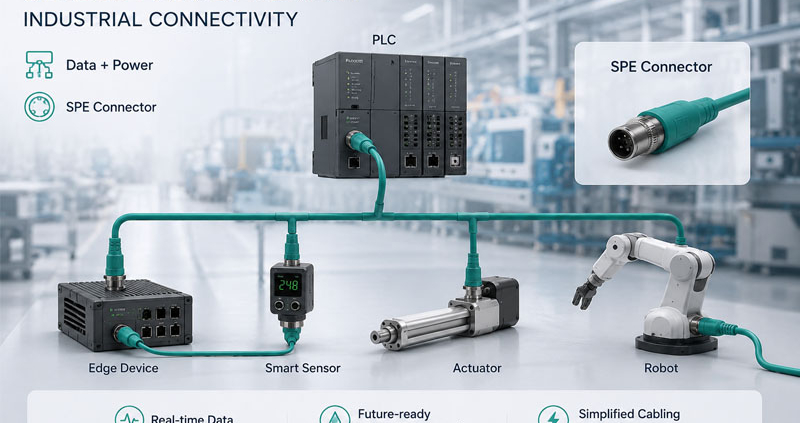
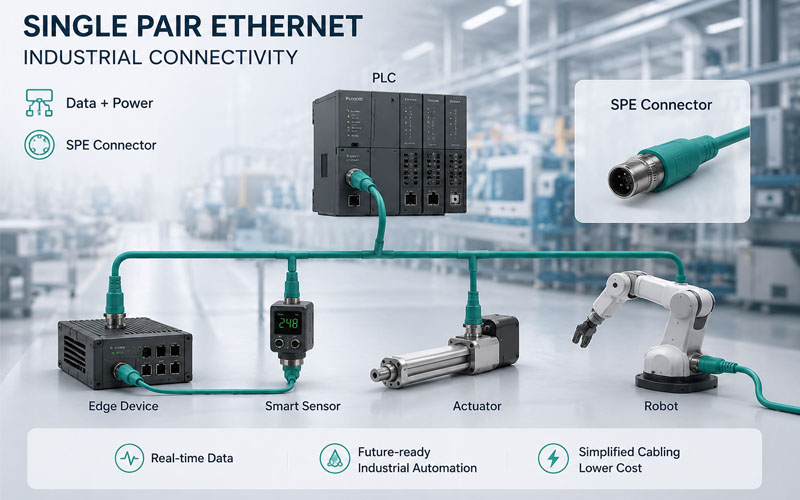
Today, Single Pair Ethernet (SPE) is emerging as one of the most important technologies supporting Industry 4.0, IIoT, and smart manufacturing initiatives.
While SPE has been discussed for several years, 2026 is expected to be a significant milestone as more industrial equipment manufacturers move from pilot projects to commercial deployment.
For engineers, OEM buyers, and system integrators, understanding upcoming SPE connector trends can help guide future product and infrastructure decisions.
Why SPE Is Gaining Momentum
Industrial networks continue to evolve toward greater connectivity.
Factories now require:
- more sensors
- more data collection
- more edge devices
- more intelligent actuators
Traditional Ethernet remains effective, but many field-level devices do not require the size and complexity of four-pair Ethernet infrastructure.
Single Pair Ethernet offers:
- reduced cable size
- lighter harnesses
- simplified installation
- Ethernet-based communication down to the sensor level
This makes SPE highly attractive for next-generation automation architectures.
Trend #1: Increasing Adoption of IEC 63171 Connector Standards
One of the biggest developments to watch in 2026 is the growing acceptance of IEC 63171 connector standards.
These standards define connector interfaces for SPE applications.
Common variants include:
- IEC 63171-2
- IEC 63171-5
- IEC 63171-6
As more automation suppliers adopt standardized interfaces, interoperability across equipment platforms is expected to improve.
For buyers, connector standard compatibility will become an increasingly important procurement criterion.
Trend #2: Expansion of SPE in Smart Sensors and Actuators
Many industrial sensors currently use:
- discrete I/O
- fieldbus interfaces
- proprietary communication methods
SPE enables direct Ethernet connectivity to field devices.
Benefits include:
- simplified architectures
- real-time diagnostics
- easier device integration
- reduced gateway requirements
By 2026, more sensor and actuator manufacturers are expected to release SPE-enabled products.
Trend #3: Growth of Power over Data Line (PoDL)
Power over Data Line (PoDL) remains one of the most compelling SPE features.
PoDL allows:
- data transmission
- device power
through the same twisted pair.
Potential advantages include:
- fewer cables
- reduced installation costs
- smaller harnesses
- simplified device deployment
As SPE ecosystems mature, PoDL adoption is expected to accelerate across industrial automation markets.
Trend #4: Smaller and More Compact Industrial Devices
Machine builders continue to pursue:
- smaller equipment footprints
- higher device density
- reduced cabinet space
SPE connectors support these goals through:
- compact connector designs
- reduced cable diameter
- lighter cable assemblies
This trend is particularly important in:
- robotics
- machine vision
- semiconductor equipment
- compact automation cells
Connector miniaturization will remain a major development focus in 2026.
Trend #5: Stronger Focus on EMC Performance
As industrial networks become more data-driven, communication reliability becomes increasingly critical.
Industrial environments contain significant sources of electromagnetic interference:
- servo drives
- VFDs
- motors
- switching power supplies
Although SPE cables are smaller, EMC challenges remain.
Future SPE connector development will likely emphasize:
- improved shielding
- lower transfer impedance
- optimized grounding
- enhanced connector shielding continuity
EMC performance will continue to be a key differentiator among suppliers.
Trend #6: More SPE Solutions for Robotics
Robotic systems require communication solutions that can withstand:
- continuous flexing
- torsion
- vibration
As robots become more connected, SPE presents an opportunity to simplify communication architectures.
However, robotic SPE cable assemblies must still address:
- dynamic motion
- shielding durability
- flex life requirements
2026 may see a broader range of SPE products specifically designed for robotic applications.
Trend #7: Integration with Industry 4.0 Architectures
Industry 4.0 initiatives emphasize:
- unified communication
- real-time data access
- device interoperability
SPE aligns closely with these goals.
Benefits include:
- end-to-end Ethernet connectivity
- simplified networking
- easier data collection
- scalable architectures
Many manufacturers view SPE as a foundational technology for future smart factories.
Trend #8: Growing Demand for Hybrid Connectivity Solutions
The transition to SPE will not happen overnight.
Many facilities will operate mixed environments including:
- traditional Ethernet
- fieldbus networks
- SPE networks
As a result, demand is growing for:
- SPE-to-Ethernet adapters
- hybrid cable assemblies
- migration-friendly connectivity solutions
Suppliers that support both legacy and emerging standards may have a competitive advantage.
Trend #9: Higher Expectations for IP Protection
Industrial users continue to demand robust environmental protection.
Common requirements include:
IP67
Factory automation equipment.
IP68
Harsh industrial environments.
IP69K
Washdown applications.
Future SPE connectors will need to maintain industrial-grade sealing despite smaller form factors.
Trend #10: Supplier Qualification Will Become More Important
As SPE adoption grows, buyers will increasingly evaluate suppliers based on:
- connector standard compliance
- EMC performance
- environmental testing
- manufacturing quality
- application engineering support
Selecting the right connectivity partner may become as important as selecting the connector itself.
Challenges That Still Need Attention
Although SPE offers significant advantages, several challenges remain.
Standard Fragmentation
Multiple connector standards continue to coexist.
Ecosystem Maturity
Some industrial markets are still in the early adoption phase.
Infrastructure Transition
Existing Ethernet systems remain deeply established.
Education and Training
Many engineers are still learning SPE design principles.
These factors will influence adoption rates over the coming years.
Questions Buyers Should Ask in 2026
Before selecting SPE connector solutions, buyers should ask:
- Which IEC 63171 standard is supported?
- Is PoDL available?
- What EMC testing has been completed?
- What IP protection level is achieved?
- Is the connector suitable for robotics or drag-chain applications?
- What interoperability testing has been performed?
- How does the supplier support future scalability?
Typical Applications Expected to Grow
SPE connectors are expected to expand across:
- Smart sensors
- Intelligent actuators
- Industrial IoT devices
- Edge computing equipment
- Robotics
- Machine vision systems
- Process automation
- Smart manufacturing platforms
How FPIC Supports Emerging SPE Connectivity Needs
FPIC develops advanced industrial connectivity solutions including:
- SPE cable assemblies
- Industrial Ethernet harnesses
- M8 and M12 communication cables
- Shielded data cable assemblies
- Robotic communication harnesses
- Custom overmolded connector solutions
Our engineering team helps customers evaluate emerging connectivity technologies while maintaining compatibility with current industrial infrastructure.
Final Thoughts
Single Pair Ethernet connectors are moving from concept to practical deployment.
In 2026, key developments are expected around:
- IEC 63171 standard adoption
- PoDL expansion
- connector miniaturization
- robotics integration
- Industry 4.0 implementation
- EMC optimization
For OEMs and industrial buyers, now is the time to understand SPE technologies and prepare for the next generation of industrial networking.
Organizations that evaluate SPE early may gain advantages in system simplification, scalability, and future connectivity readiness.
FAQ
What is a Single Pair Ethernet connector?
An SPE connector is a connector designed to transmit Ethernet communication through a single twisted pair of conductors.
What is PoDL?
Power over Data Line (PoDL) enables both power and data transmission over the same SPE cable.
Will SPE replace Industrial Ethernet?
Not immediately. SPE is expected to complement existing Ethernet infrastructure, particularly at the device level.
Which SPE connector standards are most important?
IEC 63171-2, IEC 63171-5, and IEC 63171-6 are among the most widely discussed industrial SPE connector standards.
Why is SPE important for Industry 4.0?
SPE enables direct Ethernet connectivity to sensors and actuators, supporting unified and scalable industrial communication architectures.
Planning for Next-Generation Industrial Connectivity?
FPIC provides custom SPE cable assemblies, Industrial Ethernet harnesses, M8/M12 connectivity solutions, and engineering support for automation, robotics, and Industrial IoT applications.
Contact us to discuss your future Single Pair Ethernet connectivity requirements.
Resources
- IEC 63171 Series – Single Pair Ethernet Connector Standards
- IEEE 802.3cg – 10BASE-T1L and 10BASE-T1S Standards
- PROFIBUS & PROFINET International (PI) SPE Resources
- ODVA Single Pair Ethernet Guidance
- Phoenix Contact and HARTING SPE Technology Documentation
Source References: IEC 63171, IEEE 802.3cg, PI, ODVA, Phoenix Contact, HARTING SPE technical resources.