
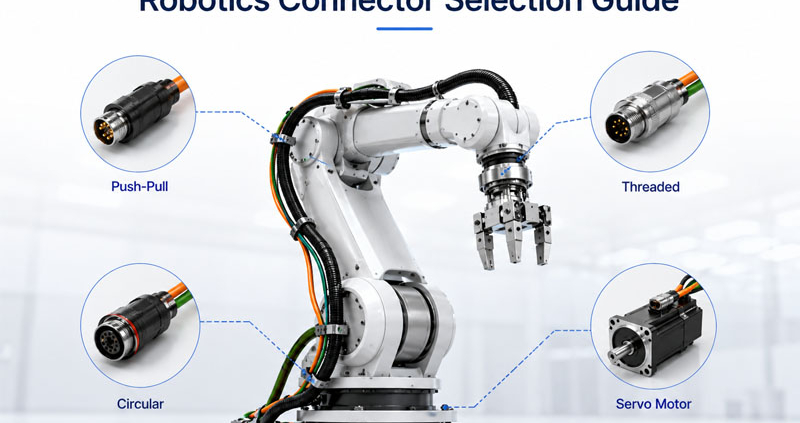
Industrial robots operate in demanding environments where connectors are exposed to constant motion, vibration, electromagnetic interference (EMI), and frequent maintenance. While much attention is often given to servo motors and robot controllers, connector selection is equally important for ensuring reliable power delivery and stable signal transmission.
A poorly selected connector can loosen under vibration, introduce communication errors, restrict cable movement, or shorten cable life. Choosing the right connector requires more than matching the voltage and current ratings—it involves evaluating the complete operating environment.
This article explains the key considerations when selecting connectors for robotic systems, focusing on locking mechanisms, EMC shielding, cable exit orientation, and long-term durability.
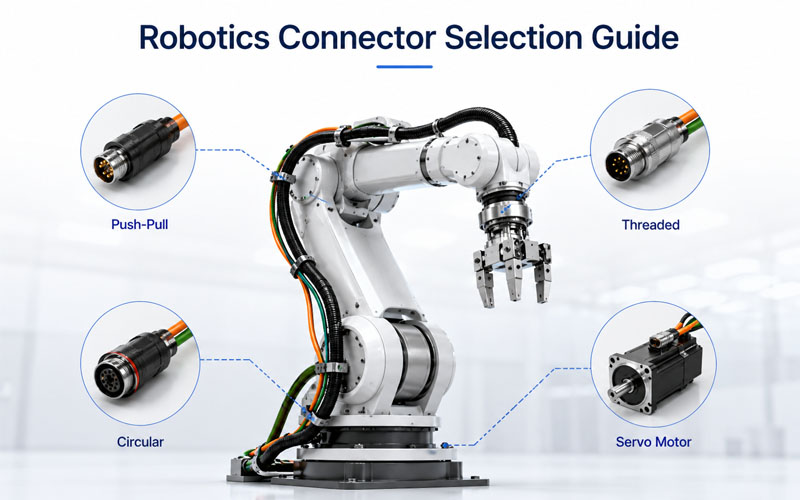
Why Connector Selection Matters in Robotics
Unlike stationary industrial equipment, robotic systems perform continuous multi-axis movements that repeatedly bend, twist, and accelerate cables.
Connectors must therefore withstand:
- Continuous vibration
- Frequent movement
- Mechanical shock
- Electromagnetic interference
- Repeated mating cycles
- Limited installation space
Connector reliability directly influences machine uptime and maintenance costs.
Choosing the Right Locking Mechanism
One of the most critical connector features is the locking system.
A connector that loosens during robot operation can interrupt power or communication, causing unexpected machine stops.
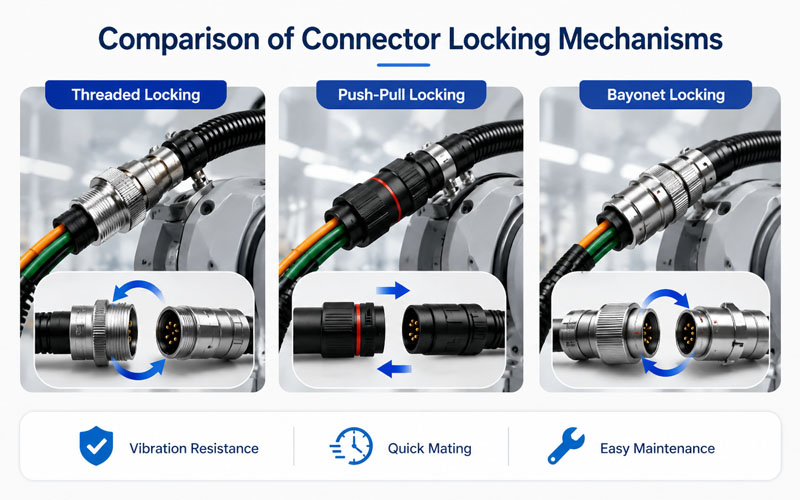
Common locking mechanisms include:
Threaded Locking
Advantages:
- Excellent vibration resistance
- High mechanical strength
- Suitable for industrial automation
Applications:
- Servo motors
- Industrial robots
- Machine tools
Push-Pull Locking
Advantages:
- Quick connection and disconnection
- Secure automatic locking
- Compact design
- Fast maintenance
Applications:
- Collaborative robots (Cobots)
- Medical robots
- Inspection equipment
- Automated production lines
Bayonet Locking
Advantages:
- Fast quarter-turn locking
- Good vibration performance
- Reliable positioning
Applications:
- Mobile robots
- Outdoor equipment
- Industrial machinery
Selecting the locking method should balance installation efficiency with vibration resistance.
Why Shielding Is Essential
Modern robots contain numerous high-speed electrical devices, including:
- Servo drives
- Frequency converters
- Industrial Ethernet
- Encoders
- Vision systems
These devices generate electromagnetic interference that may affect communication signals.
Shielded connectors help:
- Reduce EMI
- Improve signal integrity
- Lower communication errors
- Support high-speed data transmission
Proper shield continuity between cable and connector is essential for achieving effective EMC performance.
Selecting the Best Cable Exit Direction
Cable exit orientation is often overlooked during connector selection.
However, it directly affects cable stress and available installation space.
Typical exit options include:
Straight Exit
Best for:
- Open installation space
- Linear cable routing
- Easy assembly
Right-Angle Exit
Best for:
- Compact robot joints
- Tight cabinet layouts
- Reduced bending stress
- Improved cable management
Proper cable exit selection helps extend cable flex life and minimizes mechanical strain near the connector.
Environmental Protection Requirements
Robots frequently operate in challenging environments.
Connector selection should consider:
- Dust
- Water spray
- Oil
- Coolant
- Metal particles
- Cleaning chemicals
Depending on the application, connectors may require:
- IP67 protection
- IP68 protection
- IP69K protection
Environmental sealing improves long-term reliability and reduces maintenance frequency.
Connector Durability and Mating Cycles
Industrial robots often require periodic replacement of end effectors or tooling.
Frequent connection and disconnection demand connectors with long mating life.
Typical industrial requirements include:
- More than 500 insertion cycles
- 2,000–5,000 cycles for automation equipment
- Higher durability for collaborative robots and testing equipment
Gold-plated contacts further improve contact stability and corrosion resistance.
Size and Weight Considerations
As robots become smaller and faster, connector size becomes increasingly important.
Compact connectors provide:
- Lower moving mass
- Improved joint flexibility
- Easier cable routing
- Better space utilization
Miniaturization is especially important in collaborative robots and precision automation equipment.
Validation Before Deployment
Connectors should be validated under realistic operating conditions.
Recommended tests include:
- Vibration testing
- Mechanical shock testing
- Cable flex testing
- Salt spray testing
- Contact resistance measurement
- Insertion and extraction force testing
- EMC verification
- Environmental sealing tests
System-level validation provides the highest confidence in connector performance.
How FPIC Supports Robotics Connector Solutions
FPIC develops high-performance connector solutions for industrial automation, robotics, and intelligent manufacturing.
Our product portfolio includes push-pull self-locking connectors, circular connectors, waterproof connectors, and customized connector assemblies designed for demanding robotic applications. With over 23 years of manufacturing experience, FPIC supports customers from rapid prototyping through mass production, providing reliable connectivity solutions that improve equipment uptime and long-term performance.
Final Thoughts
Selecting the right connector for robotic applications involves much more than matching electrical specifications.
Locking mechanisms, shielding performance, cable exit orientation, environmental protection, and durability all influence system reliability.
As robotic systems continue to become faster, smarter, and more compact, connector design plays an increasingly important role in maintaining stable operation and reducing maintenance costs.
FAQ
Why are locking connectors important in robotics?
Locking mechanisms prevent accidental disconnection caused by vibration, motion, or mechanical shock, improving system reliability.
When should shielded connectors be used?
Shielded connectors are recommended whenever high-speed communication or servo systems operate in environments with significant electromagnetic interference.
Which cable exit is better, straight or right-angle?
It depends on available space and cable routing. Right-angle exits are often preferred in compact robot joints to reduce bending stress.
What IP rating is recommended for industrial robots?
Many industrial robots require IP67 protection, while washdown or outdoor applications may require IP68 or IP69K connectors.
How are robotics connectors validated?
Typical validation includes vibration, cable flex, EMC, sealing, mating cycle, and contact resistance testing.
Looking for Reliable Connectors for Robotics and Industrial Automation?
FPIC provides high-performance connector solutions for industrial robots, collaborative robots, servo systems, and automated equipment. From push-pull self-locking connectors to waterproof circular connectors, our engineering team helps customers select the right connectivity solution for demanding motion applications.
Contact FPIC today to discuss your robotics connector requirements.
Resources
- IEC 60529 – Degrees of Protection Provided by Enclosures (IP Code)
https://webstore.iec.ch/
Defines IP ratings such as IP67, IP68, and IP69K for connector protection against dust and water ingress. - IEC 61076 – Connectors for Electrical and Electronic Equipment
https://webstore.iec.ch/
International standards covering the design, performance, and testing of industrial connectors. - ODVA – EtherNet/IP Physical Layer and Industrial Connectivity
https://www.odva.org/
Provides technical guidance on industrial Ethernet connectivity and connector performance in automation systems. - TE Connectivity – Industrial Robotics Connectivity Solutions
https://www.te.com/
Explains connector technologies, shielding solutions, and rugged interconnect systems for robotics and automation. - Phoenix Contact – Connectors for Industrial Automation
https://www.phoenixcontact.com/
Offers technical resources on circular connectors, EMC protection, and reliable industrial connectivity.