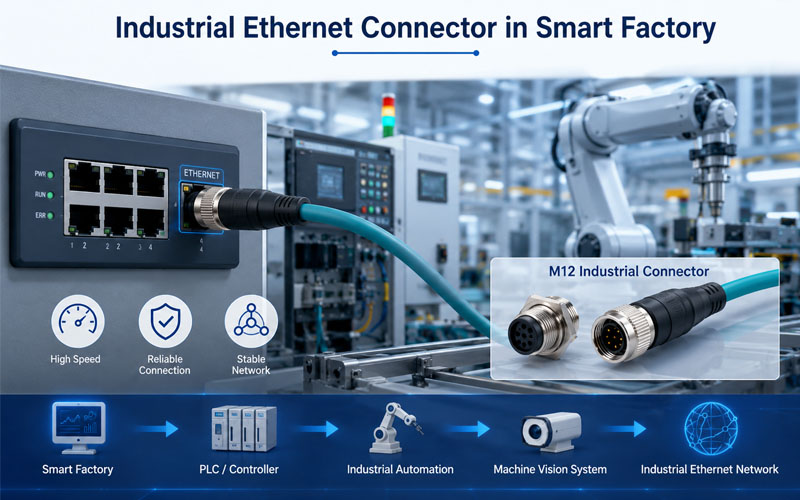
Industrial Ethernet has become the communication backbone of modern automation systems. Protocols such as EtherCAT, PROFINET, EtherNet/IP, and Modbus TCP connect PLCs, servo drives, robots, machine vision systems, and distributed I/O with high-speed, real-time data exchange.
As communication speeds continue to increase, engineers often focus on bandwidth, cable category, and protocol compatibility. However, one equally important factor is frequently overlooked—mechanical stability.
Even a connector capable of supporting Gigabit Ethernet can experience intermittent communication if vibration, repeated movement, or unstable contact compromises the physical connection.
This article explores why connector mechanical design is just as important as transmission speed for reliable Industrial Ethernet performance.
High-Speed Communication Depends on Stable Physical Connections
Industrial Ethernet transmits high-frequency differential signals that are far more sensitive than conventional power circuits.
Any variation in contact pressure or electrical continuity can negatively affect communication quality.
Poor mechanical stability may result in:
- Packet loss
- Increased bit error rate
- Network reconnection
- Communication interruptions
- Unexpected production downtime
For high-speed industrial networks, electrical performance begins with a mechanically reliable connection.
Industrial Environments Are Constantly Moving
Unlike office networks, industrial Ethernet connectors operate under continuous mechanical stress.
Typical sources include:
- Robot arm acceleration
- Servo motor vibration
- Conveyor movement
- Machine tool impacts
- AGV and AMR motion
- Continuous drag chain movement
These conditions can gradually loosen poorly designed connectors or reduce contact stability over time.
Connector reliability must therefore be evaluated under real operating conditions rather than laboratory environments.
Locking Mechanisms Improve Network Reliability
One of the primary functions of an Industrial Ethernet connector is preventing accidental disconnection.
Common locking mechanisms include:
Threaded Locking
Advantages:
- Excellent vibration resistance
- High mechanical retention
- Suitable for permanent installations
Typical applications:
- Servo systems
- CNC machines
- Heavy industrial equipment
Push-Pull Locking
Advantages:
- Fast installation
- One-handed operation
- Secure self-locking
- Reduced maintenance time
Typical applications:
- Robotics
- Medical equipment
- Automated production lines
Bayonet Locking
Advantages:
- Quick quarter-turn connection
- Reliable positioning
- Good mechanical security
Typical applications:
- Mobile machinery
- Outdoor automation
- Portable industrial equipment
Selecting the correct locking mechanism helps maintain stable Ethernet communication while simplifying maintenance.
Contact Stability Directly Affects Signal Integrity
Industrial Ethernet connectors must maintain consistent electrical contact despite vibration and repeated movement.
Important design factors include:
- Contact spring design
- Contact force
- Gold-plated contacts
- Precision machining
- Stable insertion force
High-quality contacts minimize fluctuations in resistance and help preserve signal integrity over long operating periods.
Shielding Is More Than EMI Protection
Industrial environments contain numerous sources of electromagnetic interference, including:
- Variable frequency drives
- Servo amplifiers
- Switching power supplies
- High-current power cables
Shielded connectors provide:
- Reduced electromagnetic interference
- Better signal integrity
- Stable high-speed communication
- Lower communication error rates
For maximum EMC performance, connector shielding should include continuous 360° shield termination between the cable braid and the connector housing.
Environmental Protection Supports Long-Term Reliability
Industrial Ethernet connectors are often exposed to:
- Dust
- Oil
- Coolant
- Moisture
- Metal particles
- Cleaning chemicals
Appropriate IP ratings help maintain connector performance in harsh environments.
Typical protection levels include:
| IP Rating | Typical Application |
|---|---|
| IP67 | Industrial automation and robotics |
| IP68 | Outdoor automation and renewable energy |
| IP69K | Food processing and washdown equipment |
Environmental sealing protects both electrical contacts and communication reliability.
Validation Beyond Data Speed
A connector should never be selected based solely on its data rate specification.
Comprehensive validation should include:
- Vibration testing
- Mechanical shock testing
- Mating cycle testing
- Contact resistance measurement
- EMC testing
- Cable flex testing
- Environmental sealing verification
Testing complete cable assemblies under real operating conditions provides the most reliable performance assessment.
How FPIC Supports Industrial Ethernet Connectivity
FPIC develops high-performance circular connectors, push-pull self-locking connectors, waterproof connectors, and customized connector assemblies for Industrial Ethernet applications.
Our solutions are engineered to provide reliable locking, stable electrical contacts, effective EMC shielding, and long-term durability for robotics, factory automation, machine vision, servo systems, and intelligent manufacturing equipment. With over 23 years of manufacturing experience, FPIC supports customers from design optimization to mass production.
Final Thoughts
Industrial Ethernet performance depends on far more than bandwidth specifications.
Mechanical stability, secure locking, contact reliability, shielding, and environmental protection all contribute to long-term communication performance.
As factories become increasingly connected and automated, connector design plays a vital role in reducing downtime, maintaining stable network communication, and ensuring reliable operation throughout the equipment lifecycle.
FAQ
Why is mechanical stability important for Industrial Ethernet connectors?
Mechanical stability ensures consistent electrical contact under vibration, motion, and shock, reducing communication interruptions and network failures.
Which locking mechanism is best for Industrial Ethernet?
The best locking mechanism depends on the application. Threaded connectors provide excellent vibration resistance, while push-pull connectors offer faster maintenance and secure self-locking.
Do Industrial Ethernet connectors require shielding?
Yes. Shielded connectors help reduce electromagnetic interference (EMI), improve signal integrity, and support reliable high-speed communication.
What IP rating is recommended for Industrial Ethernet connectors?
IP67 is suitable for many factory automation applications, while IP68 or IP69K may be required for outdoor or washdown environments.
How should Industrial Ethernet connectors be tested?
Recommended tests include vibration, EMC, contact resistance, mating cycles, cable flex, mechanical shock, and environmental sealing.
Looking for Reliable Industrial Ethernet Connector Solutions?
FPIC provides high-performance circular connectors, push-pull self-locking connectors, and customized Industrial Ethernet connectivity solutions for robotics, factory automation, machine vision, and intelligent manufacturing. Our engineering team helps customers achieve reliable communication through robust mechanical design, effective shielding, and application-specific connector solutions.
Contact FPIC today to discuss your Industrial Ethernet connector requirements.
Resources
- IEC 61076 – Connectors for Electrical and Electronic Equipment
https://webstore.iec.ch/
International standards covering the design, testing, and performance of industrial and circular connectors. - IEC 61158 – Industrial Communication Networks (Fieldbus Specifications)
https://webstore.iec.ch/
Defines communication standards widely used in industrial Ethernet and automation networks. - ODVA – EtherNet/IP Technology Overview
https://www.odva.org/
Provides technical guidance on EtherNet/IP architecture, industrial networking, and physical connectivity. - PROFIBUS & PROFINET International (PI)
https://www.profibus.com/
Offers technical resources for PROFINET communication, connector requirements, and industrial networking best practices. - Phoenix Contact – Industrial Ethernet Connectivity Solutions
https://www.phoenixcontact.com/
Provides engineering resources on Industrial Ethernet connectors, shielding, and reliable network infrastructure.