
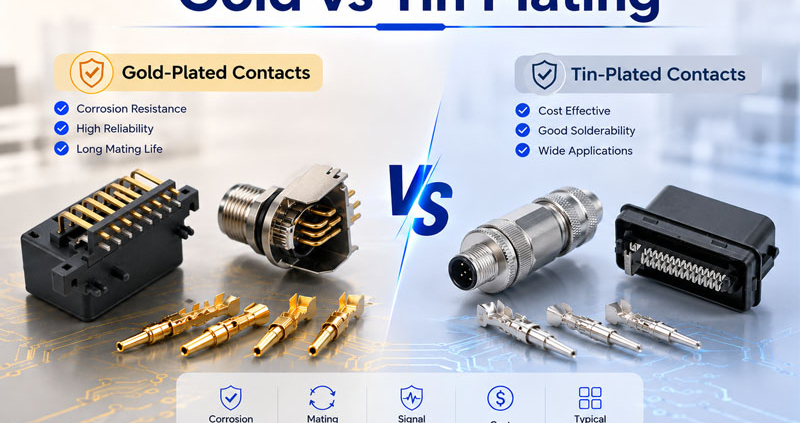
The performance of an electrical connector depends on more than its housing, locking mechanism, or IP rating. One of the most important—but often overlooked—factors is contact plating.
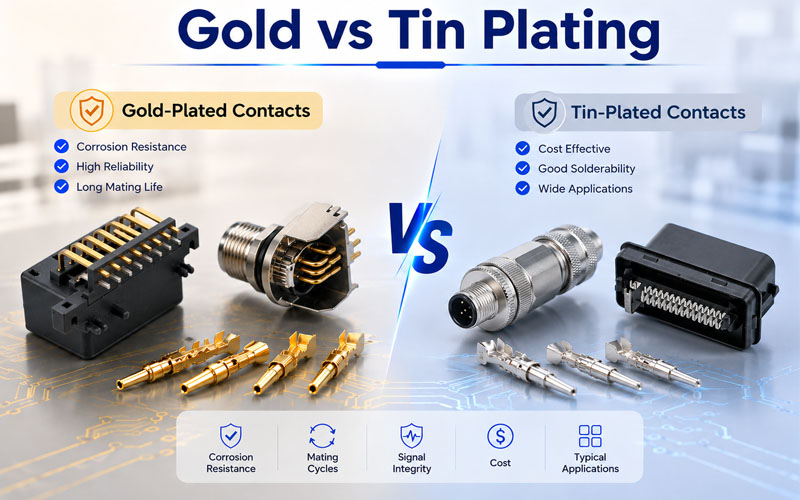
Gold and tin are the two most common plating materials used in electrical connectors. While both provide reliable electrical connections, they are designed for different operating conditions and performance priorities.
Selecting the wrong plating can lead to increased contact resistance, fretting corrosion, intermittent signals, or reduced service life.
This article explains how engineers can choose between gold-plated and tin-plated connectors based on current requirements, mating frequency, and operating environment.
Why Connector Plating Matters
Connector contacts are repeatedly exposed to mechanical wear, electrical current, vibration, humidity, and temperature changes.
The plating material directly affects:
- Contact resistance
- Signal integrity
- Corrosion resistance
- Wear resistance
- Mating cycle life
- Long-term reliability
Even when two connectors have identical mechanical designs, different contact plating can significantly influence their performance over time.
Gold-Plated Connectors
Gold is widely used in high-performance connectors because it offers excellent conductivity and exceptional resistance to oxidation.
Advantages
- Extremely low contact resistance
- Excellent signal integrity
- Superior corrosion resistance
- Outstanding wear resistance
- Stable performance in humid environments
- Suitable for high mating cycles
Typical applications include:
- Medical equipment
- Robotics
- Industrial Ethernet
- Aerospace systems
- Precision test equipment
- High-speed communication
Gold plating is especially recommended where reliable low-current signal transmission is critical.
Tin-Plated Connectors
Tin plating is one of the most common and cost-effective contact finishes.
Advantages
- Lower manufacturing cost
- Good conductivity
- Suitable for higher current applications
- Easy solderability
- Widely used in industrial equipment
Typical applications include:
- Power distribution
- Automotive wiring
- Industrial machinery
- Control cabinets
- General electrical equipment
Tin plating performs well in applications with relatively low mating frequency and stable operating conditions.
Current Carrying Capability
Many engineers assume gold-plated contacts always carry more current.
In reality, current capacity is determined primarily by contact design, contact area, conductor size, and temperature rise—not by the plating material alone.
However, plating still influences long-term electrical stability.
Gold plating maintains consistently low contact resistance over time, while tin plating may gradually increase resistance if oxidation develops under certain environmental conditions.
Mating Cycles: Where Gold Has a Clear Advantage
Repeated insertion and removal gradually wear the contact surface.
Gold-plated contacts generally provide:
- Lower insertion wear
- Stable contact resistance
- Reduced fretting corrosion
- Longer service life
Applications requiring thousands of mating cycles—such as medical devices, testing equipment, and modular automation systems—typically benefit from gold-plated contacts.
Tin-plated connectors are often more suitable for applications where connectors remain mated for extended periods with infrequent maintenance.
Environmental Considerations
Operating conditions have a major influence on plating selection.
Gold-Plated Contacts
Recommended for:
- High humidity
- Corrosive environments
- Outdoor electronics
- Industrial automation
- High-speed data transmission
Tin-Plated Contacts
Recommended for:
- Indoor electrical equipment
- Dry industrial environments
- Power connections
- Cost-sensitive applications
Engineers should evaluate not only today’s operating conditions but also long-term environmental exposure.
Cost vs Lifecycle Value
Tin plating generally offers lower initial cost.
Gold plating typically requires higher manufacturing investment due to the precious metal content.
However, total ownership cost should also include:
- Maintenance frequency
- Downtime risk
- Contact replacement
- Equipment reliability
- Product lifecycle
For mission-critical equipment, the higher initial cost of gold plating is often offset by improved long-term reliability.
Choosing the Right Contact Finish
| Selection Factor | Gold Plating | Tin Plating |
|---|---|---|
| Contact Resistance | Excellent | Good |
| Corrosion Resistance | Excellent | Moderate |
| Mating Cycles | Excellent | Moderate |
| Low-Current Signals | Excellent | Good |
| High-Speed Data | Excellent | Good |
| Power Applications | Good | Excellent |
| Cost | Higher | Lower |
| Long-Term Reliability | Excellent | Good |
Rather than asking which plating is better, engineers should determine which finish best matches the electrical, mechanical, and environmental requirements of the application.
How FPIC Supports High-Reliability Connector Solutions
FPIC manufactures circular connectors, push-pull self-locking connectors, waterproof connectors, and customized cable assemblies with both gold-plated and tin-plated contact options.
Our engineering team helps customers select the appropriate contact finish based on current rating, mating frequency, environmental conditions, and application requirements. Whether for industrial automation, robotics, medical equipment, or outdoor systems, FPIC delivers connector solutions designed for long-term reliability and consistent electrical performance.
Final Thoughts
Gold and tin plating each offer distinct advantages.
Gold-plated connectors excel in high-reliability, high-cycle, and signal-sensitive applications, while tin-plated connectors provide a cost-effective solution for many power and general industrial applications.
The right choice depends not only on electrical specifications but also on mating frequency, environmental conditions, maintenance strategy, and expected service life.
Selecting the correct contact finish helps maximize connector reliability and reduce long-term operating costs.
FAQ
Is gold plating always better than tin plating?
Not necessarily. Gold plating offers better corrosion resistance and mating durability, while tin plating is often a cost-effective choice for power applications with low mating frequency.
Does gold plating increase current capacity?
Current capacity mainly depends on contact design and conductor size. Gold plating primarily improves contact stability and corrosion resistance rather than significantly increasing current carrying capability.
Which plating is better for repeated mating?
Gold plating is generally preferred for applications requiring frequent connection and disconnection because it provides better wear resistance and more stable contact performance.
Are tin-plated connectors suitable for industrial automation?
Yes. Tin-plated connectors are widely used in industrial power distribution and general machinery where operating conditions are stable and connectors are not frequently mated.
How should engineers choose connector plating?
Selection should be based on electrical performance, current requirements, mating cycles, environmental exposure, maintenance frequency, and overall lifecycle cost.
Looking for the Right Connector Contact Finish?
FPIC provides circular connectors, push-pull self-locking connectors, waterproof connectors, and custom cable assemblies with both gold-plated and tin-plated contact options. Our engineering team can help you choose the most suitable contact finish for your application, balancing electrical performance, durability, environmental protection, and cost.
Contact FPIC today to discuss your connector application.
Resources
- IEC 60512 – Connectors for Electronic Equipment – Tests and Measurements
https://webstore.iec.ch/
Defines standardized test methods for connector contacts, including contact resistance, durability, and mechanical performance. - IEC 61076 – Connectors for Electrical and Electronic Equipment
https://webstore.iec.ch/
Provides international standards for circular and industrial connector design, performance, and contact systems. - TE Connectivity – Understanding Connector Contact Plating
https://www.te.com/
Technical guidance on gold and tin plating, wear mechanisms, contact resistance, and application selection. - Harwin – Connector Contact Plating Explained
https://www.harwin.com/
Explains how different plating materials influence connector reliability, mating life, and corrosion resistance. - Samtec – Contact Plating in High-Reliability Connectors
https://www.samtec.com/
Provides engineering resources on plating thickness, contact durability, and signal integrity for high-performance connector systems.