
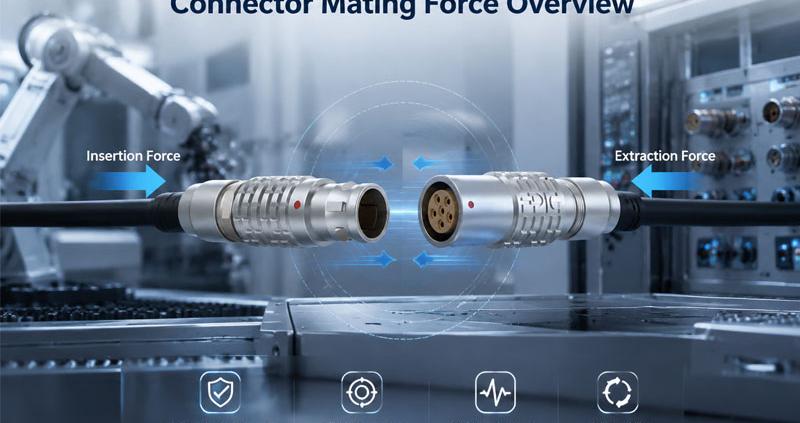
When selecting an electrical connector, engineers often focus on current rating, IP protection, contact configuration, or signal performance. However, one mechanical characteristic is frequently underestimated—mating force.
Insertion force and extraction force directly influence how a connector performs during installation, maintenance, and long-term operation. If the insertion force is too high, installation becomes difficult and contact damage may occur. If the extraction force is too low, vibration or accidental pulling can cause unexpected disconnection.
Achieving the right balance between these two forces is essential for maintaining connector reliability throughout the product lifecycle.
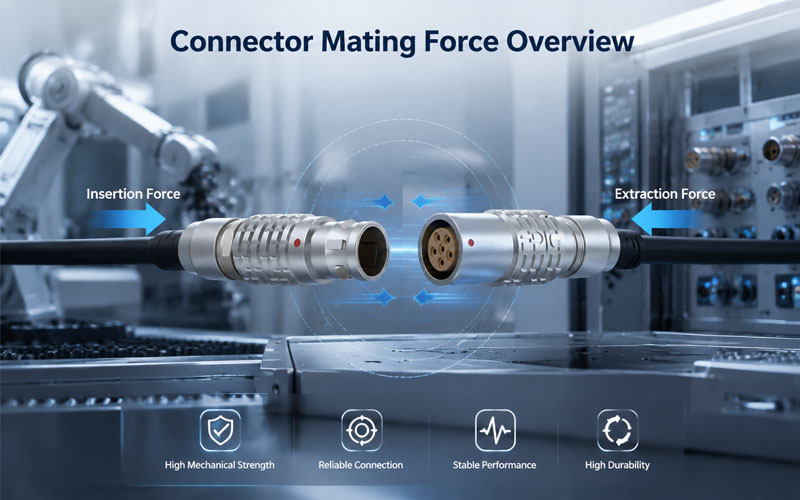
What Are Insertion Force and Extraction Force?
Insertion force is the amount of force required to fully mate two connectors.
Extraction force is the force needed to separate them after they are connected.
Both values are carefully engineered and verified during connector development because they affect:
- Installation efficiency
- Contact stability
- User experience
- Mechanical reliability
- Long-term electrical performance
Reliable connectors are designed to maintain consistent insertion and extraction forces throughout thousands of mating cycles.
Why Insertion Force Matters
A connector requiring excessive insertion force may create several practical issues
Typical problems include:
- Difficult installation
- Increased operator fatigue
- Connector misalignment
- Bent contacts
- Housing damage
These risks become even more significant in compact equipment where installation space is limited.
Applications such as medical devices, portable instruments, and electronic test systems benefit from connectors that provide smooth and controlled insertion without sacrificing contact reliability.
Why Extraction Force Is Equally Important
Extraction force determines how securely a connector remains engaged during operation.
If extraction force is too low, connectors may disconnect due to:
- Equipment vibration
- Cable movement
- Mechanical shock
- Operator handling
- Repeated motion
Conversely, excessive extraction force may increase maintenance time and make field servicing unnecessarily difficult.
The goal is to achieve secure retention while allowing efficient maintenance.
Contact Force Determines Electrical Stability
Insertion and extraction forces are closely related to contact force.
Proper contact force ensures:
- Stable electrical continuity
- Low contact resistance
- Consistent signal transmission
- Reduced micro-motion
- Lower risk of fretting corrosion
If contact force decreases over time, electrical resistance may increase, leading to intermittent signals or localized heating.
For high-speed data transmission and low-current signal applications, stable contact force is particularly important.
Mating Force Changes Over Connector Life
Insertion and extraction forces are not fixed values.
Over thousands of mating cycles, they may gradually change due to:
- Contact wear
- Spring fatigue
- Surface contamination
- Plating wear
- Mechanical deformation
Connector manufacturers therefore perform mating cycle tests to verify that insertion force, extraction force, and electrical performance remain within specification throughout the product’s expected service life.
Different Applications Require Different Force Levels
There is no universal mating force suitable for every connector.
Medical Equipment
Priority:
- Smooth insertion
- Frequent mating
- Operator comfort
- Reliable electrical contact
Industrial Automation
Priority:
- Secure retention
- Vibration resistance
- Stable contact pressure
- Long service life
Outdoor Equipment
Priority:
- Reliable locking
- Environmental sealing
- Resistance to cable pull
- Stable performance under harsh conditions
Connector selection should always reflect the actual mechanical demands of the application.
Locking Mechanisms Influence Mating Force
Different locking systems distribute insertion and extraction forces differently.
Push-Pull Connectors
Advantages:
- One-handed operation
- Fast mating
- Automatic locking
- Consistent extraction force
Ideal for:
- Medical equipment
- Robotics
- Test equipment
Threaded Connectors
Advantages:
- Strong mechanical retention
- Excellent vibration resistance
- High pull-out resistance
Ideal for:
- Servo systems
- Machine tools
- Heavy industrial equipment
The locking mechanism should be selected together with the required mating force to achieve optimal reliability.
How Connector Manufacturers Validate Mating Force
Reliable connector manufacturers evaluate mating force using standardized mechanical testing.
Typical validation includes:
- Insertion force measurement
- Extraction force measurement
- Mating cycle durability testing
- Contact resistance testing
- Vibration testing
- Mechanical shock testing
- Environmental exposure testing
These tests ensure the connector maintains both mechanical integrity and electrical performance throughout its service life.
How FPIC Designs Reliable Connector Interfaces
FPIC develops circular connectors, push-pull self-locking connectors, waterproof connectors, and customized cable assemblies for industrial automation, robotics, medical devices, and outdoor equipment.
Our connectors are engineered with optimized contact structures, precision locking mechanisms, and durable contact materials to provide balanced insertion and extraction forces. Combined with rigorous durability and electrical testing, these designs help maintain stable connections and long-term reliability even in demanding operating environments.
Final Thoughts
Insertion force and extraction force are far more than mechanical specifications.
They influence installation efficiency, maintenance convenience, contact stability, vibration resistance, and overall connector reliability.
Selecting a connector with properly balanced mating forces helps reduce installation errors, prevent accidental disconnection, and maintain consistent electrical performance throughout the equipment lifecycle.
FAQ
What is connector insertion force?
Insertion force is the mechanical force required to fully engage two mating connectors.
Why is extraction force important?
Extraction force determines how securely a connector remains connected during vibration, movement, and everyday operation while still allowing efficient maintenance.
Can insertion force change over time?
Yes. Contact wear, spring fatigue, plating wear, and contamination may gradually change insertion and extraction forces after repeated mating cycles.
Does higher insertion force mean a more reliable connector?
Not always. Excessive insertion force can increase wear and installation difficulty. Reliable connectors achieve a balance between secure contact and ease of use.
How are insertion and extraction forces tested?
Manufacturers measure these forces using standardized mechanical testing before and after durability, vibration, and environmental testing to verify long-term performance.
Looking for Reliable Circular Connector Solutions?
FPIC provides circular connectors, push-pull self-locking connectors, waterproof connectors, and custom cable assemblies engineered for reliable mating performance. From optimized insertion force to secure locking and long-term durability, our connector solutions help improve equipment reliability across industrial automation, robotics, medical devices, and outdoor applications.
Contact FPIC today to discuss the right connector solution for your project.
Resources
- IEC 60512 – Connectors for Electronic Equipment – Tests and Measurements
https://webstore.iec.ch/
Defines standardized mechanical and electrical test methods, including insertion force, withdrawal force, durability, and contact resistance. - IEC 61076 – Connectors for Electrical and Electronic Equipment
https://webstore.iec.ch/
Provides international standards for the design, performance, and testing of circular and industrial connectors. - USCAR-2 – Performance Specification for Automotive Electrical Connector Systems
https://www.uscar.org/
Describes mechanical performance requirements, including connector mating and unmating force evaluation for high-reliability applications. - TE Connectivity – Connector Mechanical Performance
https://www.te.com/
Engineering resources explaining connector mating force, contact retention, and long-term mechanical reliability. - Molex – Connector Design Considerations
https://www.molex.com/
Provides technical guidance on connector mating performance, contact systems, and durability testing.