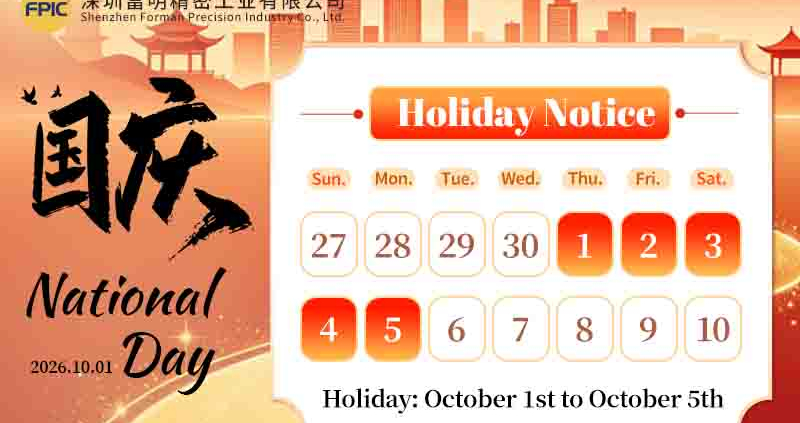
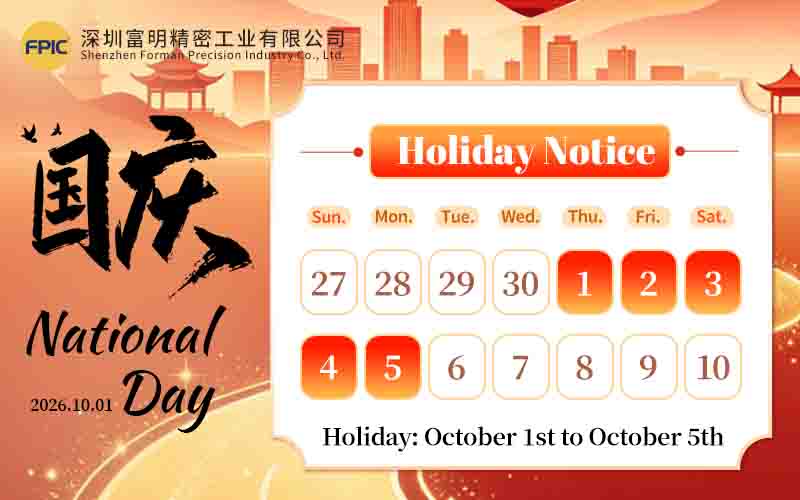
To celebrate China National Day, FPIC will observe the following holiday schedule in accordance with the official 2026 public holiday arrangement:
Holiday Period: October 1–5, 2026
Duration: 5days
Work Resumes: October 6, 2026
According to the official public holiday schedule issued by the General Office of the State Council, the 2026 National Day holiday will run from Thursday, October 1, through Monday, October 5.
During the holiday period, responses to emails, product inquiries, quotations, and customer requests may take longer than usual.
We appreciate your understanding and continued support. FPIC will respond to customer inquiries as soon as our team resumes normal operations.
Thank you for your trust and cooperation.
FPIC Team
What Is China National Day?
China National Day (国庆节, Guóqìng Jié) is a national holiday observed annually on October 1 in the People’s Republic of China.
The date commemorates the founding of the People’s Republic of China in 1949.
For people outside China, it is useful to understand that National Day is both a public holiday and an important national commemorative occasion.
The holiday is marked by public celebrations, cultural activities, travel, family gatherings, exhibitions, decorations, and other events across the country.
October 1 is also the beginning of a major annual holiday period commonly known as the National Day holiday or Golden Week.
Why Is October 1 China’s National Day?
The date goes back to a historic event in 1949.
On October 1, 1949, the founding ceremony of the People’s Republic of China was held at Tiananmen Square in Beijing.
The Central People’s Government was formally established, and the founding of the People’s Republic of China was proclaimed at the ceremony.
Later that year, on December 2, 1949, the Central People’s Government Committee passed a resolution designating October 1 as the National Day of the People’s Republic of China.
Therefore, October 1 became the fixed annual date for National Day.
The historical event is documented in Chinese government archives and official historical records.
The Historical Background of National Day
To understand why National Day has such importance, it is necessary to look at China’s history during the first half of the 20th century.
China experienced significant political, social, economic, and military changes during this period.
The country went through:
- The end of the Qing dynasty
- The establishment of the Republic of China in 1912
- Political and social transformation
- The Second Sino-Japanese War
- The Chinese Civil War
- The establishment of the People’s Republic of China in 1949
The founding of the People’s Republic of China marked a major political transition in modern Chinese history.
For the Chinese government and official historical narratives, 1949 is regarded as the beginning of a new period in China’s modern development.
For international readers, National Day can therefore be understood as a holiday connected to a major turning point in modern Chinese history, rather than simply a seasonal celebration.
October 1, 1949: The Founding Ceremony
The founding ceremony took place in Tiananmen Square in Beijing on October 1, 1949.
The event included:
- The formal proclamation of the Central People’s Government
- The raising of the national flag
- The playing of the national anthem
- A military parade
- A mass procession and public celebrations
The ceremony became one of the most significant events in modern Chinese history.
Historical footage and archival materials from the event have since become important records of this period.
The ceremony also established October 1 as a date with strong historical and national significance.
How Did China National Day Develop?
In its early years, National Day celebrations were closely associated with public ceremonies and commemorative activities.
Over time, the way people experience the holiday expanded.
Today, National Day combines several different dimensions:
National Commemoration
Official ceremonies and public activities commemorate the founding of the People’s Republic of China.
Cultural Activities
Museums, cultural institutions, public spaces, and local communities often organize exhibitions and cultural events around the holiday.
Family Time
For many people, the extended holiday provides an opportunity to return home, visit relatives, or spend time with family.
Travel
The National Day holiday is one of the major travel periods in China’s annual calendar.
Leisure and Recreation
People may visit parks, museums, historical sites, cultural attractions, or tourist destinations during the holiday.
This evolution has made National Day both a historical commemoration and an important period for social and cultural activities.
What Is Golden Week?
The term Golden Week is commonly used to describe the extended National Day holiday period.
The National Day holiday traditionally provides one of the longest continuous public holiday periods in the second half of the year.
The 2026 official arrangement provides seven days of holiday from October 1 to October 7, with adjusted working days before and after the holiday.
For businesses working with Chinese manufacturers and suppliers, understanding this schedule can be useful when planning:
- Production schedules
- Customer communication
- Shipping arrangements
- Order confirmations
- Sample development
- Quality inspections
- Project milestones
- International logistics
For international customers, planning ahead can help reduce unnecessary delays around the holiday period.
How Is National Day Celebrated?
National Day celebrations vary between cities, communities, families, and generations.
Common activities may include the following.
1.National Flag Displays
Red national flags and other festive decorations are widely displayed in public areas, buildings, streets, and commercial spaces during the holiday.
The national flag is an important visual symbol of the occasion.
2.Public Ceremonies and Events
National Day may be marked by official ceremonies and public events.
Large cities may organize cultural performances, exhibitions, light shows, or other activities during the holiday period.
The scale and format of celebrations can vary from year to year.
3.Cultural and Historical Visits
National Day is also a popular period for visiting:
- Museums
- Historical sites
- Memorials
- Cultural institutions
- Famous landmarks
- Traditional villages
- Scenic destinations
For younger generations, these activities can provide opportunities to learn about Chinese history and culture.
4.Family Gatherings
Although National Day has a national historical meaning, the long holiday also has a practical family dimension.
Many people use the holiday to:
- Return to their hometowns
- Visit relatives
- Travel with family
- Spend time with parents
- Explore local attractions
- Rest after a busy working period
This combination of public history and private family life is one reason the holiday is significant in everyday life.
National Day and Travel in China
The National Day holiday is traditionally one of China’s major travel periods.
In recent years, holiday travel has increasingly included cultural tourism, family trips, city breaks, outdoor activities, museums, historical attractions, and local food experiences.
The 2025 National Day and Mid-Autumn Festival holiday period, for example, generated significant domestic travel activity according to China’s Ministry of Culture and Tourism.
For 2026, government and local tourism authorities have again planned cultural and tourism activities around the National Day holiday period.
This demonstrates how the holiday has developed beyond formal ceremonies into a broader period of cultural, family, and leisure activities.
The Cultural Meaning of National Day
National Day has different meanings for different people, but several themes are commonly associated with the holiday.
Historical Memory
The holiday provides an opportunity to remember a major turning point in China’s modern history.
National Development
It is also connected with reflection on China’s development over the decades since 1949.
Family and Community
The extended holiday provides time for people to reconnect with family and communities.
Looking Toward the Future
National Day is also commonly associated with hopes for continued development and a better future.
For international audiences, these dimensions help explain why October 1 is more than simply another public holiday on China’s calendar.
National Day for International Customers
For international customers working with Chinese companies, National Day is also an important cultural and business-calendar event.
China’s National Day holiday can affect:
- Factory operating schedules
- Production planning
- Shipping arrangements
- Logistics
- Customer service response times
- Supplier communication
- Project delivery schedules
For this reason, international customers are encouraged to communicate important requirements with suppliers before the holiday.
At FPIC, we also see the holiday as an opportunity to appreciate the international relationships that have developed through years of cooperation.
China National Day and FPIC’s Corporate Culture
At FPIC, we believe that sustainable development is built through people, teamwork, responsibility, innovation, and long-term cooperation.
These values provide a natural connection between National Day and our company culture.
Responsibility Creates Long-Term Value
National Day provides an opportunity to reflect on history and development.
For a manufacturing company, development also comes from taking responsibility for everyday work.
At FPIC, responsibility can be seen across different stages of a project:
- Engineering design
- Product development
- Manufacturing
- Quality control
- Testing
- Delivery
- Customer support
Every stage contributes to the final customer experience.
We believe that taking responsibility for each detail helps build reliable products and sustainable customer relationships.
Teamwork Builds Stronger Solutions
Modern manufacturing is never the work of a single department.
Engineers, production teams, quality professionals, purchasing teams, sales teams, warehouse personnel, and customer service teams all contribute to a successful project.
At FPIC, we value communication and collaboration across teams.
A complex custom connector, cable assembly, or wire harness project may require multiple departments to work together from design to mass production.
Strong teamwork creates stronger solutions.
Continuous Improvement
National Day also provides an opportunity to look back at development and think about the future.
This idea connects closely with FPIC’s approach to continuous improvement.
In manufacturing, improvement can come from many small details:
- Better process control
- More efficient production
- Improved traceability
- Stronger quality management
- Better engineering communication
- More effective testing
- Faster response to customer requirements
Continuous improvement is not necessarily about making one dramatic change.
It is often about making many practical improvements over time.
Innovation and Future Development
China’s modern development has included major changes in manufacturing, technology, infrastructure, and international trade.
For FPIC, innovation is also an important part of long-term development.
As customer requirements become more complex, manufacturers need to continuously improve engineering capabilities, production processes, quality control, and customization support.
Our focus is not simply on producing components.
We aim to understand application requirements and develop solutions that fit real-world projects.
People Are an Important Part of Company Development
A company’s development ultimately depends on its people.
At FPIC, we believe that a positive workplace should provide employees with opportunities to grow, communicate, contribute, and feel valued.
Employee birthdays, monthly recognition, holiday activities, team events, and other internal activities are part of this people-oriented approach.
These activities may seem simple, but they help create everyday connections between colleagues.
A strong company culture is not created by a slogan alone.
It is built through daily behavior, mutual respect, teamwork, and care for people.
From Connection to Cooperation
FPIC’s products are designed around one fundamental concept: connection.
Connectors connect electrical and electronic systems.
Cable assemblies connect components and equipment.
Wire harnesses organize and connect multiple circuits within a system.
But business relationships also depend on connection.
Communication connects teams.
Trust connects partners.
Quality connects products with customer expectations.
Long-term cooperation connects today’s project with tomorrow’s opportunities.
This is why the idea of connection is meaningful not only to FPIC’s products, but also to our company culture.
Looking Back and Moving Forward
National Day is a moment to look back at an important chapter of China’s modern history.
For businesses, anniversaries and milestones also provide opportunities to reflect on what has been achieved and consider what comes next.
At FPIC, we believe long-term development comes from:
Experience + Responsibility + Innovation + Teamwork + Continuous Improvement
Our manufacturing journey continues to evolve alongside the needs of customers around the world.
Every new project brings new requirements.
Every challenge provides an opportunity to learn.
Every long-term partnership creates another opportunity to grow together.
Our National Day Wishes
As China prepares to celebrate National Day, FPIC would like to extend our warmest wishes to our employees, customers, partners, and friends around the world.
May this holiday provide an opportunity to:
🌱 Reflect on the past
🤝 Strengthen connections
💡 Explore new possibilities
❤️ Spend meaningful time with family
🚀 Look forward to future growth
Thank you for your continued trust, cooperation, and support.
Happy China National Day!
Frequently Asked Questions
When is China National Day?
China National Day is celebrated every year on October 1.
Why is October 1 China’s National Day?
October 1 commemorates the founding ceremony of the People’s Republic of China held in Beijing on October 1, 1949.
Are there adjusted working days in 2026?
Yes. According to the official 2026 holiday arrangement, September 20 and October 10, 2026 are designated as adjusted working days.
What is Golden Week in China?
“Golden Week” is a commonly used term for the extended National Day holiday period. It is one of China’s major annual holiday and travel periods.
Does National Day affect international manufacturing?
It can. Factory schedules, customer service, logistics, shipping, and production planning may be affected during the holiday. International customers are advised to confirm important project requirements in advance.
What does National Day mean in Chinese culture?
National Day commemorates a major event in modern Chinese history and is also a period for public celebrations, family activities, cultural events, travel, and reflection on national development.
Conclusion
China National Day is both a historical commemoration and an important part of modern Chinese life.
October 1 marks the founding of the People’s Republic of China in 1949, while the extended holiday period provides time for cultural activities, travel, family gatherings, and rest.
For international audiences, understanding National Day can provide useful insight into China’s modern history, social culture, and business calendar.
For FPIC, the holiday also offers an opportunity to reflect on the values that support long-term development: responsibility, teamwork, innovation, respect for people, continuous improvement, and lasting partnerships.
As we look back at the past and toward the future, FPIC is grateful to have customers and partners around the world on this journey.
Happy China National Day!
References / Sources
- General Office of the State Council of the People’s Republic of China, Notice on Arrangements for Several Public Holidays in 2026 — official 2026 National Day holiday dates and adjusted working days.
- The State Council of the People’s Republic of China, National Day — background information on October 1 and the establishment of National Day.
- The State Council of the People’s Republic of China, Chronology of Major Events of the People’s Republic of China (October 1949–September 2019) — historical information concerning the founding ceremony and the December 1949 designation of October 1 as National Day.
- Ministry of Foreign Affairs of the People’s Republic of China, Color Footage of the Founding Ceremony of the People’s Republic of China — archival information about the October 1, 1949 founding ceremony.
- Beijing Municipal Government, Public Holidays — 2026 National Day holiday schedule and adjusted working days.
- Ministry of Culture and Tourism / State Council information on National Day tourism and cultural activities.